According to the CDC, roughly one in four adults in the United States lives with some form of disability, which means accessible parking isn’t a rarely used compliance feature at a typical apartment community. It’s a daily-use amenity for a meaningful share of residents and guests. We think about repainting these spaces through that lens first: not as a box to check, but as something real people depend on every single day to get to their own front door.
Quick answers:
- Accessible parking is a daily necessity for a meaningful portion of residents and guests, not an occasional-use feature, which changes how urgently faded markings deserve attention.
- Crisp, clearly visible markings reduce how often non-disabled drivers park in an accessible space without a placard, since a faded space is far easier to overlook or rationalize parking in than a clearly marked one.
- Refreshing an already correctly placed accessible space is a low-cost maintenance task, meaningfully cheaper than the kind of full compliance review needed when a space’s placement or count is actually in question.
- Clear, unambiguous, accessible markings matter in time-sensitive moments too, when a resident with a mobility device or a medical need can’t afford confusion about where they’re actually allowed to park.
- According to the U.S. Access Board, the required blue color and international symbol are meant to be immediately recognizable, a purpose that a faded, hard-to-identify marking undermines regardless of whether it’s still technically present.
Why Faded Accessible Markings Cause Real, Daily Friction, Not Just a Compliance Gap
For a resident who genuinely relies on an accessible space, a faded marking isn’t an abstract legal concern. It’s a real, repeated obstacle: a space that’s supposed to be reliably available and instead gets treated as ordinary overflow parking because it doesn’t look clearly marked anymore. That daily friction, having to search for an alternative, wait for a space to clear, or navigate a longer distance than necessary, is the actual, lived cost of a marking that’s been allowed to fade past the point of easy recognition.
How Fresh Markings Reduce Misuse by Non-Disabled Drivers
A crisp, unmistakable blue marking with a clearly visible accessibility symbol makes it much harder for someone to convince themselves that parking there without a placard is a reasonable, low-stakes choice. A faded, barely legible marking, by contrast, makes that same choice easier to rationalize, even though it’s never actually permitted regardless of how visible the paint is. Refreshing these markings regularly is one of the more effective, low-cost ways to reduce this kind of casual misuse before it becomes a recurring pattern in a specific space.
The Cost Advantage of Refreshing vs. Redesigning
Repainting an accessible space that’s already correctly located and properly sized is a straightforward, inexpensive maintenance task. This is a meaningfully different, and far less involved, project than the kind of compliance review needed when a space’s placement, count, or dimensions are actually in question, which can involve remapping an entire property’s layout. Keeping existing, correctly placed spaces freshly marked on a regular basis is one of the most cost-effective things a property can do to maintain both usability and compliance without triggering a bigger project.
Why This Matters for Emergency Response Too
Clear, unambiguous, accessible markings matter most in exactly the moments when confusion is least acceptable. A resident with a mobility device dealing with a medical emergency, or a caregiver arriving to help someone quickly, benefits directly from a space that’s obviously identifiable at a glance rather than one that requires a second look to confirm. This is a genuine safety consideration, not just a convenience one, and it’s part of why we treat these specific markings with more urgency than a standard stall’s cosmetic fading.
What We Check Beyond Just the Paint When We Refresh These Spaces
When we repaint an accessible space, we don’t treat it as a simple color touch-up. We confirm the space still connects to a usable accessible route toward the nearest building entrance, check that any required van-accessible signage nearby is still legible, and note if anything about the property’s layout has changed since the space was last reviewed. A fresh coat of paint on a space that’s quietly stopped meeting its full purpose doesn’t actually solve the underlying problem, which is why we treat the repaint as a chance to double-check the whole picture, not just the color.
Maintain Equal Access and Compliance with Fresh Handicap Space Markings
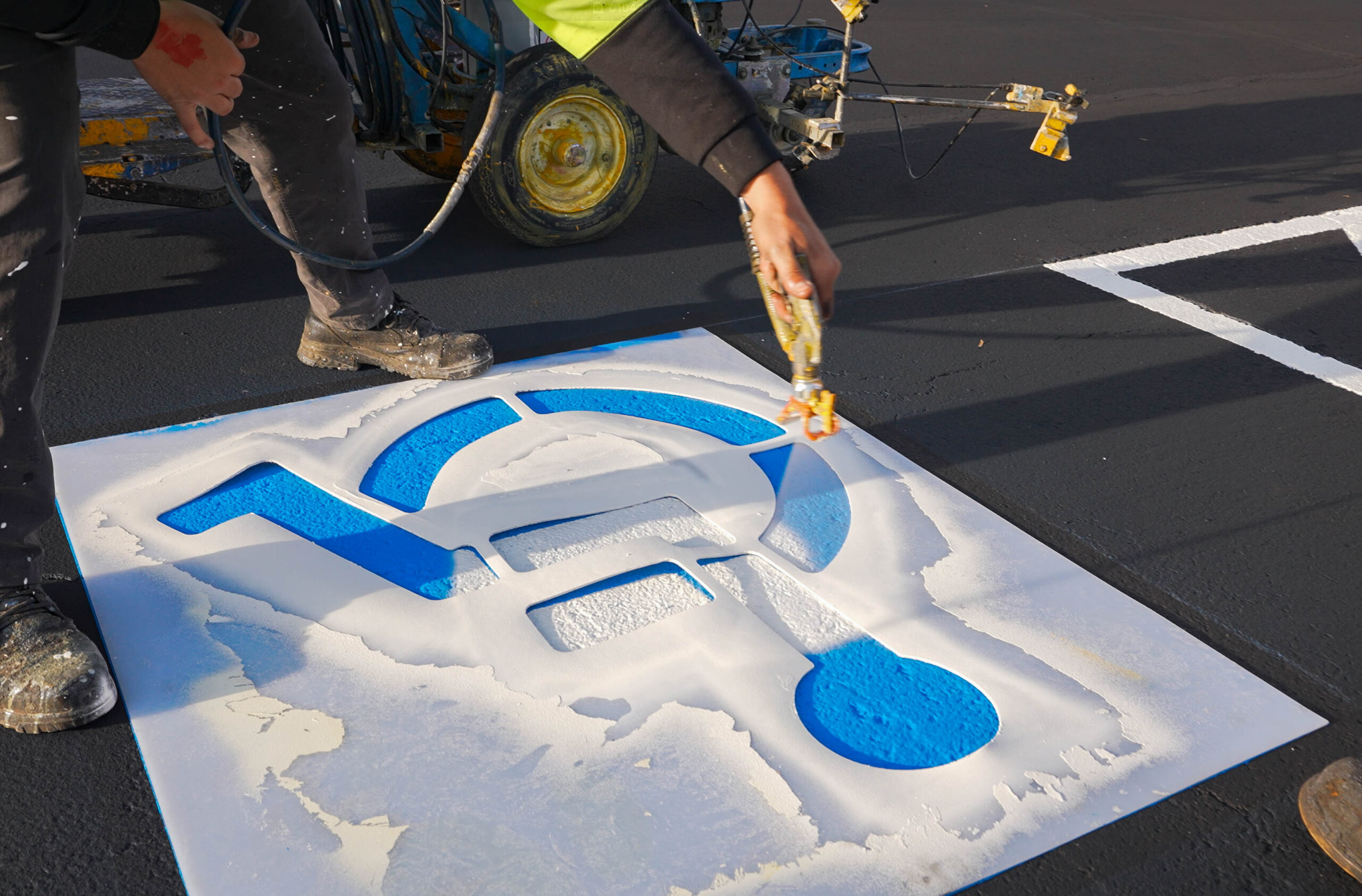
Faded or worn handicap markings make accessibility zones hard to distinguish, increasing the risk of unauthorized parking and leaving residents with disabilities without vital access. Crisp, freshly painted blue stall blocks, bright white handicap symbols, and clearly marked access aisles ensure your property remains compliant, accessible, and welcoming to all residents and visitors.
ProLine Parking Lot Maintenance delivers high-contrast, durable ADA re-striping services that eliminate visual ambiguity and safeguard your community against accessibility violations.
- High-Visibility Stenciling: Vibrant, heavy-duty paint formulations that resist tire wear, sun fading, and weather breakdown.
- Proactive Legal Protection: Prevent costly ADA non-compliance claims by keeping all handicap stalls, van aisles, and signage up to standard.
Frequently Asked Questions
Does repainting an accessible space more often than standard stalls actually make a measurable difference in how it’s used?
In our experience, yes, particularly in reducing casual misuse by drivers without a placard. A clearly marked space removes the ambiguity that makes parking there feel like a low-stakes choice, while a faded one makes that same choice easier to rationalize even though it’s never actually appropriate. Properties that keep these specific markings fresher than the rest of the lot tend to report fewer complaints about misuse from residents who actually rely on the space.
Can a faded accessible space marking be used as an excuse by someone who parked there without a placard?
Legally, no, a faded marking doesn’t create a valid excuse for parking in an accessible space without proper authorization, since the requirement doesn’t depend on how visible the paint happens to be. In practice, though, a faded marking does seem to lower the social and psychological barrier that would otherwise stop someone from parking there casually, which is a separate, practical problem from the legal one and part of why keeping the marking clear matters even though it isn’t a legal loophole.
Should accessible spaces be repainted on a different schedule than the rest of the lot?
We generally recommend it, given how much more consequential a faded accessible marking is compared to a faded standard stall line. A shorter, more frequent inspection and repainting cycle for these specific spaces catches fading before it reaches the point of causing real confusion or misuse, rather than waiting for the property’s general restriping schedule to come around.
Do residents who use accessible parking ever report the condition of the space directly, or does it usually go unnoticed by management?
It varies, but many residents don’t report it directly, sometimes assuming it’s simply how the space has always looked, or not wanting to raise what feels like a personal accommodation request. This is part of why we recommend property staff proactively check these specific spaces during routine walk-throughs rather than waiting for a complaint, since the residents most affected by a faded marking are often the least likely to be the ones flagging it.
Is there a specific type of paint or material that holds up better for accessible space markings specifically?
Thermoplastic and epoxy-based materials generally hold up longer than standard traffic paint for any high-visibility marking, accessible spaces included, given their better resistance to wear and fading. According to the International Parking & Mobility Institute, material choice is a meaningful part of overall parking facility management, and given how much more it matters for an accessible space to stay clearly visible, a more durable material is often worth the additional upfront cost specifically for these spaces even if standard paint is used elsewhere on the property.
Does repainting an accessible space help if the real problem is that there aren’t enough of them, not that the paint is faded?
No, and this is an important distinction to make before assuming a repaint solves the issue. If residents and guests are struggling to find available accessible parking because the total count doesn’t match current demand or the property’s current total space count, fresh paint on the existing spaces won’t address that underlying shortage. This is a separate question worth raising directly, since it may point toward needing an actual layout review rather than a maintenance refresh.
Can bright or high-contrast paint improve visibility for residents with low vision, beyond just meeting the color requirement?
Yes, to some degree. According to the U.S. Access Board, the required blue color and symbol are meant to be immediately recognizable, and a bright, well-maintained, high-contrast application of that required color performs this function more effectively than a faded or inconsistently applied one, even though both might technically use the same specified color. For residents with low vision specifically, this kind of visibility difference can be the deciding factor in whether the marking actually serves its intended purpose.
What’s the benefit of repainting the access aisle next to an accessible space, not just the space itself?
The access aisle, the striped area next to an accessible space meant to allow room for a wheelchair lift or ramp, serves a distinct and equally important function, and a faded access aisle can lead to it being used as if it were an ordinary parking space rather than protected clearance. Repainting the space itself while leaving a faded access aisle unaddressed only solves half the problem, since the aisle’s clarity matters just as much for the space to actually function as intended.
See also: How Clear Parking Stall Markings Reduce Resident Parking Conflicts, ADA Parking Compliance for Multi-Family Properties: What Property Managers Need to Know