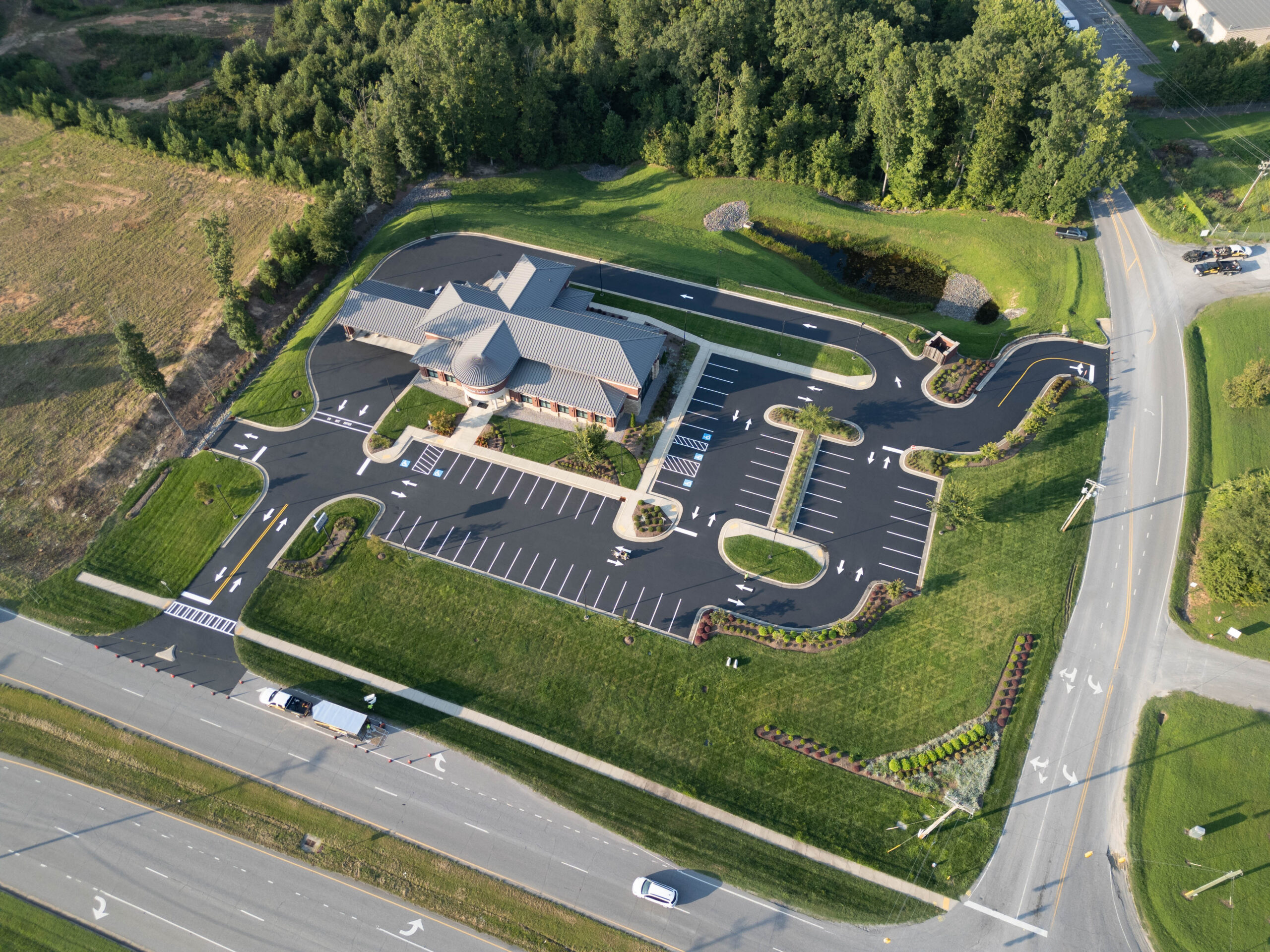
Builders started 68,000 single-family built-for-rent homes in 2025, down 19% from 84,000 in 2024, according to NAHB’s analysis of Census data. Charlotte sits near the center of the wave. Berkadia counted roughly 3,000 build-to-rent units delivered across 29 Charlotte-area communities in 2024, with 4,156 more under construction and 64% of them in Mecklenburg County.
Those numbers change how I plan a striping job. I work at ProLine Parking Lot Maintenance in Denver, NC, and I have striped plenty of apartment lots, but a build-to-rent (BTR) community needs a different plan. Every home brings its own garage and driveway, so residents rarely need striped stalls. The striping lives in the shared pieces: guest pockets, fire lanes, hydrant buffers, and the leasing lot. This guide shows you how I lay those pieces out, with the numbers and sources behind each one.
Stripe the Shared Pieces, Not the Driveways
Before I quote a BTR job, I sort the site into the table below. It shows why a BTR scope looks nothing like an apartment scope.
| Feature | Typical apartment lot | Typical BTR community | What it means for striping |
|---|---|---|---|
| Resident parking | Assigned or open stalls | A garage plus a driveway at each home | We rarely stripe resident parking |
| Guest parking | One or two shared lots | Pockets along private streets, plus the driveway aprons | We stripe parallel guest pockets |
| Fire access | Wide drive aisles | Private streets and rear alleys | Street width controls the layout |
| Public-facing lot | Leasing office lot | Leasing office, clubhouse, and mail kiosk | We stripe to ADA geometry |
Two sources back up that picture. Reliant Parking’s property manager guide notes that for communities of single-family homes, the dimension question usually concerns shared visitor spaces because most homes have private driveways. ProBuilder’s BTR design review shows a typical product that pairs a two-car garage with a full driveway apron for guest parking and adds more guest parking on the street. In Charlotte, Axios reports that most BTR properties have been townhomes, which adds rear alleys and short private streets to the mix.
Let the Street Width Decide Your Guest Parking
I measure every private street from curb to curb before I mark a single pocket. Model fire code language ties the width of a fire apparatus road to where cars may park, and Washoe County’s summary of the rule gives the three numbers I use: 20 feet with no parking, 26 feet with parking on one side, and 32 feet with parking on both sides. Lincolnton, NC, whose code sits a short drive from our Denver office, posts fire lane signs on both sides of roads 20 to 26 feet wide and on one side of roads wider than 26 and narrower than 32 feet.
| Private street width | What the model code language allows | How I stripe it |
|---|---|---|
| Under 20 feet | Falls below the minimum | I flag it to your engineer before any paint goes down |
| 20 to under 26 feet | No parking on either side | Fire lane markings on both sides, with no guest pockets |
| 26 to under 32 feet | Parking on one side | Guest pockets on one side, fire lane markings on the other |
| 32 feet or wider | Parking on both sides | Guest pockets on both sides |
| Within 20 feet of a hydrant | A 26-foot minimum width, extending 20 feet each way from the hydrant | No pocket, with hatching or fire lane marking instead |
These widths come from the International Fire Code’s Appendix D, and each jurisdiction adopts its own edition. Your fire official has the final word, so I confirm the adopted edition before I chalk anything.
Stripe the Guest Pockets to These Dimensions
Once the street width approves parking, I mark pockets to the numbers below.
| Item | Dimension | Source |
|---|---|---|
| Parallel guest pocket | 8 feet wide by 22 feet long | VTA on-street parking design |
| Four-pocket run | 88 feet of curb | Four pockets at 22 feet each |
| Travel lane beside a pocket | At least 12 feet | Reliant Parking |
| Perpendicular guest stall in a cluster lot | 9 feet wide by 18 feet long | Reliant Parking |
| Gap between a hydrant and the nearest pocket line | 15 feet on each side | Asheville, NC design manual |
| Gap between a pocket end and a driveway apron | 5 feet | ProLine field practice |
The last row deserves a note. No code gives that 5-foot number, but I have watched residents lose their own driveways to a guest car parked one foot from the apron edge. The gap costs you about a quarter of a pocket and saves you a complaint call.
Stripe the Leasing Office, Clubhouse, and Mail Kiosk Lots
The leasing office and clubhouse lots work like small commercial lots, so I use the ADA’s parking rules there. Residential facilities carry different accessibility requirements under section 208.2 of the 2010 Standards, so ask your architect or attorney which rules apply to the homes themselves.
| Element | What I stripe | Rule |
|---|---|---|
| Accessible space count | At least one accessible space for a lot of 1 to 25 spaces | ADA scoping table |
| Van-accessible space, option 1 | 132 inches wide with a 60-inch access aisle | ADA |
| Van-accessible space, option 2 | 96 inches wide with a 96-inch access aisle | ADA |
| Slope in the space and the aisle | No steeper than 1:48 (2.08%) in all directions | ADA |
| Mail kiosk pull-off | One or two short stalls with a hatched approach | ProLine field practice |
Four Mistakes We Fix in BTR Communities
| Mistake | What goes wrong | My fix |
|---|---|---|
| Copying an apartment layout onto a private street | Pockets squeeze a street that the fire code requires to stay clear | I measure the street first and then decide |
| Painting a guest pocket across a hydrant | A parked car blocks the crew’s connection | I drop the pocket and hatch the zone |
| Pockets that touch driveway aprons | Residents cannot reach their own garages | I leave a 5-foot gap |
| Skipping the slope check at the leasing lot | The accessible space exceeds 1:48 | I recommend regrading before I stripe |
If your community has a gated entry, read our guide on how to handle asphalt damage around apartment parking lot gates. If your townhome clusters have shared doors, equipment, or hydrants, our guide on how to mark safe clearance areas around apartment building access points covers those zones.
What Property Managers Say About ProLine
ProLine holds a 4.9 rating from 87 reviews on Birdeye. Reviewer Tommi Watson wrote, “Proline did an amazing job! Great communication, prompt and professional.” On ProLine’s own testimonials, Pete R. described our process as exceptionally organized and praised our communication, scheduling, and workmanship.
What We Bring to Your Community
We handle the full striping package for BTR communities, so you do not coordinate several vendors:
- Line striping for guest pockets, cluster lots, and leasing lots
- Stenciling and pavement markings for fire lane wording and accessible symbols
- Crosswalk striping at amenity and mail kiosk crossings
- Signage installation for posted restrictions
- Wheel stop installation at cluster lots and amenity areas
Improve Parking Organization in Your Build-to-Rent Community
A well-planned parking layout helps build-to-rent communities manage vehicle movement, maximize available parking spaces, and create a better experience for residents and visitors. ProLine Parking Lot Maintenance provides professional parking lot striping and pavement marking services to help keep your property’s parking areas organized, visible, and easy to navigate. From designated parking spaces to directional arrows and pedestrian markings, we can help create a layout that supports your community’s needs.
Contact Us TodayFrequently Asked Questions
Should I stencil the word “GUEST” or number the guest pockets in a BTR community?
Yes, stencil GUEST in every pocket, because Reliant Parking’s guide notes that signage and clear striping matter as much as the dimensions themselves. In a BTR community, a visitor arrives for one specific house, so we also number each pocket by block (B-1 through B-4), which lets a resident tell a visitor exactly where to park. Numbers give your leasing team a precise way to report a violation or a damaged space by location. We use stencils instead of freehand lettering so every pocket matches, and you can see the range on our stenciling and pavement markings page. We place the stencil at the curb end of each pocket, where an approaching driver reads it before committing to the space.
When should I stripe during a phased build, and how does new asphalt affect the schedule?
We wait until the final asphalt lift is down and the utility trenching and driveway aprons are finished, because every saw cut that crosses fresh paint forces a repaint. The Pavement Coatings Technology Council says hot mix asphalt usually cures for 30 to 90 days before sealing, so we plan sealcoating and striping as one sequence. Once the sealer goes down, sealer specifications call for at least 24 hours of cure before traffic paint. If your lease-up date arrives before the cure window ends, ask the Charlotte Fire Prevention Bureau which markings must be in place before occupancy, and tell us so we can mark those first. We then schedule the remaining markings for the first dry window after the cure.
How do you stripe a street when residents already live in the homes?
We work one block at a time, and we post written notice with exact dates at least three days ahead. Because every home has a driveway and a garage, residents can park there while we work on the street, which keeps disruption low. We close one block’s street, cone both ends, keep the next block open, and leave our barricades in place until the paint is hard, as PCTC guidelines direct. Ask residents to move any car from the guest pockets the night before, and send a text reminder that morning. If a closure ever blocks the only route for emergency vehicles, call your local fire marshal before we start.
How often will markings need refreshing in a BTR community with lower traffic?
Lower traffic means paint usually lasts longer, but traffic is only one factor. ProLine’s article on striping cites FHWA guidance that marking durability depends on material, traffic volume, weather, and location. Many Charlotte-area neighborhoods have mature trees, and leaf litter and shade hold moisture against the paint, which dulls paint pockets faster than you expect. Fire lane and hydrant markings need extra attention, because the Charlotte Fire Department’s bulletin makes the property owner responsible for keeping them legible. We walk the community with you each year and rank which markings need a refresh now and which can wait.
What should I do when residents use guest pockets as permanent storage for a second car?
Start with a posted time limit, because a sign gives your team something concrete to cite. We install the signs at each pocket cluster through our signage service, and you set the limit in your lease or community rules. Ask your attorney to review your lease language and towing process before you act, because I am a contractor, not a lawyer. Keep dated photos of the pockets, so your team can show a pattern instead of a single complaint. Combine the signs with the stenciled GUEST wording and block numbers, so a resident cannot claim the space belongs to a home.