Overview
- Design your layout so that it corresponds with the time when your land is at its busiest.
- Confirm the hauler’s truck route in writing before you mark anything.
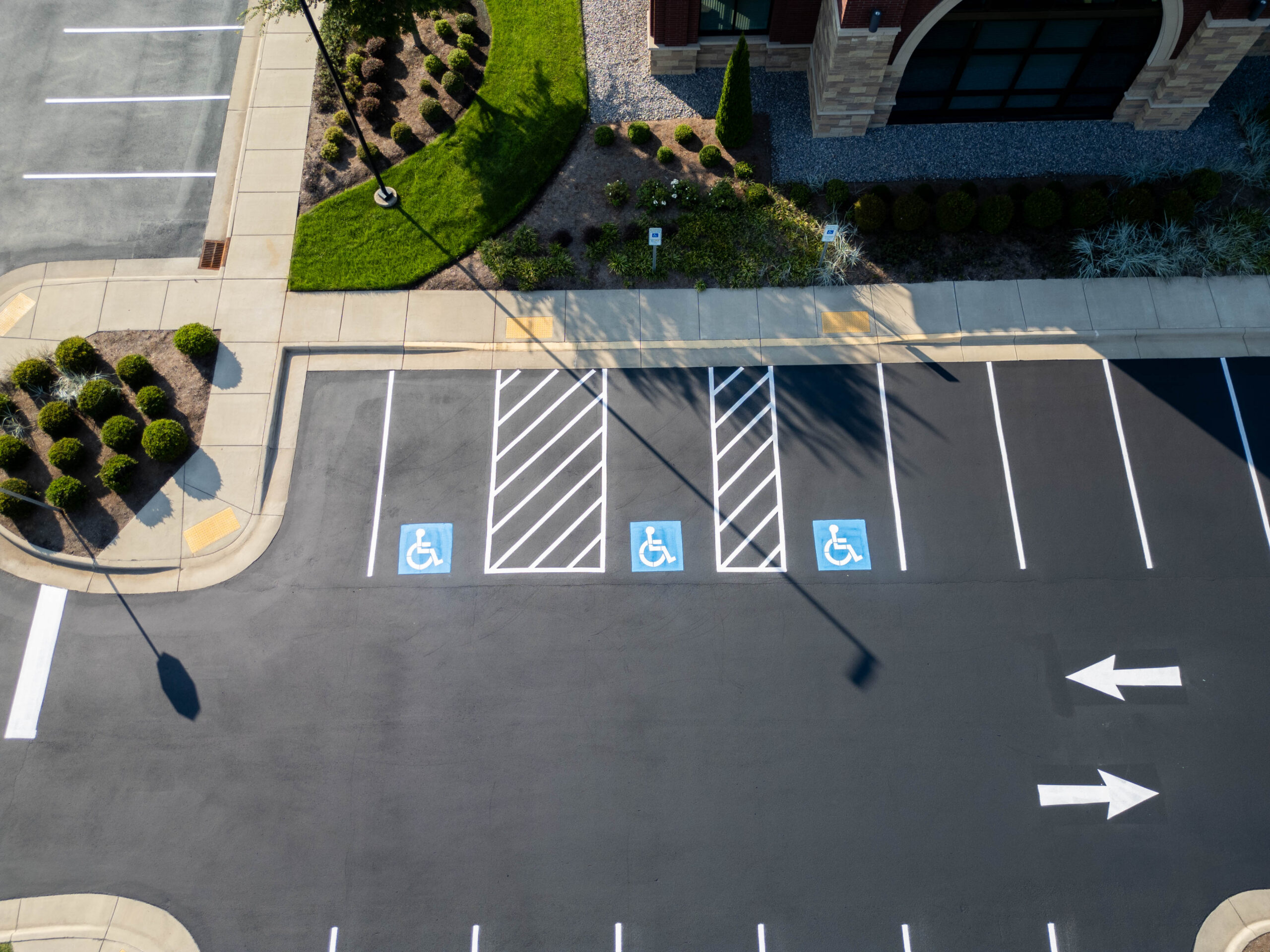
- Set up a hatched keep-clear area at each enclosure.
- Provide residents with a clearly marked path leading to the bins.
- Place staging boxes in community areas where curbside carts are used.
- Take the usual stalls away from the gate and the truck swing.
- Set the work out between the days when the item is picked up.
According to the EPA, each person in the United States produced 4.9 pounds of municipal solid waste per day in 2018, the last year the agency conducted its national review. Multiply that by the 300 residents in a typical garden-style community in either Charlotte or Greenville, and your property generates about 1.5 of rubbish every day. This entire amount exits through one or two waste enclosures, and a collection truck has to go to each one without colliding with a parked car.
Striping the parking spaces beside the trash and recycling areas solves one of the most frequent daily problems on your premises. The residents want the nearest spot, the waste collector needs a clear route, and your management team gets the complaint calls. Here’s how we use striping to put an end to that conflict.
Plan Around the Hour Your Lot Is Fullest
Most haulers come in early in the morning, and that timing is what causes the problem. Since almost all residents have their cars parked by 6:30 a.m., the car park is most crowded when the truck needs the most space. A layout that is suitable at 2 p.m. may not work at dawn.
Before we do any design work, we go to your community at that time to take photographs showing which cars block the enclosure, where the truck stops when backing up, and where it bumps into a bumper. The photos help us identify the stalls causing the problem and let us request a change based on evidence rather than opinion.
Get the Hauler’s Truck Path Before You Mark Anything
First, request the geometry your hauler or city solid waste office has set, since we have to follow it; requirements vary by jurisdiction. For instance, the City of Greensboro publishes specifications for its dumpsters that require a concrete pad 18 feet long and 10 feet wide for each container, sized to support both the container and the truck’s front wheels. On the same page, the enclosure must also have an opening at least 12 feet wide, add 10 more feet of width for each additional dumpster, and include two fixed guard posts behind each dumpster where screening forms the enclosure.
We use numbers like these when defining the edges of our striping because the stripes must protect the area the pad and enclosure already occupy. If your city has a standard, then we adhere to it. If your hauler requests a greater approach distance, we comply, since many municipal standards call for 40 to 50 feet of straight approach to the container.
Build a Hatched Keep-Clear Zone at the Enclosure
In any trash-area arrangement, the keep-clear zone does the most demanding work. To make it clear to drivers from their seats that parking is not allowed, we draw diagonal hatching in front of the enclosure and surround it with solid edge lines. When local regulations don’t specify a color, we generally use yellow hatching because it stands out against dark asphalt and contrasts with the white parking lines.
The layout we install at most Carolina apartment complexes is shown in the table below.
| Marking element | Our standard layout | What it does |
| Hatched keep-clear box | Width of the gate opening plus 2 ft each side, at least 20 ft deep | Keeps the truck’s approach and swing area open |
| Truck approach lane | White edge lines and directional arrows, length set by the hauler | Shows the truck’s path and warns drivers away |
| Stop bar | Painted 4 ft in front of each crossing | Stops residents’ cars before they cross the walk |
| Resident crosswalk | 6 ft wide with high-visibility bars | Gives residents a safe path with bags in hand |
| Cart staging box | 3 ft by 4 ft per pair of carts | Lines up curbside carts for the truck’s arm |
| Stall setback | No regular stall within 25 ft of the gate opening | Prevents parked cars from clipping the truck |
We established these dimensions based on our field experience, then modified each one to meet your hauler’s written requirements and local codes.
Give Residents a Safe Walking Path to the Bins
A person who is carrying two bags usually doesn’t look both ways. We put a stripe across the crossing point where the walking path meets the drive aisle and position the stop bar far enough back so that, once a car stops, it won’t obstruct the enclosure gate. We use the MUTCD as our standard for arranging crosswalks and stop bars since drivers are already familiar with those markings from the main streets.
At places like the podium building in Raleigh’s Glenwood South, we also provide a well-defined, five-foot-wide lane along the front of the building so residents can access the bins without stepping into traffic. Paint guides people and shows drivers where pedestrians will be.
Add Staging Boxes Where Residents Use Curbside Carts
In Fort Mill, Charleston, and Durham, townhome complexes generally use separate carts rather than having a central dumpster. On collection day, e-carts build up along the curb, and the truck’s arm needs a steady gap between them. So we place small staging boxes along the curb, one for each pair of carts, spaced to match your waste removal truck’s lifting arm.
The boxes tell residents where to place a cart and don’t send any single reminder email; they also prevent carts from blocking the sidewalk and drifting into the travel lane when the wind picks up.
Move Regular Stalls Away From the Gate and the Swing
The highest-value stall in a car park is next to a building door, while the lowest-value stall is by the dumpster. We usually remove or move the stall closest to the enclosure and replace it with hatching, since if a car is parked there, the truck has to back up and try again. There is always a 25-foot distance between any standard stall and the gate opening, and before we paint, we confirm the total number with you so you know exactly how many spaces you are giving up.
Whenever a fire hydrant is near the enclosure, we include it in the plan immediately. Because the North Carolina fire code language used in Wake County plan reviews requires that access to hydrants must always be unobstructed, we never allow the trash area arrangement to interfere with this.
Schedule the Work Between Pickup Days
We strip the trash areas the day after collection, which gives us the longest quiet period before the next truck comes. We then sweep and blow the surface clean, mark out the area with chalk, and use fast-drying traffic paint when the weather is dry, since a sudden Carolina afternoon storm could spoil the newly applied paint. We’ll finish the area by placing cones and posting a notice at the entrance 48 hours in advance so residents will know where to leave their bags while the work is being done.
We will check with your hauler about the next pickup time before we begin, then reopen the area as soon as the paint has cured enough for tires to pass through.
Call ProLine for a Trash-Area Layout That Works at 6:30 a.m.
When you hire ProLine Parking Lot Maintenance, you get a dawn site visit, a layout built from your hauler’s requirements, and clean markings that keep your trash areas clear. Call us for a free site walk at your Carolina community, and we will show you how a few well-placed stripes can end the early-morning standoff with your collection truck.
Keep Apartment Trash and Recycling Areas Clearly Marked
Clearly marked pavement around trash enclosures and recycling collection areas helps keep service access open, prevent unauthorized parking, and improve vehicle movement throughout apartment communities. ProLine Parking Lot Maintenance provides professional parking lot striping and pavement marking services to help property managers define no-parking zones, organize traffic flow, and maintain accessible collection areas.
Contact Us TodayFrequently Asked Questions
What should we do when the asphalt near our dumpster pad has ruts or cracks before we restripe?
We should repair the area first, since paint can’t conceal a depression, and ruts wear off quickly. The heavy collection trucks exert the most pressure where they stop, often causing ruts, alligator cracking, or a lip at the point where the pavement meets the concrete. We suggest patching or milling and resurfacing that area before we apply the stripes, and we can do both so the final markings are placed on a smooth, solid surface. Also, remember that municipalities such as Greensboro state their trucks are not responsible for pavement damage, meaning your community generally has to pay for repairs.
How do we update the striping if our hauler changes trucks or switches from dumpsters to a compactor?
Before the first collection, ask your new hauler for the truck’s written dimensions and service requirements, then contact us to have the layout checked. If you switch from a front-loader to a rear-loader, grapple truck, or compactor, it will affect the approach route, swing area, and the space the driver needs in front of the enclosure. We remove any lines that no longer fit by applying a blackout coat or grinding them away, then paint the new keep-clear zone to the new specifications. Treat a change in hauler as a completely new site plan, since a layout designed for one type of truck often doesn’t work for another.
Can we stripe a temporary area for bulk items during move-out season?
Certainly, a temporary area often helps prevent your permanent rubbish zone from overflowing. To mark a removable staging area, we use cones, temporary signs, and chalk or removable tape lines in a location that doesn’t interfere with the truck route or the fire lane. During busy periods around May and August near the Carolina college towns, residents place their furniture, boxes, and mattresses in this area, and your team can then clear it on a fixed schedule. When the season ends, we remove the cones and temporary markings, and your permanently striped area remains undisturbed.
Will spills and stains from trash cause paint to peel near the enclosure?
They can, since oil, food scraps, and liquid from the bins prevent the paint from sticking to the asphalt. To address this, we pressure wash the area and use a degreaser when staining is present, ensuring the surface is completely dry before we apply the stripes. For particularly difficult areas, we apply a primer or sealer to give the paint a stable surface to adhere to. We also advise you to ask your hauler to fix the leaking containers, as continuous moisture reduces the lifespan of the markings.
How often do we need to restripe the area around our trash enclosure?
Plan to restripe the keep-clear zone and the approach lane about every 12 months, sooner than standard stalls. Heavy trucks turn, brake, and idle in the same spot every week, and that traffic grinds paint away faster than passenger cars do. Crosswalks and stop bars also wear quickly because residents and cars use them daily. We suggest a short inspection each spring and fall, and we touch up the first lines that fade so the zone keeps its authority with drivers.
See also: How to Stripe Parking Lots Around Apartment Mailboxes and Package Lockers, Stop Bars, Yield Markings, and Intersection Striping for Apartment Parking Lots