Over 50,000 crashes occur in car parks and garages each year, and the National Safety Council attributes these to about 500 deaths and more than 60,000 injuries. In an apartment complex, the entrance and exit areas are where this risk is focused. Each resident, delivery driver, rideshare passenger, and visitor has to cross those short stretches of pavement, usually while looking at their phone, a gate keypad, or a GPS.
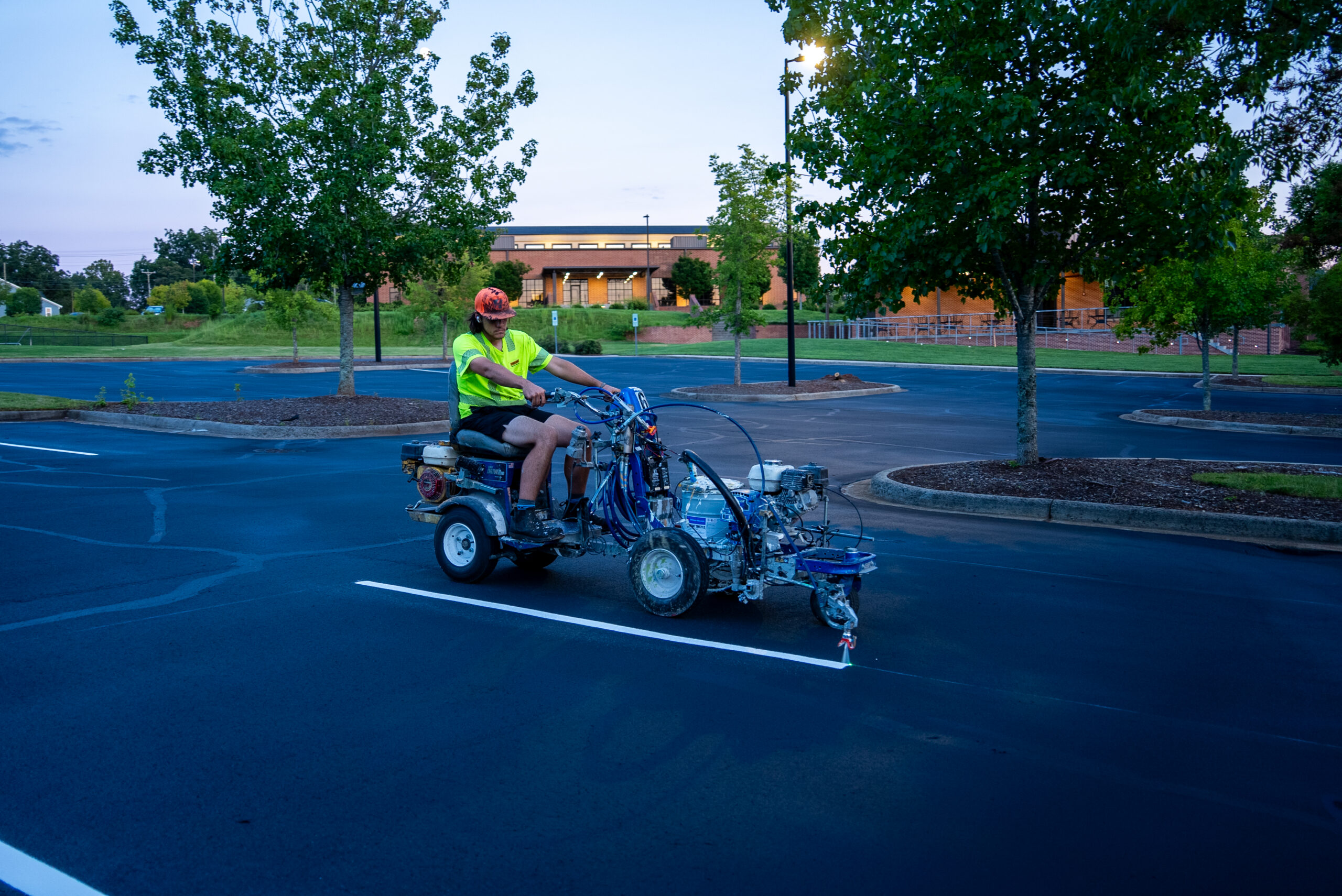
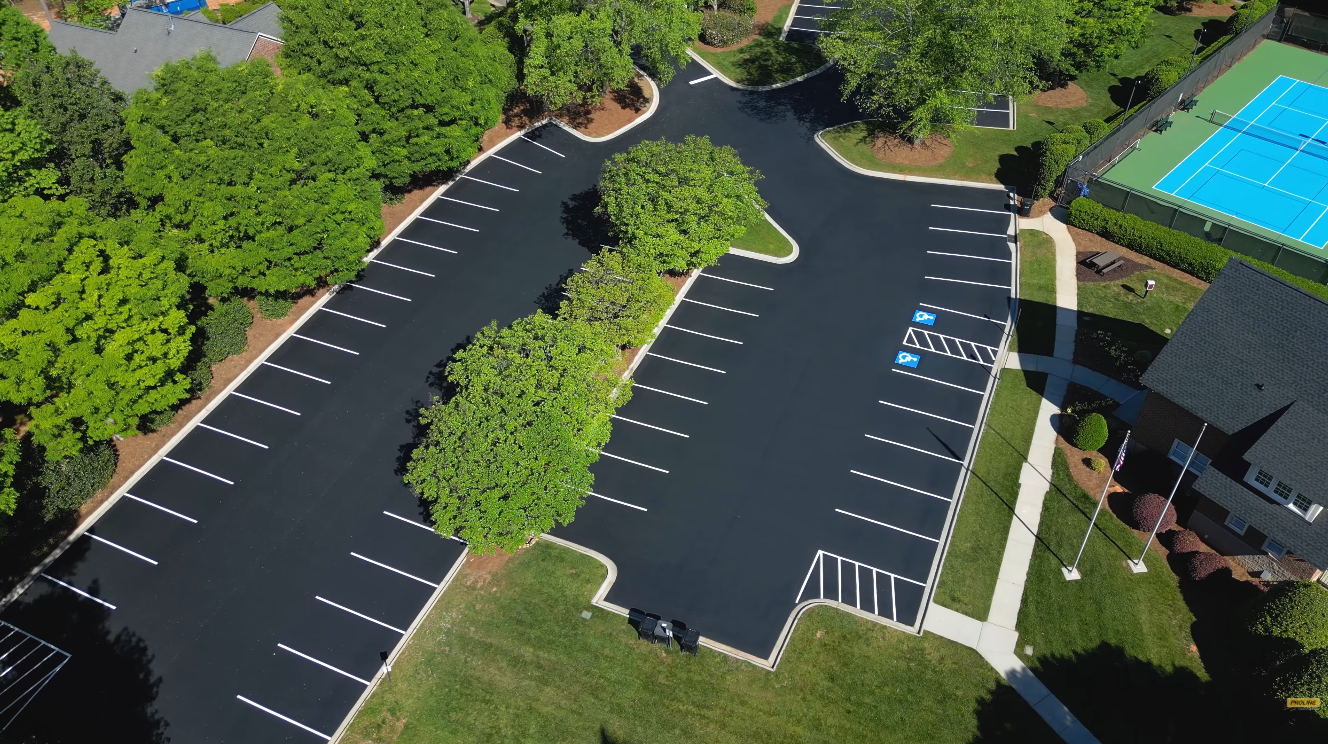
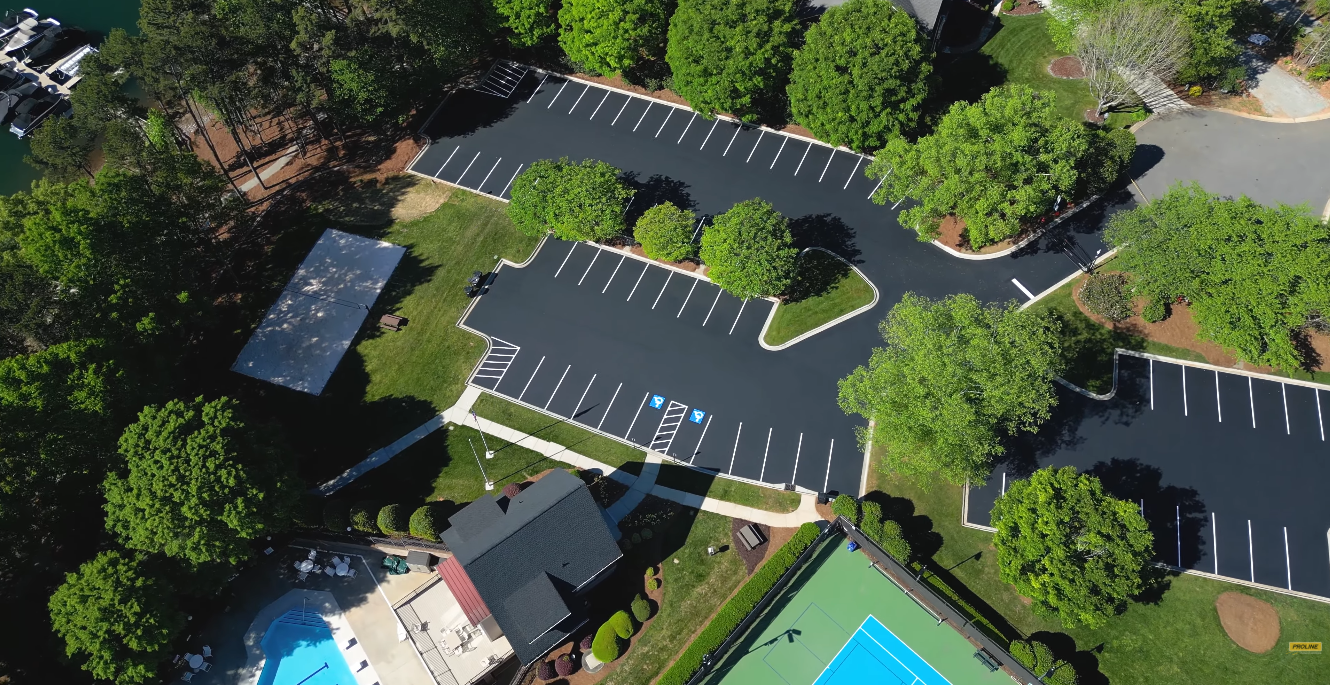
At ProLine Parking Lot Maintenance, we provide striping services for apartment complexes ranging from Charlotte and Huntersville to Greenville and Columbia. The same trend shows up at all properties: entrance and exit areas lose their visible markings first, and managers often don’t notice until then. The following guide will show you how to identify this problem, correct it, and ensure that it remains corrected. This guide focuses on parking lot markings at apartment building entrances and exits and applies whether the community is gated or open.
Overview
- Why entrances and exits fade faster than the rest of your lot
- A three-time audit that shows you what drivers actually see
- How to fix contrast before you add brightness
- Which marking belongs at which entrance or exit element
- How federal standards apply and where they leave gaps
- A Carolina-specific refresh calendar
Why Entrances and Exits Lose Visibility First
More abuse happens at the entrance than anywhere else in the area. When drivers brake, they turn the wheels, and paint rubs off both the stop bar and the first arrow. People who are waiting at the gate keypad leave fluids in the same small area. A yellow-green film, caused by spring pine pollen, covers the surface, and leaf litter from live oaks and willow oaks keeps the paint moist through the fall.
Overspray from the irrigation system at the landscaped entrance monument keeps the area moist, leading to algae growth and blurring the marker. The direction of the exit is also important; if it faces east or west, the low angle of the sun will be directly in the driver’s line of sight, and the faded stop bar will disappear exactly when it is needed.
Run a Three-Time Visibility Audit
You can’t judge the entrance markings from the back of a golf cart at noon; we check each entrance and exit three times, and we advise you to do the same.
During the day, we look for any physical damage such as missing paint, cracked thermoplastic, and tire scrub. At dusk, we check glare and contrast since the low angle of the sun reveals poor markings. On a wet night, we stand at a driver’s eye level when the vehicle is stopped and note where each marking first becomes readable. After that, we measure the distance with a wheel.
The stop bar and legend should be readable from a distance of about 50 feet when the speed is 15 miles per hour, since this distance includes both the time it takes the driver to react and the braking time; if a marking fails at any of the three checks, then it needs repairing even if it appears satisfactory in a photo taken during the day.
Fix Contrast First, Then Add Brightness
Most managers believe faded markings should be repainted in a brighter color. However, in our experience, contrast, not brightness, leads to more failures. Even when the paint is new, light gray concrete aprons make white arrows and yellow lines almost impossible to see. Adding a black border to each arrow, stop bar, and legend solves this problem, since the eye naturally focuses on the dark edge.
Weather presents another issue. FHWA research shows that conventional markings lose much of their retroreflectivity on wet roads at night. This matters in the Carolinas, where afternoon thunderstorms, tropical systems, and the long Atlantic hurricane season leave roads wet in the evening. Therefore, for the areas where the risk is greatest, we suggest using wet-reflective optics or thermoplastic rather than standard paint.
Match the Marking to Each Entrance and Exit Element
Each section of the entrance has its own role and its own way to fail; refer to the table when planning your scope.
| Entrance or exit element | What fails first | What we recommend | Audit time that exposes it |
| Exit stop bar and STOP legend | Tire scrub and low-sun glare | Thermoplastic or high-build paint with black border | Dusk |
| Entry directional arrows | Gate-queue fluid stains and fading | Stenciled arrows with contrast border | Wet night |
| ENTER and DO NOT ENTER legends | Wear from turning wheels | Large stencils placed before the turn | Midday |
| Sidewalk crosswalk at the drive | Fade under pedestrian and wheel traffic | Wide ladder-style bars, high-build paint | Wet night |
| Gate stacking lane edge lines | Mildew and overspray film | Pressure wash, then restripe | Midday |
| Fire lane curb at the entrance | Sun bleaching of red or yellow paint | Fresh curb paint plus stenciled legend | Dusk |
When addressing the crosswalk pedestrians use to cross the drive, pay close attention to it. According to the NSC parking lot safety page, 9 percent of pedestrian deaths in parking lots are caused by backing-up incidents. A bright, wide crosswalk encourages exiting drivers to slow down and look before moving forward.
Use Federal Standards as Your Benchmark
Most property managers miss this gap. While MUTCD Section 3A.05 specifies the minimum retroreflectivity levels for pavement markings, the section only applies to longitudinal lines on public roads and does not include non-longitudinal markings such as transverse lines and crosswalks. As a result, the stop bar and crosswalk at your exit are outside the federal minimum retroreflectivity requirement. Likewise, private apartment driveways are also not subject to direct MUTCD enforcement.
We advise clients to see this as a reason to set a higher standard, not a lower one. Plaintiff attorneys and insurers use the MUTCD as the standard against which a reasonable property owner should be measured. By keeping your entrance markings in line with that standard, you protect both residents and your liability position.
Accessibility is also important near the leasing office entrance. Under ADA guidelines for restriping, a business that restripes must provide accessibility in accordance with the 2010 ADA Standards. Before we draw a single line, we check the accessible route against your entrance layout.
Time Your Refresh Around the Carolina Calendar
Timing protects your investment: we remove pollen and mildew before assessing any fading, since a pressure wash can reveal paint that still has life in it. Fall, the current season, gives us dry, mild weather so we can restripe before winter rain and the next wave of pollen. Spring work also works, but we schedule it after the heaviest pollen period.
We also suggest a rapid inspection after each hurricane season ends on November 30, since wind-blown debris and standing water leave their mark on the aprons and gate lanes.
Pair Visibility Upgrades With Layout Fixes
No matter how good the paint is, it can’t correct poor geometry. If your entrance throat manages to squeeze two lanes into a small area, you should look at our guide on narrow drive aisles before you restripe. If your community needs clearer legends and symbols, read how pavement stencils can improve organization across the entire parking area.
Make Apartment Entrances and Exits Safer With Clear Pavement Markings
Faded directional arrows, stop bars, and lane markings can make navigating busy apartment entrances and exits confusing. At ProLine Parking Lot Maintenance, we provide professional parking lot striping solutions to improve visibility, guide traffic flow, and keep your apartment community organized. Let us help you create clear, easy-to-follow pavement markings that residents and visitors can recognize.
Contact UsFrequently Asked Questions
Can residents still use the entrance while you restripe it?
Yes, in almost all cases. We work one lane at a time and use cones and signage to keep residents’ routes clear. Since the striping paint dries in about 20 minutes under good conditions, each section becomes accessible again quickly. In gated communities, we arrange with your property manager to either keep the gate open or assign a staff member during the work, ensuring residents and emergency vehicles can move about.
Do I need city or state approval to change markings at the entrance?
It depends on the pavement’s location. The area between the road and your property boundary is sometimes within the public right-of-way, and the city or the state transportation department (NCDOT in North Carolina and SCDOT in South Carolina) generally decides what you can paint there. Paintings on your private drive usually don’t require a permit, though a local municipality may still require review of new designs. We advise you to contact the local planning or public works office before you begin, and we will be happy to provide the layout drawings they request.
Should I upgrade the lighting at the same time?
Lighting and markings should be considered together, which is why we advise you to check both. No matter how good the marking is, it won’t be visible at night if the entrance is in a dark area or if uneven lighting casts strong shadows. Various Carolina utilities, such as Duke Energy, have outdoor area lighting schemes, and a qualified electrician or lighting expert can assess your entrance and suggest appropriate fixtures. We usually recommend improving the lighting first, since it affects how drivers see the markings you apply.
What should I send you to get an accurate quote?
Send us a satellite image or site plan, along with photographs of each entrance and exit taken from the driver’s point of view. Let us know whether your gates are manual or automatic, how many units you look after, and which hours work best for the crews. If you already have an engineer’s striping plan or a list of resident complaints, please include these as well. We’ll arrange a free site visit, inspect the surface, and provide a written scope you can take to your owner or regional manager.
How should I document the work for my insurance carrier?
Take photos of each entrance and exit dated before the work, immediately after it’s completed, and again at night. Keep the audit notes, the invoice, and the product specifications in the same file as your maintenance log. In the event of a claim, this record will prove that you had identified a hazard, repaired it, and then checked it according to a schedule. A written summary of the work carried out will be provided to you if you request it so that your file remains complete without you having to put in any additional effort.