
Overview
- Check your situation at the five points where confusion begins.
- View stencils as part of a wayfinding system that drivers encounter at speed.
- Set the letter height and shape based on how quickly drivers are approaching.
- Stay short when writing each message and use the same words for the property.
- Use the stencils in a controlled manner that avoids bleed and fade.
- Take them out in stages and then check your results 30 days later.
Since drivers mostly focus on the road directly in front of them, they’re more likely to see a mark on the pavement than one on a signpost. Researchers at the University of Wisconsin reached that conclusion through their study of pavement markings, which is why a stenciled word on the asphalt usually performs better than a sign a driver never turns to look at. Apartment complexes in Charlotte, Raleigh, Greenville, and Charleston can use this behavior.
As parking lot contractors in the Carolinas, we apply pavement stencils to solve specific problems rather than decorate the lot. That’s how we plan, apply, and lay out stencils so your parking area stays organized without requiring any additional staff hours.
Treat Stencils as a Wayfinding System
An apartment estate differs from a shopping center site: residents drive slowly, know the layout, and will stop if a few seconds of convenience is better than walking a long way. Children cross the drive lanes, trash trucks swing wide, and visitors go around looking for a spot to park. A stencil is visible to all drivers exactly at the moment they decide what to do.
We create a stencil package just as an engineer would design a sign package—each word has a specific purpose, each position has a reason for being, and each message corresponds with what a driver needs to know at that stage in the parking area. This discipline keeps the pavement readable instead of cluttered.
Audit Your Lot for Five Problem Spots
For each project, we start with a walk-through where we examine the same five problem areas. At dumpster enclosures, cars park on the apron and obstruct the trash truck. At mailbox kiosks and on walkway ramps, drivers stop for a quick pickup and leave pedestrians trapped behind them. At gate entrances, drivers go through the stop bars without braking. At speed humps and playground crossings, cars arrive faster than they should. In one-way aisles and dead-end turnarounds, one driver going the wrong way can cause a standoff.
In the South End of Charlotte at a mid-rise community, we located three of the five areas within 200 feet of the leasing office. Please photograph each problematic area, including a date stamp, and send us a list of the photos; the images will serve as the baseline for the 30-day audit outlined below.
Match Letter Height and Shape to Driver Speed
Size and shape determine whether a driver can read a stencil in time; research at the University of Wisconsin found that elongated pavement-marking letters greatly increase the distance at which they can be recognized compared with letters with normal proportions. This is due to simple geometry: a driver looks at the pavement at a shallow angle, so the letters must extend in the direction of travel to appear natural.
The federal manual illustrates this principle on a highway scale; for example, it shows the word “ONLY” drawn 8 feet tall and 5.9 feet wide for use on public roads. Because apartment building drive aisles have much lower speeds, the letters are reduced in size, but the stretched shape is retained. In drive aisles where cars approach at 10 to 15 miles per hour, we use 24-inch letters; where residents see the message from a few feet away, we use 12- to 18-inch letters.
The stencil package that we recommend for the majority of Carolina apartment complexes is given in the table below.
| Stencil message | Where we place it | Letter height | Problem it solves |
| DO NOT BLOCK | Across the apron in front of dumpster enclosures | 24 in | Keeps trash trucks from stopping and waiting |
| KEEP CLEAR | At mailbox kiosks and walkway ramp landings | 18 in | Keeps pedestrian paths open |
| STOP | 4 ft before each stop bar at gates and blind corners | 24 in | Slows cars before the hazard |
| SLOW | 15 to 20 ft before speed humps and playground crossings | 24 in | Reduces speed where children cross |
| Directional arrow | At the start of every one-way aisle and after each intersection | 5 ft long | Prevents wrong-way driving |
| NO PARKING | At blind corners and dead-end turnarounds | 18 in | Protects sightlines and turning room |
| RESIDENT PARKING ONLY | At the entry to permit-only rows | 18 in | Marks permit rows near buildings |
These dimensions are our standard layouts; however, your local code or fire official may require different sizes, so we will confirm them before spraying. Before any work begins, we review the requirements for your municipality and coordinate directly with local code or fire authorities if necessary. If special approvals or permits are needed, we guide you through the process and handle communications to keep your property compliant, giving you peace of mind and helping you avoid fines or delays.
Choose Wording Residents Read in Two Seconds
A driver only looks at the stencil for two seconds, so each message is kept to one or two words. “DO NOT BLOCK” is effective since it tells drivers what they should avoid, whereas a longer message like “Please keep this area clear for service vehicles” fails because people don’t finish reading it.
We apply the same terms throughout the whole property. For example, if the stencil on the dumpster reads “DO NOT BLOCK”, the one on the mailbox shouldn’t say “NO STOPPING”. Consistent vocabulary helps residents understand a straightforward set of rules and lets your leasing team repeat the pavement message to a resident who disputes a warning. We finalize the wording with your property manager before cutting any templates.
Apply Stencils With a Controlled Process
Crisp stencils result from a method, not chance. Using the site map you provided, we draw each position with chalk lines, then sweep and blow the surface to ensure the paint sticks to the asphalt and doesn’t lose dust. We weigh the stencils down with sandbags because even a light breeze from Carolina can lift the template and blur the letters.
Instead, we apply two light coats of fast-drying traffic paint rather than one thick coat. A thick coat will run beneath the edge of the stencil and blur the letters, while two light coats can achieve solid color with sharp edges. We pull each stencil straight up while the paint is still wet, and we wipe the template between uses so the old paint won’t smear the next letter.
We work in dry weather and check the forecast for the next few hours, since an afternoon thunderstorm might wash away paint that has cured. In spring, we first sweep the pollen off the surface as a yellow film reduces adhesion. Cool, dry mornings provide the best period of opportunity in both Carolinas.
Roll Out in Phases and Audit After 30 Days
We start by stenciling the areas that get the most complaints, typically the dumpster aprons and the gate approach, then move on to the rest of the property. This approach delivers noticeable results on day one and lets residents get used to the new messages in small doses. We provide residents with 48 hours’ notice and place cones around each newly stenciled area until the stencil cures.
Clear, timely notification helps minimize confusion and resident complaints. We recommend sending a brief message or email that explains the work schedule, the reason for the pavement stencils, and any temporary changes to parking or access. For example, you might use a message such as “Attention residents: On [date], pavement stenciling will take place in select areas to help improve parking and traffic flow. Please avoid these areas during the work period and follow any cones or signage. Thank you for your cooperation as we make our community safer and more organized.” Providing updates if schedules change and posting flyers in common areas, can also keep everyone informed throughout the process.
Thirty days after the stencil is installed, we will return to the site with the photo baseline you provided. We check how many cars still block the dumpster apron, whether the landing in front of the mailbox remains clear, and whether drivers brake at the gate. If a stencil is underperforming, we adjust its size or position, usually in less than an hour.
Improve Apartment Parking Organization With Clear Pavement Markings
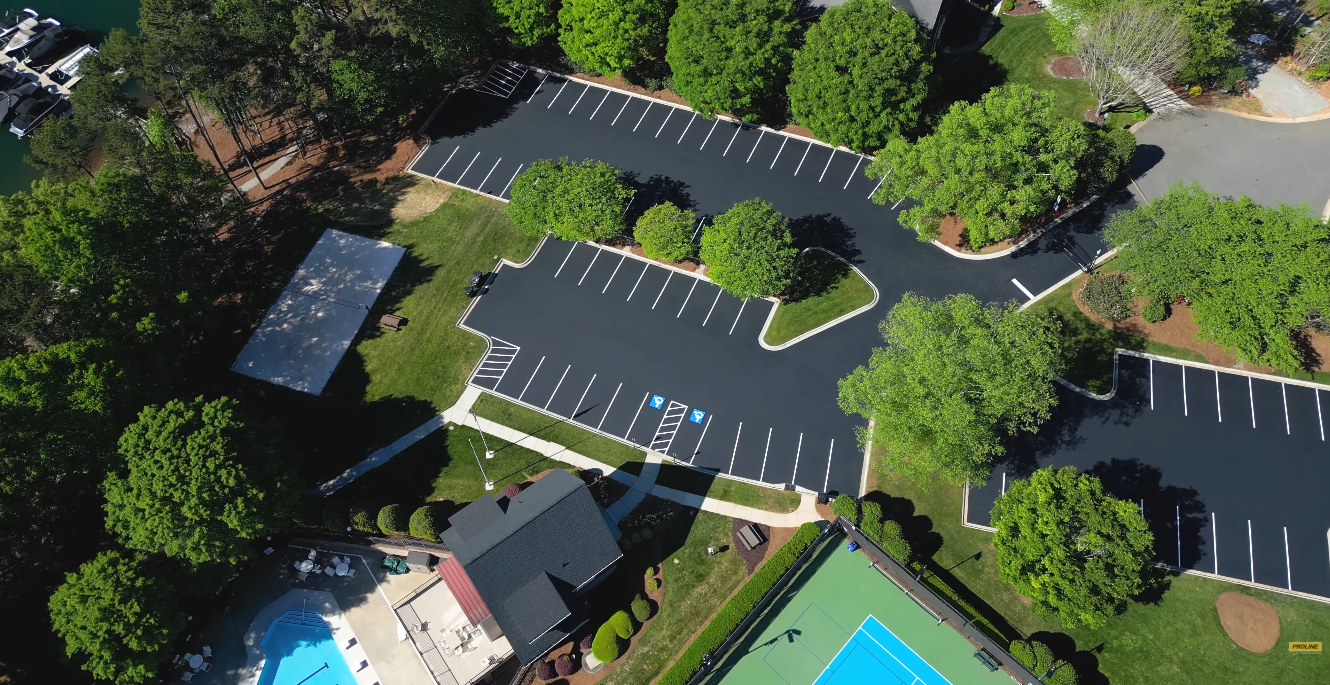
Clear pavement stencils help residents and visitors identify reserved parking spaces, directional arrows, fire lanes, accessible parking areas, and other designated zones. ProLine Parking Lot Maintenance provides professional parking lot striping and pavement marking services to help apartment property managers improve traffic flow, reinforce parking rules, and keep multifamily communities organized.
Contact Us TodayFrequently Asked Questions
How long do stenciled words last before we need to repaint them?
Most painted stencils remain legible for about one to two years, but how long they last depends on how many cars drive over them each day. Those at the approaches to the gates and at the intersections in the drive aisles wear out faster because cars have to brake and turn on them, whereas those at the edge of the premises tend to last longer. We advise checking them each spring and autumn and retouching any stencil that has lost half its contrast. If you want to extend the cycle in high-wear areas, we can use preformed thermoplastic, though this means paying more upfront, and the color will last longer.
Do we still need posted signs if we add pavement stencils?
Yes, usually, because while a stencil influences driver behavior, it doesn’t always meet the legal notice requirements for enforcement. Towing rules on private premises vary between North Carolina and South Carolina, as well as between cities, and in many locations specific signs must be posted before a vehicle can be removed. We install the stencils and can arrange to have the signs placed as well, but you should check with your property lawyer or towing contractor to ensure you meet the notice requirements in your city or county. When you use both a stencil and a sign, drivers see the notice twice—once on the road surface and again at eye level.
How do we remove or change a stencil when a space gets reassigned or a rule changes?
We lay a black or grey coating over the existing stencil that matches the surrounding asphalt , then apply the new message once the coating has cured. If we need to remove the stencils completely, we use grinding or sandblasting, but since these methods leave scars on the pavement, we only resort to them when a blackout coating can’t conceal the old message. Although blackout paint may show a slight ghost outline in low sunlight, we soften the edges and use a color-matched product. Please let us know about any changes early on so we can schedule them at the same time as your next restriping, so you only pay for one mobilization.
Can our maintenance team stencil with spray cans to save money?
Although your team can manage one small stencil if needed, we still recommend against doing the entire job with aerosol cans. Paint from cans tends to be thin and uneven, fades rapidly, and consumer paint generally doesn’t offer the same durability or color consistency as traffic paint. Furthermore, hand-cut or fragile templates can make letters crooked and edges blurred, making your community look neglected. The contractor, on the other hand, uses professionally cut stencils, properly calibrated spray equipment, and layout tools to ensure a consistent finish from the entrance drive to the back row.
Can we stencil on concrete pads, brick pavers, or parking decks?
Certainly, but each surface type requires a different method. Although concrete can take paint, we clean it thoroughly and sometimes apply a primer because curing agents and oil stains can prevent adhesion. Because brick pavers and textured surfaces generally don’t hold sharp letters, we usually suggest a mounted sign or a smooth painted pad in those cases. In parking decks, we select low-odor, fast-drying products and schedule work around residents’ access; since the ventilation is poor, fumes can remain in the enclosed area.
See also: Parking Lot Numbering and Stenciling Ideas for Multi-Family Communities, Parking Lot Stencils: How to Choose Clear, Useful Markings