
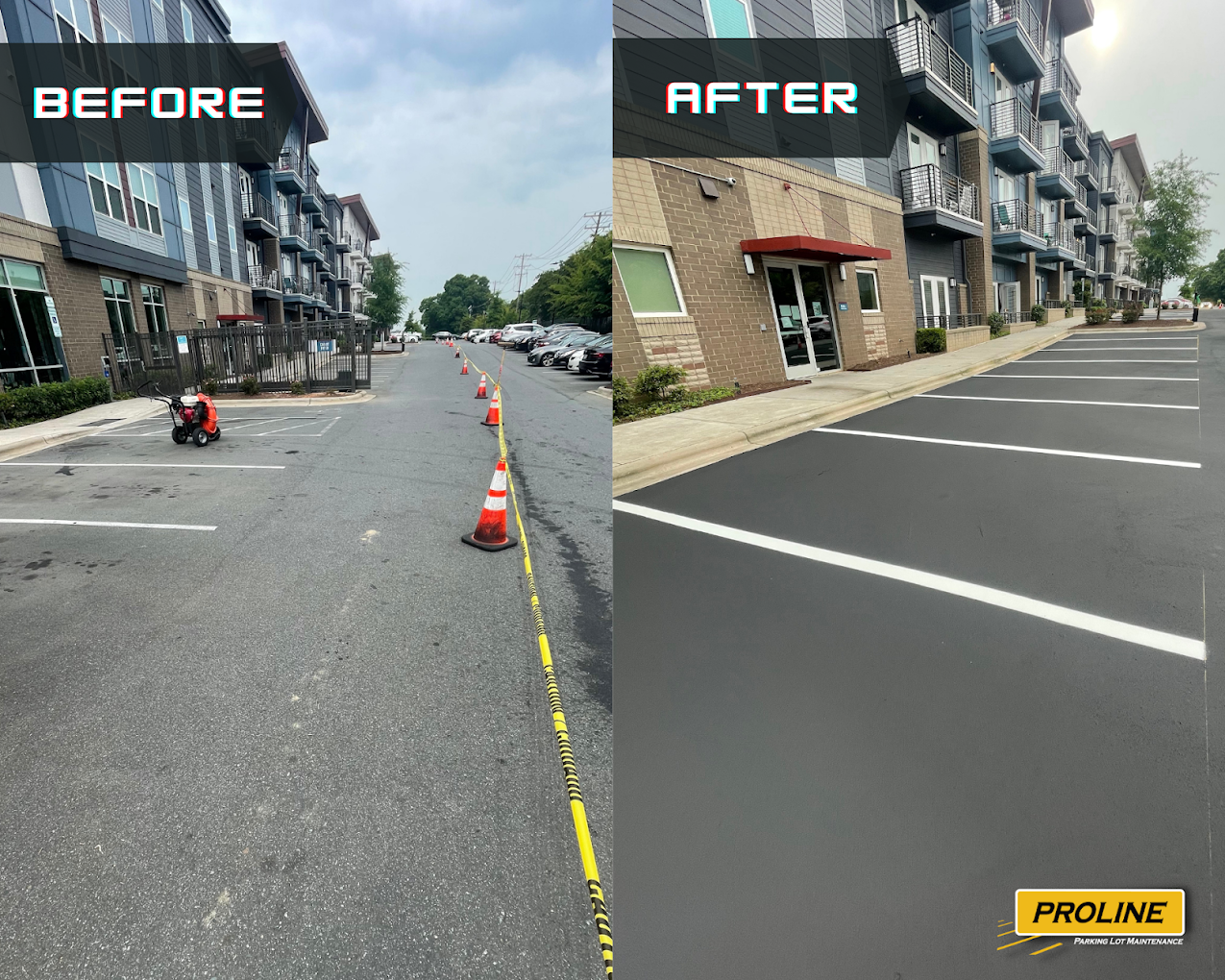
Asphalt repairs and pavement markings should be planned together. Establish the repair sequence, suitable application conditions, and surface-readiness requirements before scheduling striping.
At ProLine Parking Lot Maintenance, we observe the same expensive pattern in HOAs and apartment complexes all over the Carolinas—that is, a property fixes a pothole on a Friday only for it to have the surface striped over on Monday or spend money on new stripes only to have half of them ripped up two months later when the repair that should have been done first had actually been overlooked. This article outlines the proper sequence of operations, the exact cure times needed for each type of repair before paint can be applied, and how ProLine coordinates the two activities so a property in the Carolinas is charged only once for the work.
Why the Repair-to-Striping Sequence Matters
Every parking lot rehab project follows the same logical order, even though many Carolina properties jump straight to the last step because it is the most visible one:
- Fix the structure first (base failures, potholes, alligator cracking)
- Treat the surface second (crack sealing, patching, sealcoating, or a full mill and overlay)
- Stripe last, only once the surface has fully cured
Repairs made after striping can cover or damage the new markings. Paint applied to an unsuitable or unready surface may not bond properly. Confirm the repair sequence and surface-readiness requirements before scheduling the work.
How Long Each Repair Type Needs to Cure Before Striping
The Foundation for Pavement Preservation suggests that each surface treatment should be allowed its full cure time before applying a topcoat, and this applies equally to paint as it does to sealcoat or crack sealant.
| Repair Type | Typical Cure Time Before Striping | Why |
| Pothole patch (hot mix or infrared) | 24 to 48 hours minimum | The patch material needs to cool, compact, and bond to the surrounding asphalt before paint can grip it |
| Crack sealing | A few hours to overnight, per product spec | Sealant must skin over completely, or fresh paint applied on top will pull and peel |
| Sealcoating | 24 to 48 hours in good weather; longer in high humidity | Uncured sealcoat is still soft, and paint will not bond, often peeling within weeks |
| Mill and overlay / full repave | Minimum 3 to 5 days; many Carolina contractors recommend up to 30 days | New asphalt oils need time to rise and stabilize before paint can form a lasting bond |
ProLine builds these windows into each project schedule from the start, so the property’s move-in deadline or the board meeting date doesn’t force striping on a repair that hasn’t finished curing.
Coordinating Repairs on an Occupied Carolina Property
Apartment residents need clear information about closures and alternative parking. Agree on feasible work phases and access arrangements with the property manager before the project begins.
Include repairs, curing, striping, and reopening in one written schedule. Share a phase map with residents and update it when conditions change.
How Carolina Weather Affects the Repair-to-Striping Timeline
- The higher the humidity, the longer the curing time takes. Both sealcoat and paint cure by evaporation, and the humidity typical in the Lowcountry and coastal areas near Myrtle Beach and Charleston can extend a curing period that would otherwise be 24 hours to about 48 hours.
- Watch for severe-weather forecasts and adjust the schedule when conditions would affect surface preparation, application, or curing.
- Cold weather does more than restrict asphalt curing time; it also limits asphalt availability. Generally, most of the hot-mix asphalt plants in Carolina reduce or stop production when the temperature falls low enough to prevent proper compaction, which is why major resurfacing projects are almost every year scheduled for spring or summer.
Instead of using a single calendar that applies statewide, ProLine keeps repair-and-stripe windows separate by region because in the Piedmont area and along the coast, the windows for repair and striping seldom fall in the same week.
How ProLine Coordinates Each Repair Type With Striping
Pothole Patching
- We need to decide if the pothole requires a full-depth patch involving the removal and rebuilding of the base or a patch that only addresses the surface, since the two types have different recovery times.
- Use suitable barriers to keep repaired areas closed until the contractor confirms they are ready for the intended traffic.
- We don’t stripe until the patch has fully compacted and cooled, and we run a simple adhesion test to confirm this before applying any paint.
- We match the new stall lines to the existing layout so a single-stall patch never accidentally becomes a restripe covering the entire area.
Crack Sealing
- We examine each crack across the area and choose a treatment based on its width and movement, then apply the right sealant before we stripe the section.
- We carry out sealing within the temperature and humidity range specified by the manufacturer, since Carolina’s variable spring weather can quickly push conditions outside the ideal range.
- We allow the sealant to cure completely, typically taking a few hours to overnight depending on the product, before applying any paint to the treated crack.
- We only stripe over sealed cracks once they are level with the surrounding pavement, so the new line does not indicate a raised or sunken seam.
Sealcoating
- We confirm the base asphalt has no unresolved structural problems before applying sealcoat, since sealcoat masks such problems visually without addressing them.
- We carry out sealcoating under conditions that meet the manufacturer’s specifications for temperature and humidity, and we adjust our schedule to match the property’s coastal or Piedmont location.
- We allow 24 to 48 hours for the sealcoat to cure, extending this time in high humidity, before starting any layout work.
- Before we strip, we perform a tape-pull adhesion test on the cured sealcoat to confirm the surface is ready, rather than relying on the calendar date.
Mill and Overlay / Full Repave
- We stay in close contact with the paving contractor’s schedule since ProLine’s striping timeline depends entirely on when the new asphalt is laid and how it cures.
- We wait at least 3 to 5 days after paving and, if the homeowner’s schedule permits, recommend up to 30 days so the surface oils have time to rise and stabilize.
- Before stripping a newly paved surface, we re-survey the area, since a full repave is the best opportunity to fix layout issues, add missing spaces, or adjust guest and reserved zones.
- Each time we carry out a full repave, we treat it as a layout reset, not merely a repaint, so the property ends up with a design suited to how it’s used today.
A Realistic Timeline for a Full Carolina Parking Lot Rehab
| Day | What Happens |
| Day 1 | Structural repair: pothole patching, base repair, crack sealing |
| Day 2-3 | Repair cure period; no vehicle or foot traffic on treated areas |
| Day 4 | Sealcoat application across the full lot |
| Day 5-6 | Sealcoat cure period, longer in humid Lowcountry conditions |
| Day 7 | Layout and striping begins once the surface passes an adhesion check |
For any properties that require the entire area to be fully open for a particular event or move-in date, the date should be provided to ProLine before the project begins rather than after the repairs have already been carried out, since reducing the cure times above is the quickest way to have to repaint the same lines twice.
Get a Repair-to-Striping Schedule Built Around Your Property
Plan repairs, surface readiness, striping, and reopening as a connected sequence. Contact ProLine to discuss the marking work for your apartment property.
Tired of Managing Separate Contractors for Asphalt Repairs and Striping?
Coordinate pavement repairs and striping to avoid applying markings before the surface is ready. Document preparation, curing, closures, and reopening responsibilities in the project schedule.
Frequently Asked Questions
Does any requirement arising from resurfacing or major asphalt repair mean that new ADA compliance rules for the parking layout are needed?
Accessibility obligations can change when parking facilities are altered or resurfaced. Small maintenance tasks and larger alterations are treated differently, so have the project scope and applicable requirements reviewed before work begins.
How should asphalt repair and striping be coordinated?
Confirm which team is responsible for each repair, preparation step, marking, and closure. Set the sequence and handoff conditions in writing so striping begins only when the surface is ready.
Can Carolina Winter be used for crack sealing or patching, or do you need to wait until spring?
Cold-weather repair options depend on the pavement condition and product. Ask the contractor to identify an appropriate treatment and the conditions needed for repair and subsequent striping.
What problems might arise with the warranty if the area has been stripped before the asphalt repairs have cured?
Review the paving contractor’s written curing, access, and warranty conditions before scheduling striping. Share these requirements with every team working on the surface.
Does a stormwater or impervious surface permit need to be obtained when repairing or repaving a private parking lot in Carolina?
Routine repair and resurfacing within a property’s existing footprint usually does not require a new stormwater permit, as it doesn’t increase impervious surface or alter how the property drains. However, this is no longer the case if the project involves expanding the paved area, changing the grading, or disturbing a significant amount of soil to bring about a federal or state review, and since the EPA’s NPDES Construction General Permit covers sites that disturb one acre or more of soil—a threshold that could be reached by a complete reconstruction of the entire lot on a larger apartment or HOA property—such a review is necessary. In North Carolina, the NC Department of Environmental Quality carries out such reviews. In contrast, in South Carolina, properties deal with the SC Department of Environmental Services, the agency that took over the state’s environmental permitting responsibilities during its 2024 reorganization. Property managers planning any work beyond a simple like-for-like repair should check with the local building or planning department about permit status before starting, as failing to complete a stormwater review can delay the project by weeks.
For a property in Carolina, how long should one wait after a hurricane or a severe storm before arranging asphalt repair and striping?
After flooding or severe weather, have the pavement assessed for standing water, erosion, undermining, and other damage. Resume repairs when the contractor determines that site conditions support the selected method.
What is the difference between crack sealing and crack filling, and does this affect the striping timeline?
Crack treatment depends on the pavement condition, crack movement, and selected repair system. Have the pavement contractor identify the appropriate treatment and confirm when the marking product can be applied.
If parking lot striping is faded, does that always mean the lot needs new paint, or could it signal a deeper asphalt problem?
Inspect both the markings and the pavement beneath them. Fading on a sound surface may call for repainting; cracking, raveling, contamination, or drainage problems need assessment before new paint is applied.
See also: Planning a Line Striping Project for a Busy Apartment Community, How to Coordinate Parking Lot Striping With Asphalt Repair Projects at Apartment Properties


