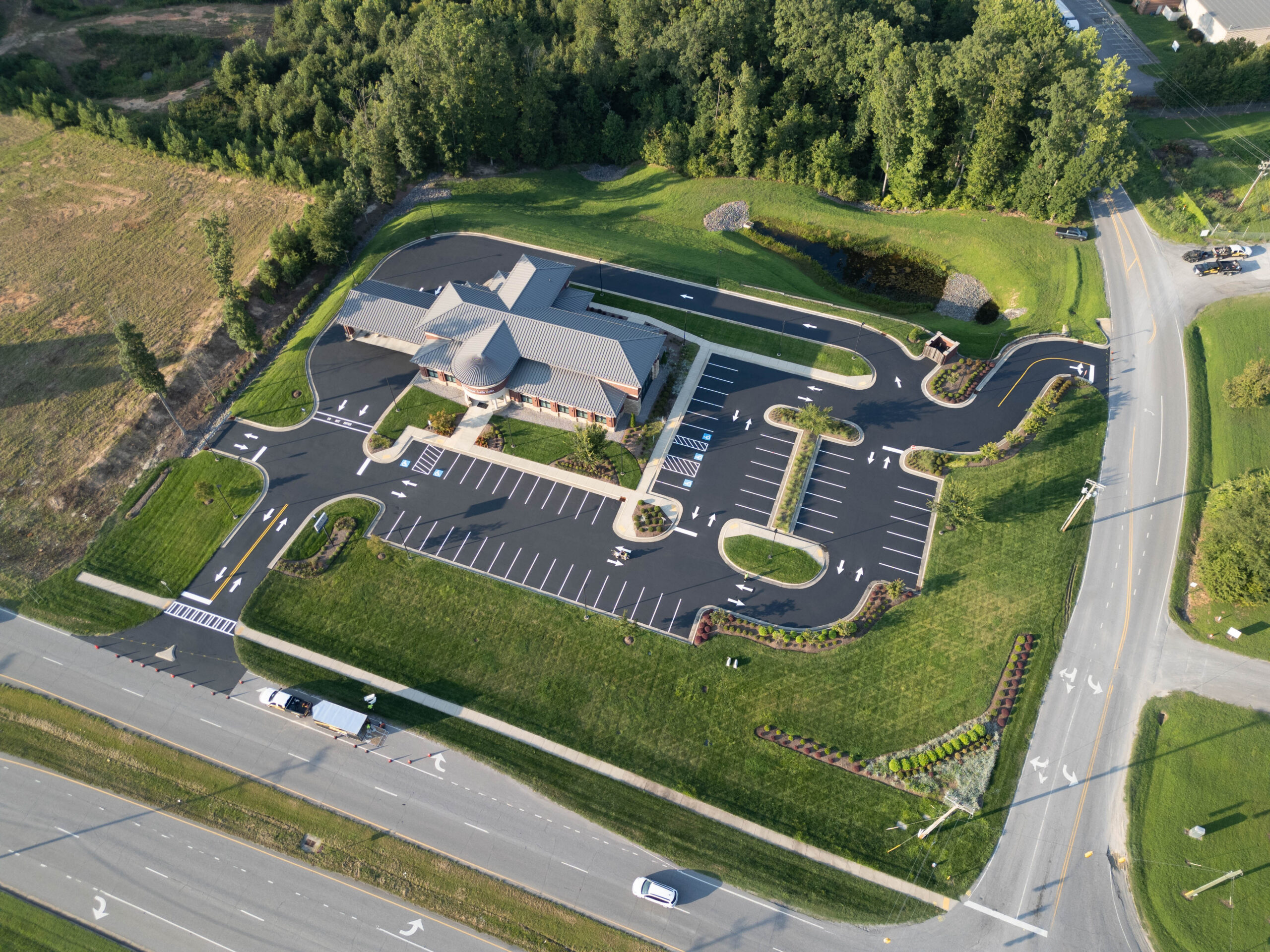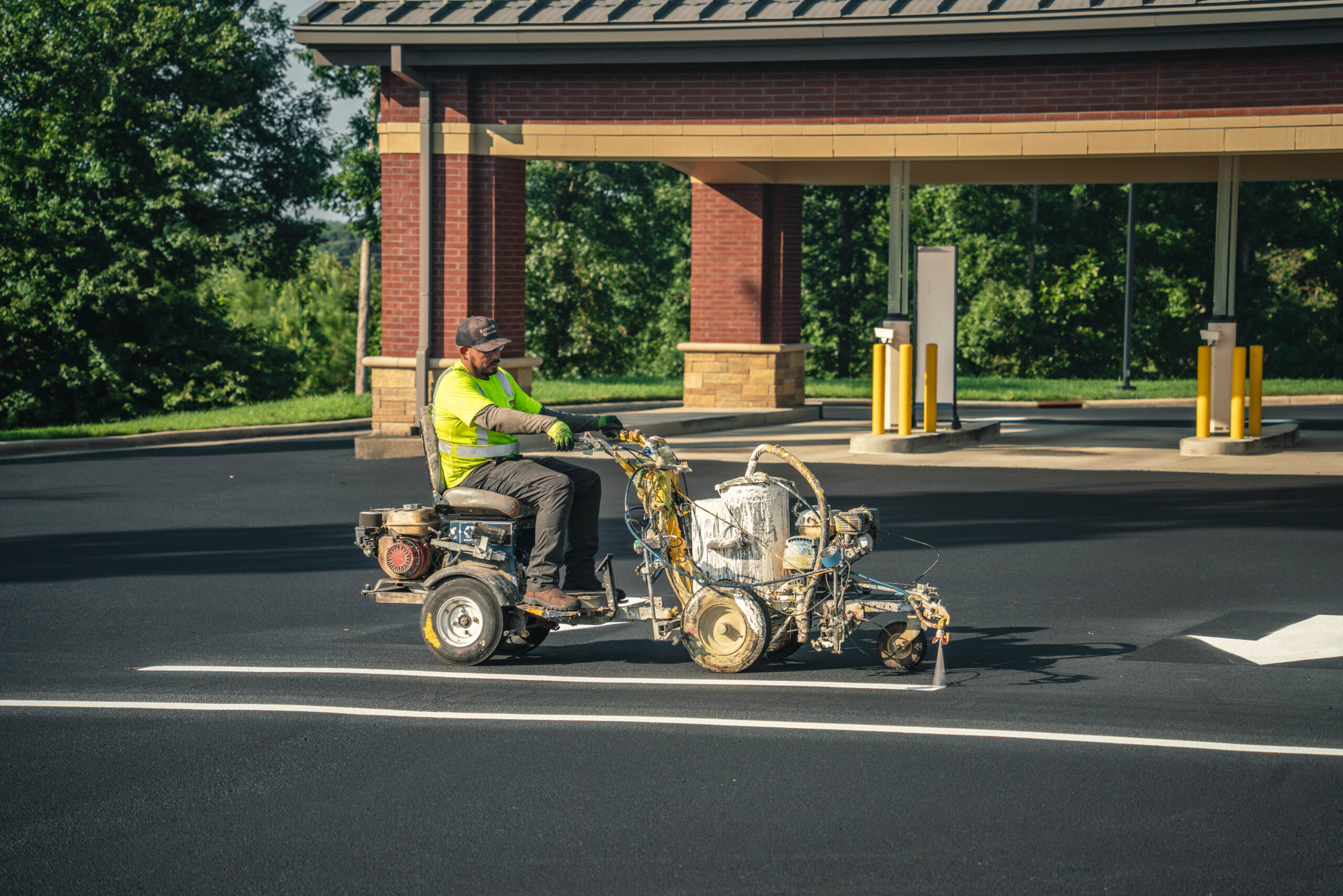
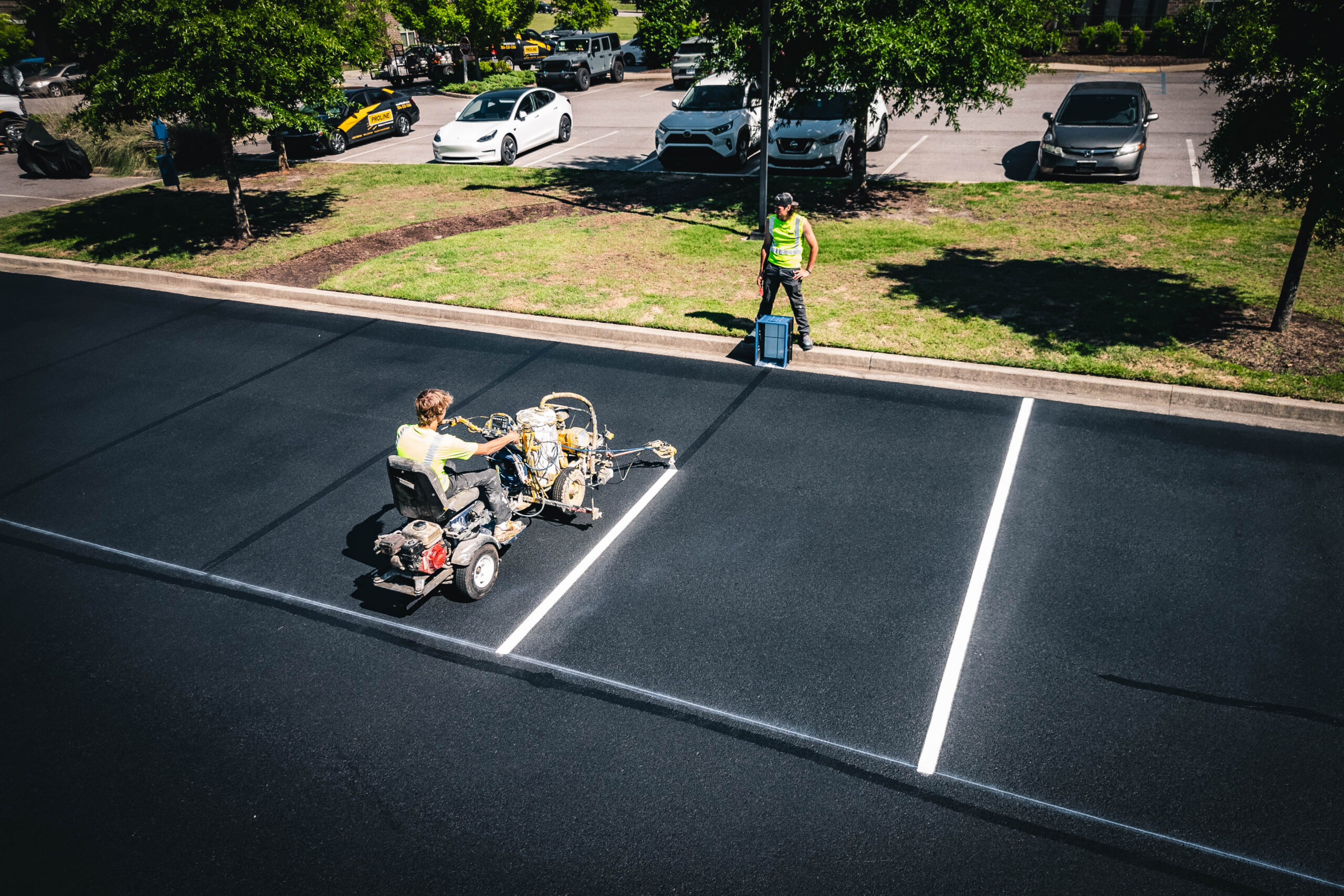
One inch of rain on one acre of pavement is going to produce approximately 27,000 gallons of runoff, according to the math that underpins the EPA stormwater program and a three-acre apartment lot in either Charlotte or Raleigh is going to shed over 80,000 gallons after a single summer thunderstorm. All of that water has to have a place to go, and every stripe we put down is either going to help that water get away or be in the way of it. We at ProLine Parking Lot Maintenance do a lot of work on multifamily properties throughout North and South Carolina, and storm drains are the single biggest source of layout problems that most managers don’t anticipate. This article looks at how we go about planning our stalls, aisles, and markings around inlets so that the lot drains well, the paint lasts, and no stripe ends up in a puddle.
Quick Overview
- We never paint over a drain grate, as the paint would clog the grates and create a slippery surface.
- The inlet type determines the layout, so we deal with grates, curb inlets, and trench drains in a different way.
- Ponding water will kill paint, so we flag any drainage issues prior to stripping.
- We shield every inlet during the painting, as overspray and cleaning water can get into the storm system.
- Carolina storms: the pollen and the leaf litter all change how we go about scheduling and cleaning around the drains.
Why Drains Change the Striping Plan
The parking lot is intentionally sloped towards the drains. The engineers have pitched the surface so that water runs along it, collects in the low spots, and drops into the inlets. If a crew decides to ignore that and stripe the stalls straight through the low spots, then you end up with cars parked on top of the flow path, leaves and rubbish piling up against the bumpers, and water backing up underneath the vehicles. The residents then park in the dry spots, and your stall counts are completely out of kilter.
Stripes also act as a guide to maintenance. There’s a clean, clear zone around each inlet to tell the sweepers and the landscapers where to look and to keep parked cars from just sitting on top of the grate. We treat the inlet as a fixed point in the layout and build the stalls around it rather than trying to fit the inlet into the stalls.
Matching the Layout to the Inlet Type
Apartment communities use a variety of inlet styles, and each one requires a different striping approach. The table below shows the five types we see most frequently and how we would strip each one.
| Inlet Type | Where We Find It | Layout Move We Make | What We Protect |
| Grate inlet in a drive aisle | Low point of a travel lane | End stall lines before the grate and keep the aisle edge line clear | Flow path and wheel travel |
| Grate inlet inside a stall | Older lots with stalls over the low spot | Shift stall lines to place the grate between stalls, or remove one stall | Grate opening and vehicle clearance |
| Curb inlet | Gutter line at islands and building edges | Leave a keep-clear zone at the curb opening and avoid painting the throat | Curb opening and water entry |
| Trench or channel drain | Garage entries, ramps, and walkways | Stop stripes at the channel edge and skip the grate | Slot openings and traction |
| Catch basin near an island | Parking row ends | Mark a hatched buffer so cars do not park on the frame | Frame, lid, and sight lines |
We also follow accessibility rules. The 2010 ADA Standards limit the size of openings in walking surfaces to 1/2 inch and require that any elongated openings be at right angles to the direction of travel. To ensure ADA compliance, we check every grate along accessible routes before any work begins. Property managers can check their own grates by measuring the openings with a tape measure and checking the slot orientation. If a grate has openings wider than 1/2 inch or slots that run parallel to the direction of travel, it is not ADA compliant and should be flagged for replacement. If you find a non-compliant grate on your property, we recommend documenting its location and scheduling a replacement with your maintenance team or a certified contractor to ensure accessibility and avoid safety or regulatory issues.
Keep-Clear Zones and Buffer Markings
We have two very simple tools to protect inlets: hatched buffers and painted keep-clear boxes. The hatched buffer is a buffer filled with diagonal hatching, which tells the driver not to park in that area. The keep-clear box outlines the inlet and a few feet of upslope pavement, since debris tends to collect there first. We size the buffer so a sedan can’t sit on the grate, even if the driver pulls right up to it.
We stop our stripes at the grate frame rather than letting them cross it. Paint on the metal grate itself fills the slots, peels in big sheets, and becomes very slippery when it’s wet. The paint on the concrete collar around the grate likewise conceals the cracks and settlement you need to see. If a crew goes ahead and paints over all that, the inspector and maintenance staff are effectively blinded to the drain’s actual condition.
Slope, Ponding, and Where Paint Fails
Standing water kills paint. A stripe that’s sitting under half an inch of water for several hours during each storm will lift at the edges, collect algae, and be gone within a season. We walk each lot after the rain and mark the low spots, birdbaths, and wet corners. If ponding sits right up against an inlet, we go and look at the cause (a settled frame, a blocked pipe, or a grade that’s now gone wrong).
The table below sets out the warning signs we most commonly see and the steps we recommend before any paint goes down.
| Warning Sign | Likely Cause | What We Recommend Before Striping |
| Puddle around a grate after 24 hours | Settled frame or low pavement | Raise the frame or patch the asphalt |
| Debris pile at an inlet | Blocked grate or poor sweeping | Clean the inlet and adjust the buffer |
| Stained pavement downhill from a drain | Backed-up pipe or overflow | Ask your engineer or plumber to inspect the line |
| Cracks radiating from a catch basin | Frame movement or base failure | Repair the basin and surrounding pavement |
| Algae streak in a stall | Chronic standing water | Correct the grade, then stripe the stall |
The Access Board parking guide also makes it clear that accessible stalls must stay within a 1:48 slope, so we’re mindful not to put them in low-lying areas that will collect water and lead to ponding. Where we can, we’ll move those stalls into the flatter, drier areas.
Protecting the Storm System While We Paint
Parking lot paint is a pollutant, and every inlet feeds into a creek or river. Before spraying, we fit a drain shield over each grate or a tight mat and install sediment control barriers around the curb inlets. We also keep the cones, stencils, and tape off the grates so nothing falls through. That takes a few minutes per inlet and keeps your property free of stormwater complaints.
Carolina weather makes this protection absolutely essential. Afternoon downpours in Charlotte, Greenville, and Columbia can arrive in minutes, and wet paint can wash into a drain before the crew even finishes. We watch the radar, start early, and stop painting when the sky turns. We also anticipate heavy pollen in the spring and pine and oak debris in the fall, so we sweep every inlet area before laying a single line.
Coordinating Drain Work With Other Striping Details
Drain layouts interact with other lot features. If you’ve got concrete wheel stops on your lot, our guide to striping around wheel stops explains how we ensure the stops don’t block inlets and flow lines. If you have angled parking in your community adjacent to drainage features, our article on striping in angled space shows how we adjust the stall angle so water still reaches the drain.
We recommend coordinating your striping schedule with other planned maintenance work, such as cleaning storm drains, repaving, or landscaping, to minimize how often you need to restrict parking access. Notifying residents in advance about any upcoming striping and drain work helps reduce confusion and complaints. If possible, group tasks by area so residents are displaced only once while several projects are completed together. Evening or weekend scheduling, or working in phases, can further limit disruptions to peak resident parking hours. Good planning keeps the lot organized and residents happy.
Plan Your Drain-Friendly Striping With ProLine
A good striping plan works with your drainage, not against it. That’s the approach we take at ProLine Parking Lot Maintenance when we’re working with apartment communities throughout North Carolina and South Carolina. We’ll map out every inlet before we lay a single stall. Get in touch for a site assessment, and we’ll go out after a rain to identify problem areas, then design a layout that protects your stalls and drainage system.
Keep Parking Lot Markings Clear Around Storm Drains and Drainage Inlets
Proper parking lot striping around storm drains and drainage inlets helps apartment communities maintain organized parking spaces without interfering with essential drainage access. At ProLine Parking Lot Maintenance, we provide professional parking lot striping and pavement marking services to help property managers define parking areas, identify restricted zones, and maintain clear traffic flow around drainage features. Let our team help keep your apartment property’s parking areas clearly marked and functional.
Contact UsFrequently Asked Questions
How soon after rain can we stripe a parking lot?
We normally wait until the pavement is completely dry (in the humid Carolina climate that can be several hours after a light shower and a full day after a heavy storm). Damp pavement will compromise the bond between the paint and the asphalt, so the stripes will peel or fade quickly if applied too early. We’ll do a moisture test and check the shaded areas and low spots, since those are the places that hold water the longest. If your schedule is tight, we’d recommend building in one or two backup dates.
What should we do with wash water and paint waste from striping?
Never send wash water, rinse water, or leftover paint down a storm drain. We collect the wash water in containers, filter it, and dispose of it in accordance with local and state regulations. We cap or seal paint containers before leaving the site. Property managers should always ask any contractor how they handle waste, as a careless crew can leave you with a violation. We provide a brief waste-handling summary with each project so you can show your owners and local authorities that the work was carried out in accordance with the rules.
Why does our lot keep flooding even after we restripe it?
Striping will change how a lot looks; it won’t solve a drainage problem. Recurrent flooding is almost always the result of a blocked pipe, a silted inlet, a failed grade, or an undersized system, and each of those requires an engineer, a paving crew, or a utility contractor. We recommend taking a number of photos with dates, then having a civil engineer or drainage specialist come out to inspect the system. Once the repair has been done, we’ll stripe the area again to ensure the striping matches the new grade.
Who maintains the storm drains in an apartment community, the property or the city?
Ownership depends on where the drain is located and how the property was developed. Inlets within a private parking lot are generally the property owner’s, whereas inlets in a public street or in a city easement are the municipality’s. Your site plan, plat, or stormwater maintenance agreement will detail who is responsible, and your local stormwater office can confirm that. We recommend checking those documents before storm season, as a blocked private drain can lead to flooding of the adjacent property and liability.
Does water-based paint behave differently than solvent-based paint around drains?
Water-based traffic paint dries quickly, cleans up with water, and gives off far fewer fumes than its solvent-based counterpart, which makes it a popular choice for apartment communities. Solvent-based paint can have a different feel and cure profile, but it does require more stringent handling and cleanup. Either type of paint needs careful protection around the drains, as wet paint can wash into the storm system. We’ll review the options for your property and recommend the product best suited to your pavement, climate, and community.
How should we prepare our parking lot drains before hurricane season?
Start by clearing out every grate, curb inlet, and trench drain of leaves, trash, and sediment, and then check that water flows freely to the outlet. Check the lids and frames for cracks or movement, and note any areas where water pooled during the last major storm. Walk the lot after the first spring rain, as you’ll see what dry weather hides. We recommend doing this check in late May, so you have time to complete any repairs and restripe before the peak storm months in the Carolinas.