The Asphalt Institute states that asphalt pavement generally lasts 15 to 20 years under normal traffic conditions, provided a property performs regular maintenance; however, in Carolina, this duration is greatly reduced because repairs and striping are done in the wrong sequence. The Federal Highway Administration notes that hot-mix asphalt requires a minimum surface temperature to compact and bond properly, which is why many paving crews in Carolina slow down on new asphalt as fall temperatures drop and then speed up the remaining work before the first hard freeze.
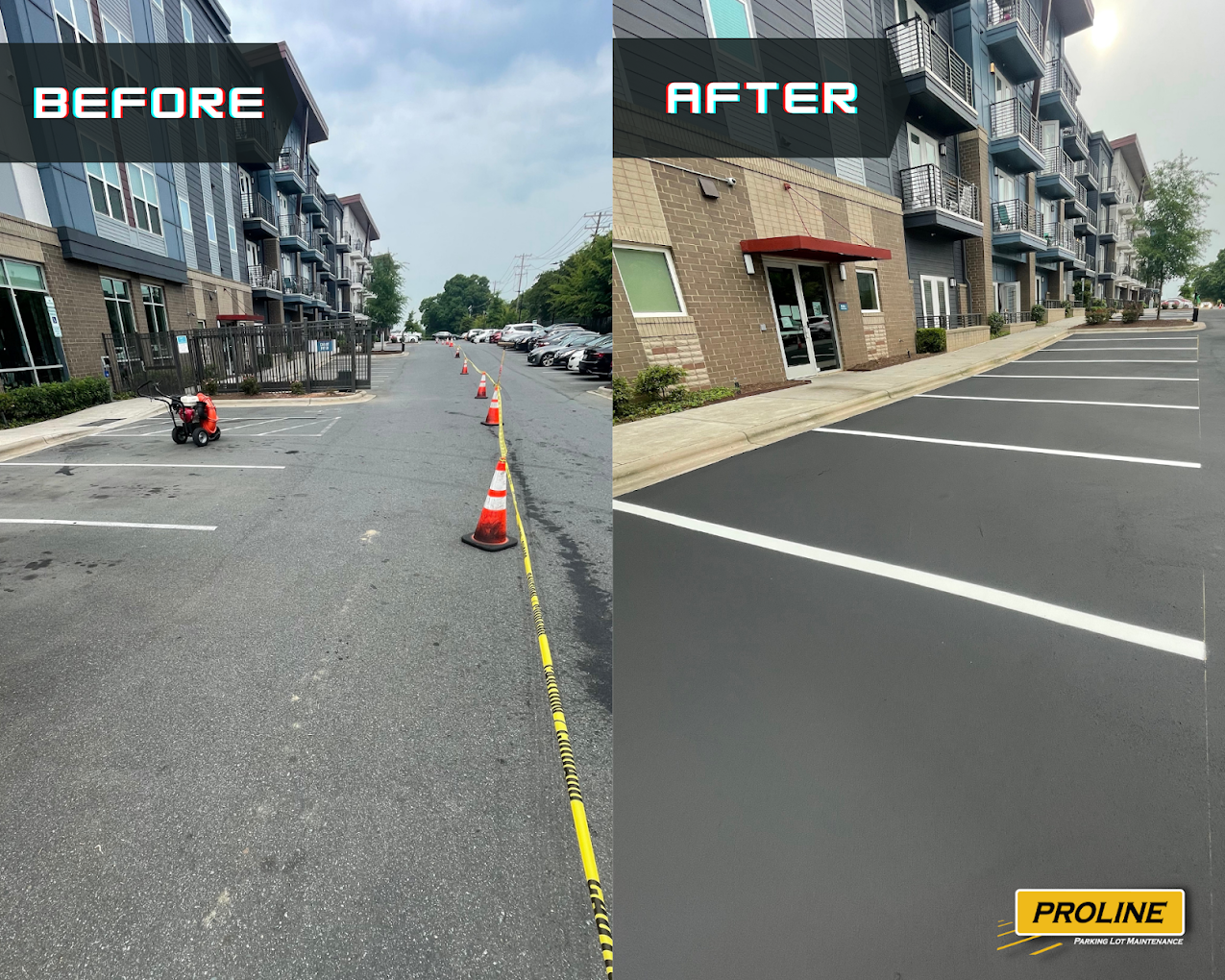
At ProLine Parking Lot Maintenance, we observe the same expensive pattern in HOAs and apartment complexes all over the Carolinas—that is, a property fixes a pothole on a Friday only for it to have the surface striped over on Monday or spend money on new stripes only to have half of them ripped up two months later when the repair that should have been done first had actually been overlooked. This article outlines the proper sequence of operations, the exact cure times needed for each type of repair before paint can be applied, and how ProLine coordinates the two activities so a property in the Carolinas is charged only once for the work.
The Sequencing Rule: Why Order Costs Carolina Properties Real Money
Every parking lot rehab project follows the same logical order, even though many Carolina properties jump straight to the last step because it is the most visible one:
- Fix the structure first (base failures, potholes, alligator cracking)
- Treat the surface second (crack sealing, patching, sealcoating, or a full mill and overlay)
- Stripe last, only once the surface has fully cured
Any part of that sequence being reversed results in a particular and foreseeable cost. If you carry out striping on a patch that has not yet cured, you will have to repaint the same section within a few weeks. If you fill a pothole after having freshly restripped the road, you will have to redo the lines that the contractor had previously completed. If you completely omit the surface treatment and instead stripe directly onto the old, oxidized asphalt, the paint has almost nothing solid to bond to and begins to fail after just one summer in Carolina.
How Long Each Repair Type Needs to Cure Before Striping
The Foundation for Pavement Preservation suggests that each surface treatment should be allowed its full cure time before applying a topcoat, and this applies equally to paint as it does to sealcoat or crack sealant.
| Repair Type | Typical Cure Time Before Striping | Why |
| Pothole patch (hot mix or infrared) | 24 to 48 hours minimum | The patch material needs to cool, compact, and bond to the surrounding asphalt before paint can grip it |
| Crack sealing | A few hours to overnight, per product spec | Sealant must skin over completely, or fresh paint applied on top will pull and peel |
| Sealcoating | 24 to 48 hours in good weather; longer in high humidity | Uncured sealcoat is still soft, and paint will not bond, often peeling within weeks |
| Mill and overlay / full repave | Minimum 3 to 5 days; many Carolina contractors recommend up to 30 days | New asphalt oils need time to rise and stabilize before paint can form a lasting bond |
ProLine builds these windows into each project schedule from the start, so the property’s move-in deadline or the board meeting date doesn’t force striping on a repair that hasn’t finished curing.
Coordinating Repairs on an Occupied Carolina Property
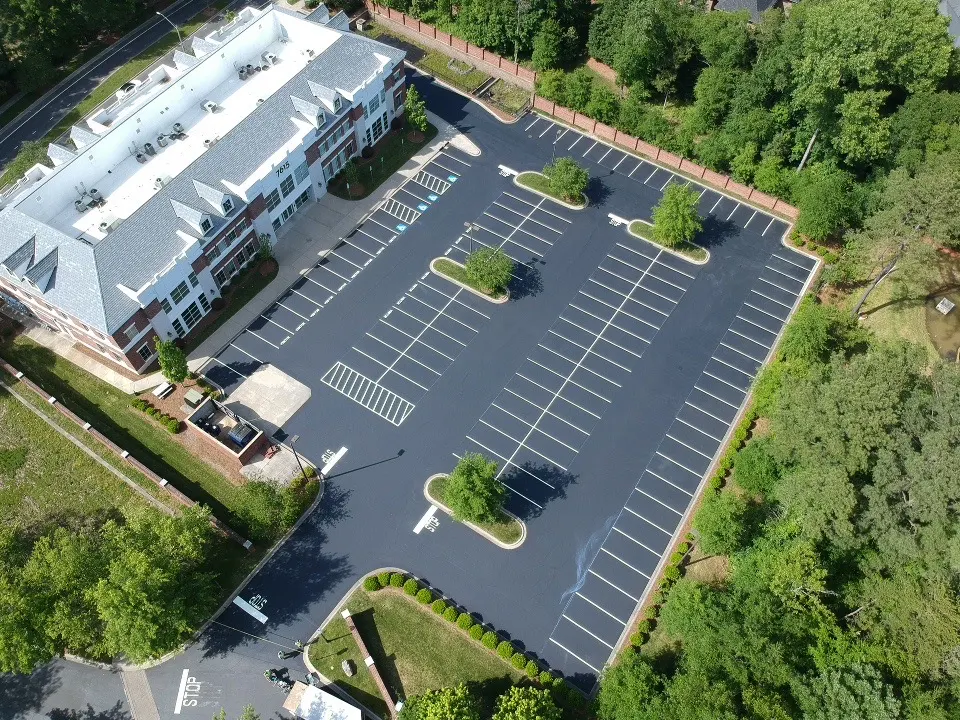
An empty commercial lot can remain closed for a full week without much objection. However, a 200-unit apartment complex in Charlotte or a housing association in Mount Pleasant cannot, since residents still need a place to park each night. ProLine carries out the repair and striping work in sections, generally completing repairs and striping in no more than 25 to 30 percent of the parking spaces on the site at any one time, so there is always some open and striped parking available on the property.
When property managers and HOA boards are drawing up a budget for a phased rehabilitation project, they should incorporate the repair-then-stripe sequence into their reserve planning rather than treating the two as separate budget entries, as the Community Associations Institute advises for any major common-area capital project. Before work begins, we provide a written phase map that clearly indicates which day each stall will close, enabling the board to inform residents with specific dates rather than a general closure period.
How Carolina Weather Affects the Repair-to-Striping Timeline
- The higher the humidity, the longer the curing time takes. Both sealcoat and paint cure by evaporation, and the humidity typical in the Lowcountry and coastal areas near Myrtle Beach and Charleston can extend a curing period that would otherwise be 24 hours to about 48 hours.
- Because of hurricane season, work that has just been cured carries a risk. The National Hurricane Center considers June 1st to November 30th the hurricane season, and heavy rain during that time can damage a patch or sealcoat that hasn’t fully bonded, requiring a redo.
- Cold weather does more than restrict asphalt curing time; it also limits asphalt availability. Generally, most of the hot-mix asphalt plants in Carolina reduce or stop production when the temperature falls low enough to prevent proper compaction, which is why major resurfacing projects are almost every year scheduled for spring or summer.
Instead of using a single calendar that applies statewide, ProLine keeps repair-and-stripe windows separate by region because in the Piedmont area and along the coast, the windows for repair and striping seldom fall in the same week.
How ProLine Coordinates Each Repair Type With Striping
Pothole Patching
- We need to decide if the pothole requires a full-depth patch involving the removal and rebuilding of the base or a patch that only addresses the surface, since the two types have different recovery times.
- To keep patched sections closed to traffic for at least 24 to 48 hours, we use cones or barricades to mark them off instead of relying on residents to notice the new asphalt.
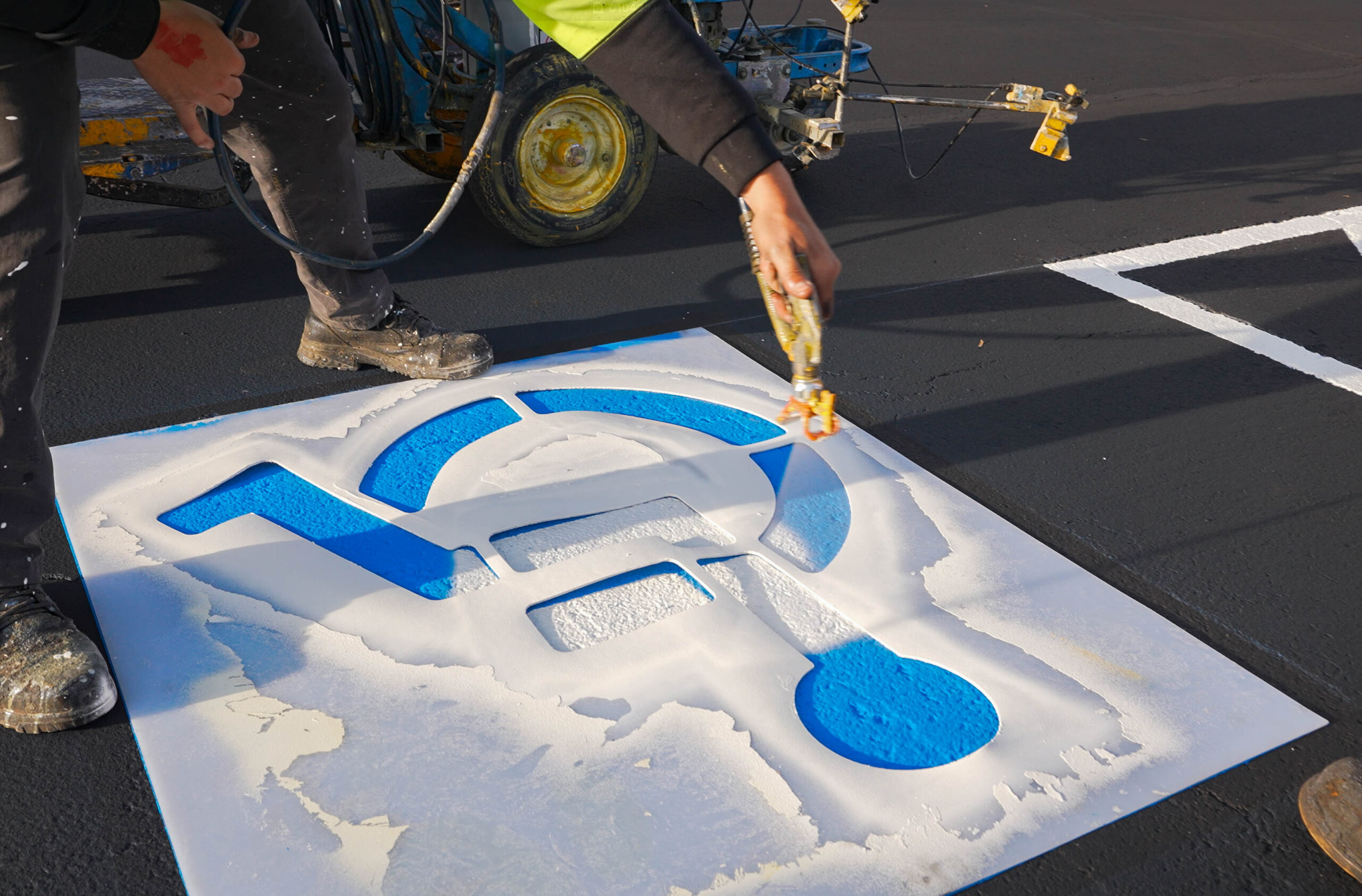
- We don’t stripe until the patch has fully compacted and cooled, and we run a simple adhesion test to confirm this before applying any paint.
- We match the new stall lines to the existing layout so a single-stall patch never accidentally becomes a restripe covering the entire area.
Crack Sealing
- We examine each crack across the area and choose a treatment based on its width and movement, then apply the right sealant before we stripe the section.
- We carry out sealing within the temperature and humidity range specified by the manufacturer, since Carolina’s variable spring weather can quickly push conditions outside the ideal range.
- We allow the sealant to cure completely, typically taking a few hours to overnight depending on the product, before applying any paint to the treated crack.
- We only stripe over sealed cracks once they are level with the surrounding pavement, so the new line does not indicate a raised or sunken seam.
Sealcoating
- We confirm the base asphalt has no unresolved structural problems before applying sealcoat, since sealcoat masks such problems visually without addressing them.
- We carry out sealcoating under conditions that meet the manufacturer’s specifications for temperature and humidity, and we adjust our schedule to match the property’s coastal or Piedmont location.
- We allow 24 to 48 hours for the sealcoat to cure, extending this time in high humidity, before starting any layout work.
- Before we strip, we perform a tape-pull adhesion test on the cured sealcoat to confirm the surface is ready, rather than relying on the calendar date.
Mill and Overlay / Full Repave
- We stay in close contact with the paving contractor’s schedule since ProLine’s striping timeline depends entirely on when the new asphalt is laid and how it cures.
- We wait at least 3 to 5 days after paving and, if the homeowner’s schedule permits, recommend up to 30 days so the surface oils have time to rise and stabilize.
- Before stripping a newly paved surface, we re-survey the area, since a full repave is the best opportunity to fix layout issues, add missing spaces, or adjust guest and reserved zones.
- Each time we carry out a full repave, we treat it as a layout reset, not merely a repaint, so the property ends up with a design suited to how it’s used today.
A Realistic Timeline for a Full Carolina Parking Lot Rehab
| Day | What Happens |
| Day 1 | Structural repair: pothole patching, base repair, crack sealing |
| Day 2-3 | Repair cure period; no vehicle or foot traffic on treated areas |
| Day 4 | Sealcoat application across the full lot |
| Day 5-6 | Sealcoat cure period, longer in humid Lowcountry conditions |
| Day 7 | Layout and striping begins once the surface passes an adhesion check |
For any properties that require the entire area to be fully open for a particular event or move-in date, the date should be provided to ProLine before the project begins rather than after the repairs have already been carried out, since reducing the cure times above is the quickest way to have to repaint the same lines twice.
Get a Repair-to-Striping Schedule Built Around Your Property
Coordinating asphalt repair with striping is not only a paving issue but also a scheduling one, and the wrong schedule means a Carolina property wastes real money by repeating the work. ProLine Parking Lot Maintenance prepares one repair-to-striping schedule for housing associations and apartment complexes in North Carolina and South Carolina, taking into account the particular cure times, weather windows, and occupancy restrictions that each property actually has to deal with.
Tired of Managing Separate Contractors for Asphalt Repairs and Striping?
Applying new layout paint over freshly sealcoated or patched asphalt without proper curing windows leads to premature paint peeling, discoloration, and double parking lot closures. Synchronizing asphalt patching, crack sealing, and line striping under a single coordinated schedule prevents site downtime and guarantees optimal paint adhesion. ProLine Parking Lot Maintenance seamlessly integrates surface preparation, asphalt repair timing, and precision re-striping into a streamlined project plan. Contact our project coordinators today to streamline your pavement maintenance.
Frequently Asked Questions
Does any requirement arising from resurfacing or major asphalt repair mean that new ADA compliance rules for the parking layout are needed?
Things like striping alone, crack sealing, or applying a standard sealcoat usually do not require a property to bring its accessible parking up to current standards. However, a mill and overlay or a full repave is generally considered an “alteration” under Title III regulations, and the ADA National Network states that an alteration means a property must bring the relevant area into compliance with present accessible design requirements as much as is feasible. This could involve adding accessible spaces to a site that never had them, fixing access aisles that are too narrow, or moving a van-accessible space that is too far from the building entrance, even if the original arrangement was legal when the property was constructed. Property managers carrying out a full repave should treat the ADA review as an integral part of the paving project rather than something dealt with afterward, and the technical assistance materials from ADA.gov can serve as a good starting point for determining what applies to a particular project.
What is the cost if the asphalt repair and striping are coordinated as a single bundled project rather than being contracted separately?
Putting repair and striping together in a single schedule is usually cheaper than employing two contractors on separate occasions, primarily since the property does not have to pay for a second mobilization, set up a second traffic control arrangement, and, most important of all, carry out a second coat of paint when the delay in the repair work damages the first coat. The National Asphalt Pavement Association considers proper pavement preservation, carried out in the correct sequence, one of the most dependable methods of reducing a property’s total cost per square foot over the life of the property compared with reactive, piecemeal repairs. A single, coordinated contractor has a direct motivation to get the cure timeline correct, as the same team is responsible for both the repair holding up and the paint lasting on top of it. When properties compare bids, they should ask whether the bid covers the full repair-to-striping sequence or only part of it, since a particularly low striping quote often assumes the surface is already fully repaired and cured.
Can Carolina Winter be used for crack sealing or patching, or do you need to wait until spring?
You don’t have to put off crack repair and patching until spring, but the materials and techniques do change as temperatures drop. During the winter months, cold-mix asphalt can be used as a temporary fix to keep a pothole from getting worse until the weather warms up and allows a permanent repair with hot-mix asphalt, a practice the National Center for Pavement Preservation records as widely followed in cold-weather areas. Since hot rubberized crack sealant also has a minimum temperature at which it can be applied—usually between 40 and 50°F, depending on the product—a sudden drop in temperature in places such as the Piedmont or the Blue Ridge foothills can delay a planned crack-sealing job by a few days even though it is late fall according to the calendar. It is more important to wait for the correct temperature rather than for a particular season, which is why ProLine monitors both pavement and air temperature directly rather than relying on a set monthly schedule.
What problems might arise with the warranty if the area has been stripped before the asphalt repairs have cured?
Most paving and sealcoating contracts include a minimum cure or traffic-closure period in their warranty conditions, and carrying out striping or driving on treated pavement before this period ends will cancel the warranty on the original repair. This leaves a property in a difficult situation if the patch or sealcoat eventually fails, since the paving contractor can cite early traffic—such as from striping crews and their vehicles—as the reason the warranty no longer applies. If a different striping contractor is working according to their own schedule, there is no means by which they can find out the paving contractor’s exact warranty terms unless those terms are given to them directly, and this kind of gap frequently occurs when a property hires the two contractors separately. The National Asphalt Pavement Association advises that manufacturer and contractor cure requirements should be confirmed in writing before any subsequent work starts, and ProLine asks for this documentation to be obtained directly from the property’s paving contractor before arranging striping on any recent repair.
Does a stormwater or impervious surface permit need to be obtained when repairing or repaving a private parking lot in Carolina?
Routine repair and resurfacing within a property’s existing footprint usually does not require a new stormwater permit, as it doesn’t increase impervious surface or alter how the property drains. However, this is no longer the case if the project involves expanding the paved area, changing the grading, or disturbing a significant amount of soil to bring about a federal or state review, and since the EPA’s NPDES Construction General Permit covers sites that disturb one acre or more of soil—a threshold that could be reached by a complete reconstruction of the entire lot on a larger apartment or HOA property—such a review is necessary. In North Carolina, the NC Department of Environmental Quality carries out such reviews. In contrast, in South Carolina, properties deal with the SC Department of Environmental Services, the agency that took over the state’s environmental permitting responsibilities during its 2024 reorganization. Property managers planning any work beyond a simple like-for-like repair should check with the local building or planning department about permit status before starting, as failing to complete a stormwater review can delay the project by weeks.
For a property in Carolina, how long should one wait after a hurricane or a severe storm before arranging asphalt repair and striping?
A property should not begin any patching until the standing water has completely disappeared and the ground underneath the pavement has had the opportunity to drain; the time required typically being between 24 and 72 hours after the rain has stopped, depending on how saturated the ground was, as patching over a saturated base almost always fails soon because the moisture trapped below the new patch stops the area from being properly compacted and bonded. FEMA’s Ready.gov advises that a full inspection of the property should be carried out after any hurricane or major storm before normal maintenance work is resumed. This inspection should specifically look for any washout near drains, any undermined pavement edges, and any new cracking the storm may have caused before a contractor carries out any patching. ProLine inspects storm-affected properties before quoting repair work for this reason, since a patch done too soon after a storm often has to be redone the same season.
What is the difference between crack sealing and crack filling, and does this affect the striping timeline?
Crack sealing uses a hot, rubbery material intended to flex with the pavement, and it is most effective on wider cracks that are actively moving, as these would otherwise reopen due to the temperature changes that occur during the summer and winter in Carolina. Crack filling, on the other hand, makes use of a less costly and more rigid material that is appropriate for stable, very narrow cracks that are not widening. Although it usually costs less per linear foot, it does not cope as well with movement over time. The Foundation for Pavement Preservation regards the choice between the two methods as a decision based on diagnosing the crack’s width and level of activity rather than merely making it based on budget considerations, since using a filler on a crack that is moving generally means that the work will have to be redone within a year or two. Timeline differences matter in striping because rubberized sealant requires a longer skin-over period before it can support paint. At the same time, the rigid filler hardens more quickly, which is another reason why ProLine evaluates the type of crack before deciding on a repair-to-striping schedule.
If parking lot striping is faded, does that always mean the lot needs new paint, or could it signal a deeper asphalt problem?
Fading alone, where the paint has simply lightened evenly from UV exposure but the surface underneath looks solid, usually does mean a straightforward repaint will fix the problem. Fading combined with other signs, such as hairline cracking radiating from the stall lines, a rough or raveling texture, or dark, oil-stained patches showing through the paint, often points to a surface or base issue that a fresh coat of paint will only cover up temporarily. The Federal Highway Administration’s pavement preservation program treats visible pavement distress as an early warning sign that maintenance timing matters, since addressing a small surface problem early costs far less than waiting until it becomes a structural repair. ProLine inspects the pavement condition around every faded line before quoting a restripe, since a property that only pays for paint on a lot that actually needed patching first usually ends up paying for both anyway, just in the wrong order.
See also: Planning a Line Striping Project for a Busy Apartment Community, How to Coordinate Parking Lot Striping With Asphalt Repair Projects at Apartment Properties