
The National Highway Traffic Safety Administration’s compilation of nationwide crash data has on numerous occasions revealed that about half of all traffic deaths take place after dark, even though only around a quarter of all driving occurs at night; rain increases this gap because wet pavement scatters headlight beams in a different way from dry pavement, so a road marking that is still visible clearly on a dry night can almost vanish as soon as it starts to rain.
For property managers in the Carolinas—a region where, according to climate data monitored by the National Centers for Environmental Information of the NOAA, most of both North and South Carolina receives about 45 to 55 inches of rain each year and which also experiences heavy, continuous rainfall during hurricane season from June through November—the difference between “looking all right on a sunny afternoon” and “failing when it’s raining at 9 p.m.” is no small matter. It is precisely the point that most people overlook when doing a simple visual inspection of the property from the position of someone at eye level, since very few people walk around the parking lot while it’s raining to check it.
The guide explains the various ways in which pavement markings fail, focusing on the stages that most people never take the time to notice, and provides a particular method that doesn’t require any special equipment for detecting a marking before it goes from faded to actually unsafe.
In a nutshell, pavement markings fail in three stages, not just one—there’s the fading of their color during the day, a loss of reflectivity at night when the surface is dry, and then a failure of reflectivity when it’s wet at night—and the final stage is generally the most hazardous and goes unnoticed. You should check the markings at night, preferably on a wet or recently hosed-down surface, from a driver’s normal eye level and at the typical speed with which a car approaches, and if any marking disappears when viewed under headlights, it must be repaired immediately, no matter how good it appears in daylight.
The Three Stages of Pavement Marking Failure
What most people consider to be a single issue—a faded marking—actually fails in three clear and successive stages, and each of these stages is not visible when examined in a particular way.
| Stage | What It Looks Like | What’s Actually Happening | Who Usually Notices |
| 1. Daytime color fade | Paint looks pale, chalky, or dulled, but the line shape is still clearly visible | UV breaks down the pigment binder, mostly cosmetic at this point | Almost anyone walking the lot in daylight |
| 2. Dry-night reflectivity loss | Looks acceptable in daylight, but headlights don’t bounce back much light on a clear, dry night | Embedded glass beads have worn away or gotten buried under a film of dirt and asphalt oils | Almost no one, unless they specifically drive the lot at night |
| 3. Wet-night reflectivity failure | Marking may still pass a dry-night check but nearly disappears the moment the surface is wet | A thin water film covers what reflective structure remains, scattering light instead of returning it to the driver | Almost no one, since most complaints and walk-throughs happen in dry conditions |
When a marking has reached Stage 3, it has generally already been failing at Stage 2 for months because the marking had never been tested under the one condition—a dark and wet night—which is the only one that shows the problem.
Why the Sunny-Afternoon Windshield Check Misses Almost Everything
The decrease in daytime color occurs slowly over a period of months, which means that a property manager’s eyes become accustomed to the change just as the paint does, and a spot that has actually faded by 40 percent may still be described as “a little worn but otherwise fine” when the property is routinely inspected on a Tuesday morning. In contrast, reflectivity cannot at all be assessed by daylight; a mark may appear reasonably sound in full sun even though it has already failed the nighttime visibility test, which is the one that really matters to a driver approaching it with their headlights.
The fact that these two tests differ accounts for a typical area of disagreement between property managers and paving crews: when a contractor marks something as needing urgent repainting, the property manager, having always seen it during the day, cannot understand the reason. The marking is not failing the test that the property manager is carrying out; it is failing a completely different test, one that only becomes apparent in the dark.
A No-Equipment Field Test Anyone Can Run
There’s no need to assume that professional retroreflectivity testing is the only means of finding out whether a marking is still effective; a five-step method achieves the same practical result by using nothing more than a car and a garden hose.
- Choose a truly dark night and don’t carry out the test near streetlights or the floodlights of buildings since these would artificially lighten or exaggerate the appearance of the marking.
- Stick to using the low-beam headlights when driving along the route since high beams give a false impression of improved visibility relative to the way most people living there and visitors actually drive through the area.
- Inspect each marking from a realistic distance, about 100 to 150 feet away, since that is how far ahead a driver actually has to see a stop bar or a lane line in order to react in time.
- Take the same route on a wet surface; if a rainy night is available, use it, otherwise hose down a section that you’re testing beforehand, since it is most important that the failure mode on a wet night should be checked and almost no one does.
- For both the dry-night and wet-night passes, record them as either a pass or a fail and indicate which specific markings did not work; a faded stop bar or an invisible ADA symbol is more urgent than a faded numbered parking space.
Reading Wear Patterns as Diagnostic Information
The same issue doesn’t always cause worn markings, and the wear shows the property manager what’s happening beneath the paint.
- Damage to the wheel path alone—specifically when the middle of the line wears thin from tire traffic, but the sides remain sharp—indicates normal traffic erosion, which can be fixed with a simple repaint.
- If the edge is lifting or there are cracks at the marking, it indicates the asphalt or underlying substrate has failed. Repainting alone won’t work on a cracked or crumbling surface, and the area must be crack-sealed or patched before applying new paint.
- The entire marked area showing uniform chalking without any wheel-path pattern is a sign of UV weathering, not traffic wear, this being most typical in the south-facing rows and unshaded areas that receive the most direct Carolina sun.
- The phenomenon known as ‘ghosting,’ in which an earlier marking is still visible through a newer one, generally indicates that the grind-out was not properly carried out during a previous restriping or resurfacing operation. It is a known visibility hazard because drivers may be drawn to the wrong line, and the problem can worsen at night.
Which Markings Deserve a Faster Response When Worn
Not all worn markings are equally dangerous, so a tight maintenance budget should follow this hierarchy rather than treat all faded lines the same way.
| Marking Type | Why a Worn Version Is Higher Risk | Recommended Check Frequency |
| Stop bars and directional arrows at internal intersections | Worn stop bars at blind internal corners are a common cause of low-speed T-bone collisions in large lots | Every 6 months, more often at blind corners |
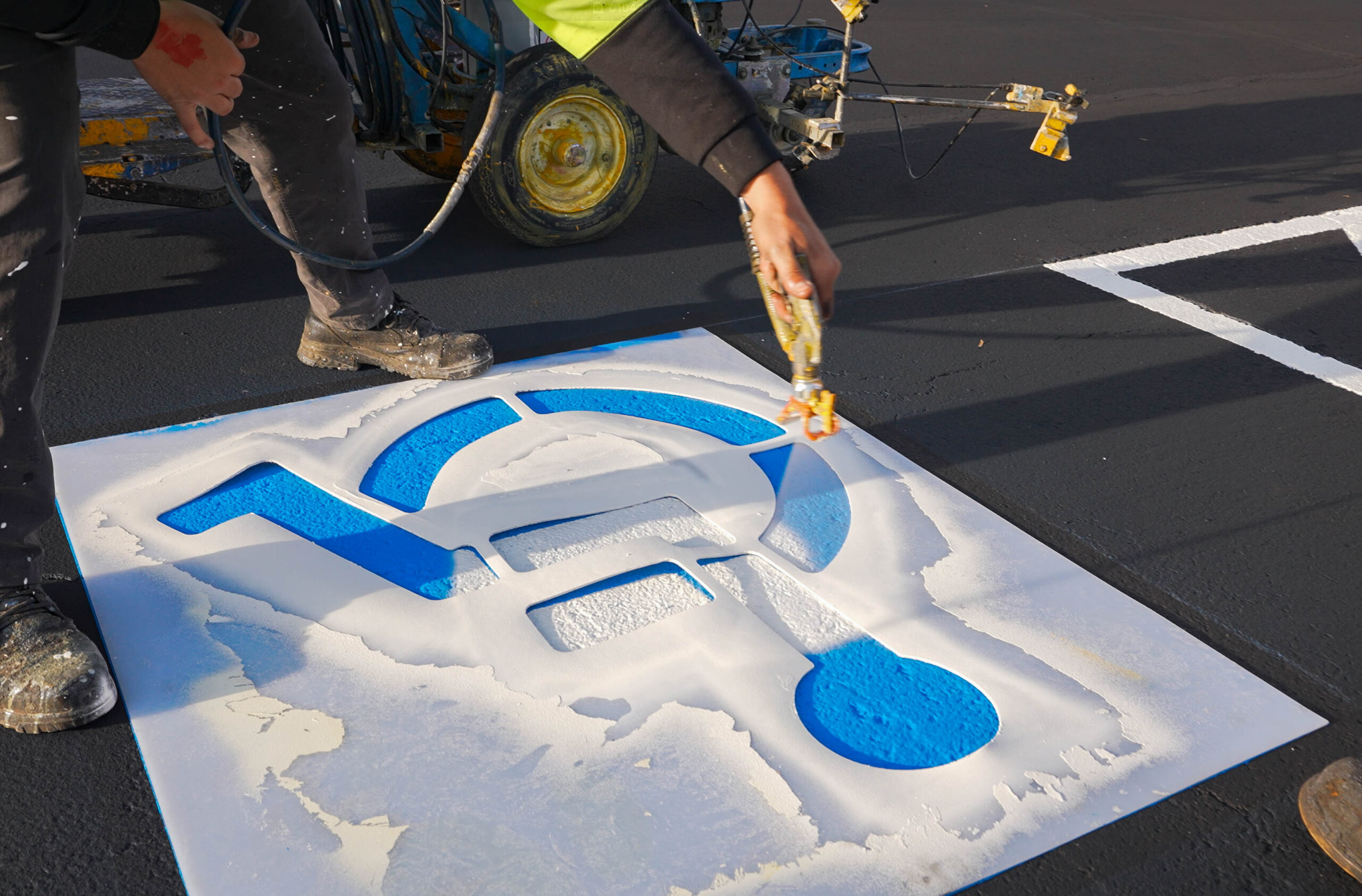
| ADA accessible space symbols and access aisles | The painted symbol takes direct tire wear; the vertical sign never does, so it often fails first even when the sign still looks compliant | Every 6 months |
| Fire lane edge striping | A worn or invisible fire lane line increases the odds that a blocked lane goes unnoticed until an actual emergency | Every 6 to 12 months |
| Speed bump or hump warning stripes | A worn warning stripe removes a driver’s only advance visual cue, raising injury risk from an unexpected impact | Every 6 months |
| Standard space numbering lines | Mostly a wayfinding and curb-appeal issue once past Stage 1 | Annually |
Carolina Climate Factors That Speed Up Marking Failure
A mark that remains satisfactory for many years when the conditions are cooler and drier will not necessarily behave in the same way under these conditions.
- In both states, the intensity of ultraviolet radiation, together with the long daylight hours of summer, causes standard paint to reach Stage 1 chalking much more quickly than it would in a northern climate.
- Because the Piedmont and coastal Carolina areas experience many thunderstorms in spring and summer, a marking that has already failed Stage 3 is often put through its paces by rainfall rather than remaining undetected throughout the season, as it might in a drier area.
- After a major storm, a fourth type of failure specific to storms occurs when the debris and standing water from hurricane season end up burying a previously undamaged marking beneath silt and sand, which is why a walk-through following such a storm should be included on the calendar for coastal communities stretching from Wilmington down to Myrtle Beach and Charleston.
Building a Marking-Level Inspection Log
The statement “the lot looks fine” is not valid documentation and fails to detect any Stage 2 or Stage 3 failures; instead, a useful log should record each marking separately.
- Marking type and location (for example, “Stop bar, Building 300 exit”)
- Date of inspection
- Dry-night pass or fail
- Wet-night pass or fail (or “not yet tested” if no rain or hose test has occurred)
- Photo, taken at night if possible
This record has two advantages over a simple daytime visual inspection: it shows a trend over time. It gives the property manager a factual basis for deciding which markings to prioritize in the budget.
The Bottom Line
Worn parking lot markings usually don’t give signs the way a pothole does; instead, they fail slowly, in stages, and the most hazardous stage is also the one very few people check. You should carry out the wet-night test on the most important markings twice each year, interpret the wear patterns as an indication of what is going on beneath the paint and not just as a cosmetic problem, and keep a log at the level of each marking so that budget decisions are based on recorded conditions rather than just a quick look during the day. The staff at ProLine Parking Lot Maintenance care for facilities and commercial properties in both North and South CA to identify this exact flaw before it results in an incident.
Are Faded Markings Creating Liability Risks on Your Property?
Deteriorating fire lane designations, illegible pedestrian crosswalks, and non-compliant ADA stalls leave property owners vulnerable to traffic accidents and steep code violations. Don’t wait for an incident to address faded paint—ProLine Parking Lot Maintenance delivers high-durability, premium traffic paint restriping to restore full compliance and keep your lot safe. Contact our safety technicians today to schedule a property assessment.
Frequently Asked Questions
What level of retroreflectivity do pavement markings have to reach in order to be regarded as safe at night?
Traffic engineers usually refer to a retroreflectivity target of about 100 millicandelas per square meter per lux for white pavement markings and to a slightly lower value, frequently given as being between 50 and 100 mcd/lux/m², for yellow markings, in both cases measured at a standard 30-meter viewing angle, which approximates a driver’s real line of sight. This standard stems from research carried out over the years by the Federal Highway Administration, even though private parking lots are outside the FHWA’s direct area of responsibility and are not subject to a mandatory federal minimum in the same way as public roads are. A marking that registers below this range when tested with a handheld retroreflectometer has, in effect, ceased to function as a nighttime safety device, even if it still appears reasonably sound to the eye during a daytime inspection, and in insurance cases or when experts are giving evidence in a liability suit insurers often refer to this same industry benchmark when assessing whether a property owner has maintained reasonable conditions.
What is the cost of having a professional retroreflectivity test carried out, and is it worthwhile for a private car park?
A handheld retroreflectivity survey carried out by a paving or traffic engineering company that provides such services usually costs a few hundred to about a thousand dollars for a development of the size typical of a multi-family community, the exact figure depending on the total length of the strips and on the number of different types of marking that are measured. In two particular cases, the expense is justified for most private communities: when it is necessary to record the condition of the markings following a liability incident or when it must be verified that a new restriping job has met the reflectivity specification the contractor quoted before the final payment is made. In all other cases, the same practical issue—markings that no longer reflect light to a driver—is caught by the no-equipment wet-night test described earlier in this article, at the cost of the property manager’s time rather than paying for a service.
How long do parking lot markings generally last before they fail in the Carolina climate?
In the high-UV, high-rainfall environment of the Carolina region, standard water-based traffic paint usually exhibits the first noticeable Stage 1 color fade within six to nine months. On heavily used drive lanes, it may fall below the safe dry-night reflectivity level within twelve to eighteen months—faster than the about two-year lifespan many property managers expect in cooler, drier climates. Thermoplastic markings typically maintain both color and reflectivity for three to five years under the same conditions, and in lower-traffic areas reflective tape can further extend the life of the markings. However, the tape generally performs worse than thermoplastic under heavy vehicle turning at entrances and intersections. Coastal areas, affected by salt air and frequent storms, generally reach the faster end of these timeframes. In contrast, inland Piedmont communities, which experience less direct storm impact but still strong summer UV exposure, tend to fall somewhere in the middle.
Would the extra cost involved in using wet-reflective pavement markings be justified for a private car park?
Wet-reflective markings achieve this by using larger glass beads that are embedded at a different depth or by employing a type of reflective tape that has been specially designed so that it continues to reflect light to the driver even when there is a thin layer of rainwater on it—thus directly tackling the Stage 3 failure point mentioned in this article. Although they cost 20 to 40 percent more than ordinary reflective markings when first installed, this extra cost is most justifiable for properties that have steep approach slopes, a high volume of night-time traffic, blind internal intersections, or are in a coastal area, since in such locations the wet-night failure point is tested much more frequently than it would be at an inland site with drier conditions. In smaller communities with low traffic and good ambient lighting across the area, standard reflective markings are usually sufficient, provided they are properly repainted on a regular schedule. It is only necessary to carry out the wet-reflective upgrade at the most vulnerable locations, for example, at the main entrance drive and at the internal stop bars, rather than paying the premium for the whole site.
Would worn parking lot markings increase liability if an accident takes place in the lot?
Certainly, when a plaintiff’s lawyer handles a premises liability claim after a vehicle collision or a pedestrian injury in a parking area, they will usually ask for maintenance records. A documented record of worn or unrepaired markings—especially at a stop bar, a crosswalk, or an ADA-accessible space—can show that the property did not maintain a reasonably safe condition. Insurance companies consider this same history when assessing a claim, and a claim related to a spot with prior complaints about markings on file is likely to face closer scrutiny during an investigation than one with a clean maintenance record. By keeping the marking-level inspection log mentioned in this article—including the date, the specific marking, and whether it passed the dry-night and wet-night tests—the property manager creates documentation that is much more credible than a general statement made afterward, such as “we maintain the lot regularly.”
Who is it that inspects and looks after the pavement markings in a multi-family community—the HOA, the property management company, or the paving contractor?
Depending on the way the property is owned, either the owner or the HOA is usually legally responsible for keeping the conditions on the property safe, including the pavement markings, even if a management company or paving contractor is in fact carrying out the day-to-day job of inspecting. And though most management agreements give the property management company the responsibility for arranging inspections and identifying problems, the wording of such contract clauses differs so greatly from one community to another that it is advisable to check this point explicitly rather than take it for granted, a situation which the Institute of Real Estate Management has pointed out as a frequent cause of disputes when properties are being transferred or following an incident. A paving contractor such as ProLine will carry out the inspection and repair work under contract but will not have any continuing legal responsibility for a marking that fails between scheduled visits unless the contract specifically states so, which is why it is important to confirm any clear, written assignment of responsibility when starting a maintenance relationship.
See also: 7 Signs Your Apartment Community Needs New Line Striping, The True Cost of Ignoring Apartment Parking Lot Cracks and Potholes