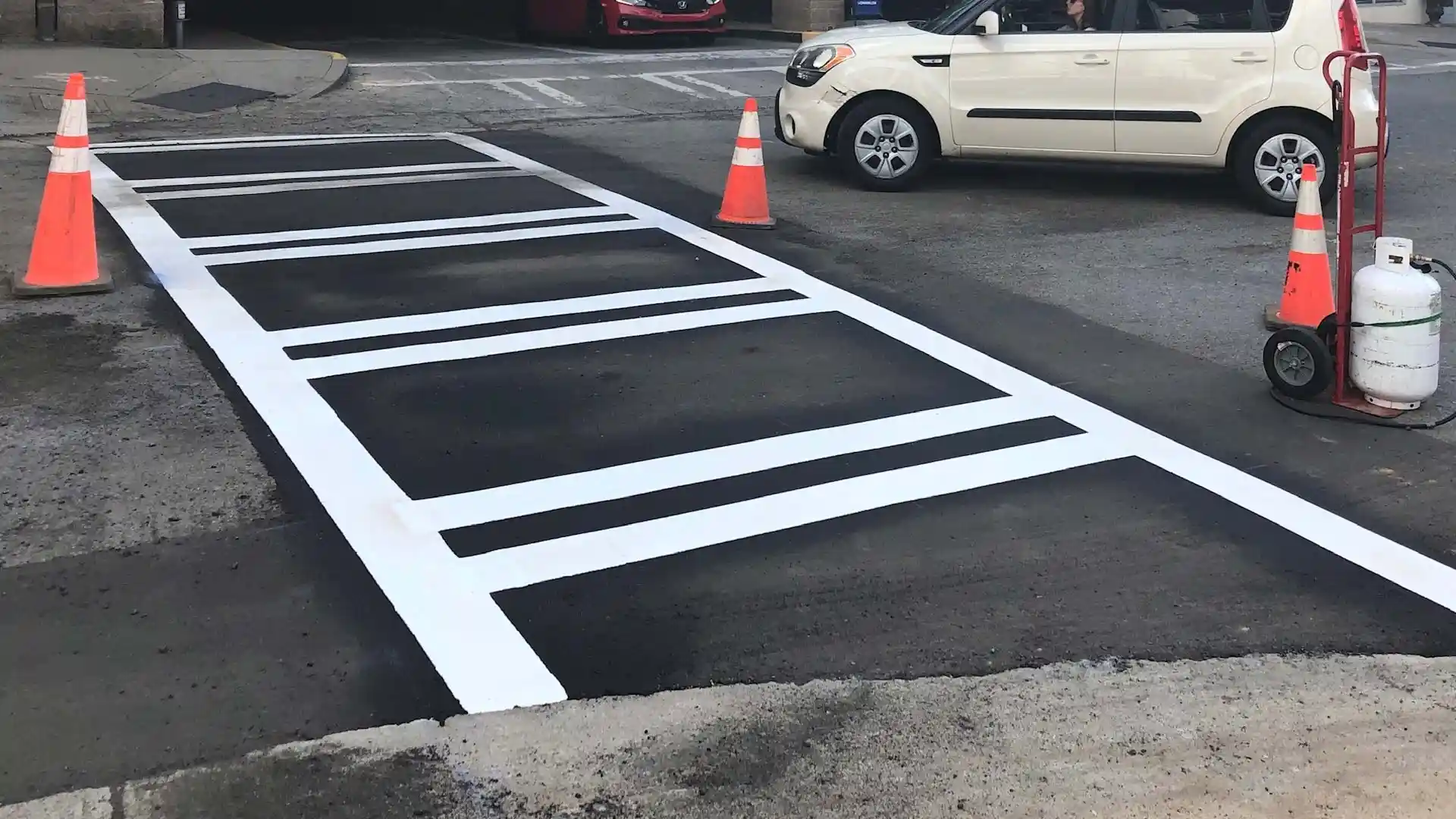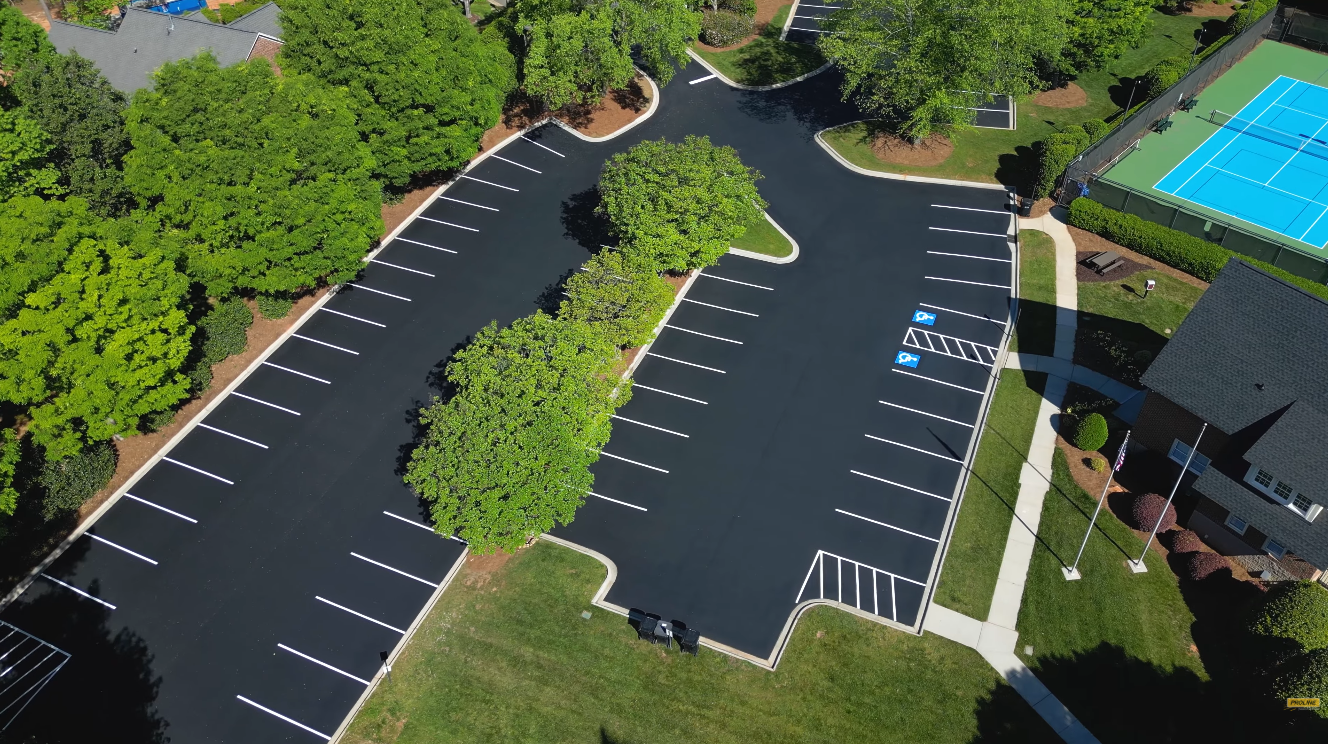

The Manual on Uniform Traffic Control Devices has set the national standard for pavement markings since the 1930s, and according to the National Safety Council, parking lots and garages remain one of the more common settings for minor vehicle collisions in the country, many of them tied to unclear or unreadable lane and stall markings rather than reckless driving. For a busy apartment community, faded striping isn’t just an appearance problem; it’s the kind of small, overlooked issue that quietly raises the odds of a fender-bender in the same aisle every week. Here are seven concrete signs that your property’s striping has crossed from a little worn into time to fix:
Quick answers:
- If drivers can’t tell where one stall ends and the next begins from a normal driving speed, that’s a functional problem, not just a cosmetic one.
- Cars parking crooked or straddling two spaces are often a direct symptom of markings that are no longer clearly visible, not just careless parking.
- According to the U.S. Access Board, accessible stall markings that have faded past recognition create a real compliance gap, not just a maintenance one.
- Fire lane markings that no longer stand out are a safety issue with direct emergency access implications, which the National Fire Protection Association treats as a serious code matter.
- Rising resident complaints or near-misses in a specific area of the lot are often the clearest real-world sign that markings have failed, even before anyone thinks to check the paint itself.
Sign 1: Drivers Can’t Tell Where One Stall Ends and the Next Begins
This is the most basic functional test, and it’s easy to overlook because property staff walk the same lot every day and their eyes fill in gaps that a first-time visitor won’t. Stand at a normal driving speed’s distance, not standing directly over the line, and check whether the stall boundaries are actually legible. If you have to guess or look twice, so does every resident and guest pulling in after dark.
Sign 2: Cars Are Parking Crooked, or Straddling Two Spaces
Crooked parking isn’t always a driver being careless. It’s frequently a direct symptom of markings that have faded enough that drivers genuinely can’t judge where the space actually is, especially at night or in rain. If you’re noticing more cars parked at odd angles or eating into a neighboring space than you used to, that pattern shift is worth reading as a striping signal before assuming it’s simply a change in who’s living there.
Sign 3: Accessible Stall Markings Are Faded, Missing, or Hard to Identify
Blue accessible stall markings and the accessible symbol itself need to be clearly identifiable, not just technically present. According to the U.S. Access Board’s 2010 ADA Standards for Accessible Design, accessible parking requirements are federally defined, and a marking that’s faded past the point of easy recognition creates a real compliance gap, not merely a cosmetic one. This is one of the signs worth checking first, precisely because it carries consequences well beyond how the lot looks.
Sign 4: Fire Lane Markings No Longer Stand Out
Red curb paint and fire lane striping exist to keep emergency vehicle access clear at a glance, and according to the National Fire Protection Association, that access has to remain clear and identifiable at all times, not just when it’s convenient to check. A fire lane marking that’s faded to the point where a driver might reasonably not realize it’s a restricted area is a sign worth treating with urgency, not folding into a general restriping schedule down the road.
Sign 5: Directional Arrows and Traffic Flow Markings Have Worn Away
One-way arrows, “do not enter” markings, and directional guidance at tight corners or shared driveways exist specifically to prevent head-on confusion in spaces that weren’t designed with much margin for error. Once these wear away, drivers start guessing at traffic flow based on habit rather than what’s actually posted, which tends to work fine until a new resident, a guest, or a delivery driver unfamiliar with the property gets it wrong at exactly the wrong moment.
Sign 6: Old Lines Are Ghosting Through After a Patch, Sealcoat, or Prior Restripe
If a section of the lot was recently patched, sealcoated, or partially restriped, and you can still faintly make out the old markings underneath the new surface, that ghosting is a sign the area needs a proper restripe rather than being left as is. Two overlapping sets of markings, even faint ones, create exactly the kind of confusion a clear striping job is supposed to eliminate.
Sign 7: Resident Complaints or Near-Misses Are Increasing in Specific Areas
Sometimes the clearest sign isn’t visual at all. If a specific corner, aisle, or section of the lot keeps generating complaints, near-misses, or minor fender-benders, that pattern is worth checking against the striping in that exact spot before assuming it’s simply bad luck or careless drivers. A cluster of incidents in one location is often the real-world consequence of a visibility problem that hasn’t been connected to its actual cause yet.
Noticing two or three of these signs but not sure if it’s time for a full restripe or just a touch-up in one area? ProLine Parking Lot Maintenance can walk the property with you and tell you exactly what’s needed and where.
Restore Order and Safety to Your Parking Facility
Faded fire lanes, hard-to-see stall dividers, and illegible handicap markings aren’t just cosmetic issues—they lead to improper parking, blocked access corridors, and heightened liability for your community. Recognizing early signs like paint flaking, poor night visibility, and confusion at intersections is essential for resident safety.
ProLine Parking Lot Maintenance restores crisp, highly visible traffic markings that keep your apartment parking lot organized, compliant, and visually sharp.
- Full Compliance Audits: Expert alignment with current local codes, fire lane specifications, and ADA layout requirements.
- Fast-Drying Formulations: High-visibility paints applied efficiently to minimize parking disruption for your residents.
Frequently Asked Questions
Can I identify these signs myself, or do I need a professional inspection?
Most of these signs are things a property manager or on-site staff can reasonably spot during a normal walk-through, especially visibility issues, crooked parking patterns, and obvious ghosting. Compliance-critical markings, accessible stalls and fire lanes in particular, benefit from a professional’s eye as well, since the standard for “acceptable” is stricter than a general visibility check and carries real regulatory weight. A combination of your own regular observation and a periodic professional assessment tends to catch more than either approach alone.
Does new line striping require the pavement itself to be repaired first, or can it go directly on the existing surface?
It depends on the pavement’s condition underneath. Striping applied over cracked, crumbling, or actively deteriorating asphalt tends to fail faster and look inconsistent, since the surface it’s bonding to isn’t stable to begin with. If the pavement itself is sound and the paint is simply worn, new striping can typically go directly onto the existing surface without additional repair work first.
If only one or two of these signs apply, do I need to restripe the whole lot or just the affected area?
Not necessarily the whole lot. A localized issue, like a single high-traffic aisle or one section where ghosting is showing through, can often be addressed on its own without redoing striping that’s still in good condition elsewhere. The main exception is compliance-critical markings: if accessible stalls or fire lanes are affected anywhere on the property, those specific areas are worth prioritizing regardless of how isolated the issue seems.
Can poor lighting at night make striping seem worse than it actually is, or is that itself a sign something needs fixing?
Both things can be true at once, and it’s worth distinguishing between them. If striping looks fine in daylight but becomes genuinely hard to see at night, that could point to a lighting issue rather than a paint issue, though many marking materials also include reflective additives specifically to stay visible under headlights, and a lack of that reflectivity is itself a sign the paint has aged past its effective life. Checking the same section of lot in both daylight and after dark gives a more complete picture than relying on either alone.
Are worn wheel-stops or curb markings also a sign of the same underlying issue as faded striping?
Often, yes, since wheel stops, curb paint, and stall lines are frequently installed and worn down on similar timelines, particularly when they’re exposed to the same traffic and weather conditions. Worn curb markings near a fire lane or accessible route carry the same compliance weight as faded striping in those areas, so they’re worth including in the same inspection rather than treating them as a separate, lower-priority item.
Does new striping increase a property’s curb appeal enough to matter for leasing?
It can, and property managers often notice this as a secondary benefit even when the primary reason for restriping was safety or compliance. Crisp, clearly visible striping reads as a well-maintained property to a prospective resident touring the grounds in much the same way fresh sealcoating does, even though neither is the main reason either project gets scheduled. It’s a reasonable factor to mention when making the case for restriping to ownership, alongside the safety and compliance reasons that usually drive the decision.
Can I request a walk-through to confirm these signs before committing to a full restriping project?
Yes, and this is generally a reasonable first step before committing to a project scope or budget. A walk-through lets a contractor confirm which of these signs actually apply to your specific property, distinguish between areas needing a full restripe versus a touch-up, and flag anything compliance-related that deserves priority. This tends to produce a more accurate, better-targeted project than deciding on scope based on a general impression alone.
Is it possible that only the paint has failed while the pavement underneath is still in great shape?
Yes, and this is actually a common and reassuring scenario. Striping paint has its own, generally shorter, lifespan than the asphalt underneath it, which means a lot can have perfectly sound pavement while still showing every sign of needing a restripe. In this situation, the fix is genuinely just the striping itself, without any of the more involved pavement repair work that a failing base or structural cracking would require.
See also: How Often Should Multi-Family Parking Lots Be Restriped?, How Parking Lot Striping Improves Traffic Flow in Multi-Family Communities