
The International Fire Code, the code that both North Carolina and South Carolina use as the foundation for their state fire codes, mandates that the address numbers on a building must be at least four inches tall with a stroke width of no less than half an inch and should be placed in such a way that they remain clearly visible from the road or from the fire apparatus access lane in front of the property (ICC IFC 505.1). It is this one code requirement that shows why a faded, mismatched, or missing number system in a large apartment complex is not only a cosmetic issue but also makes the difference between firefighters locating Building 14 in under a minute and wasting valuable time going around the parking lot during an emergency.
The accessibility standards set by the U.S. Access Board include a second requirement that means shared parking areas must have accessible spaces allocated on a sliding scale according to the total number of spaces, with at least one in every six of the accessible spaces being designated as van-accessible. Regarding deliveries, the addressing rules established by the U.S. Postal Service asks that both unit and building numbers be such that carriers—and more and more drivers from UPS, FedEx, and Amazon—can match them to a resident’s actual mailbox without having to make guesses (USPS Publication 28).
If you combine those three requirements—emergency access, accessibility compliance, and delivery accuracy—then parking lot numbering ceases to seem like a mere paint job and starts to look more like an operating system that is used every day by multi-family communities all over the Carolinas, ranging from Charlotte and Raleigh to Charleston and Myrtle Beach. The guide deals with the layouts, specifications, and local considerations that enable that system to function.
As for the solution, arrange the parking lot numbering using three interlocking systems that have the same layout: one for emergency wayfinding meeting the minimum requirements of the fire code; signage indicating accessible parking spaces that complies with ADA standards; and address numbers that correspond to the ones on the mailboxes and in the delivery service records that the residents currently use. Attach the numbers to the buildings rather than to the entire parking lot; use thermoplastic material in coastal areas, since paint wears off most quickly due to the sun and salt air; and carry out an audit of the system once every 1 to 2 years.
Why Parking Lot Numbering Is a Life-Safety System, Not Just Curb Appeal
Property managers usually arrange numbering with one group in mind: the residents. A properly designed system, on the other hand, caters to three different audiences, each of which fails in a different way when the numbering system breaks down.
| Stakeholder | What They Need From the System | Consequence of Getting It Wrong |
| Fire and EMS responders | Building numbers visible from the access road, consistent sequencing across phases, marked fire lanes | Lost minutes searching for a unit during a medical or fire emergency |
| Postal and package carriers | Unit numbers that match the cluster mailbox slot, visibility from a moving vehicle | Misdelivered packages, mail routed to the wrong building |
| Residents, visitors, and mobility-impaired guests | Clear wayfinding, correctly marked accessible routes and spaces | Wrong-space parking disputes, ADA access barriers, guest confusion |
A numbering plan based on one of these groups generally ends up failing to meet the requirements of the other two. The best-designed layouts are conceived from the very beginning to include all three, and it is at this point that most general advice of the kind ‘just add some numbers’ proves inadequate.
Choosing a Numbering Layout: Three Approaches Compared
| Layout Type | How It Works | Best For | Main Drawback |
| Lot-wide sequential | Numbers run 1, 2, 3 across the entire property regardless of building | Small single-building properties (under 60 spaces) | Breaks down fast if a later phase or building gets added |
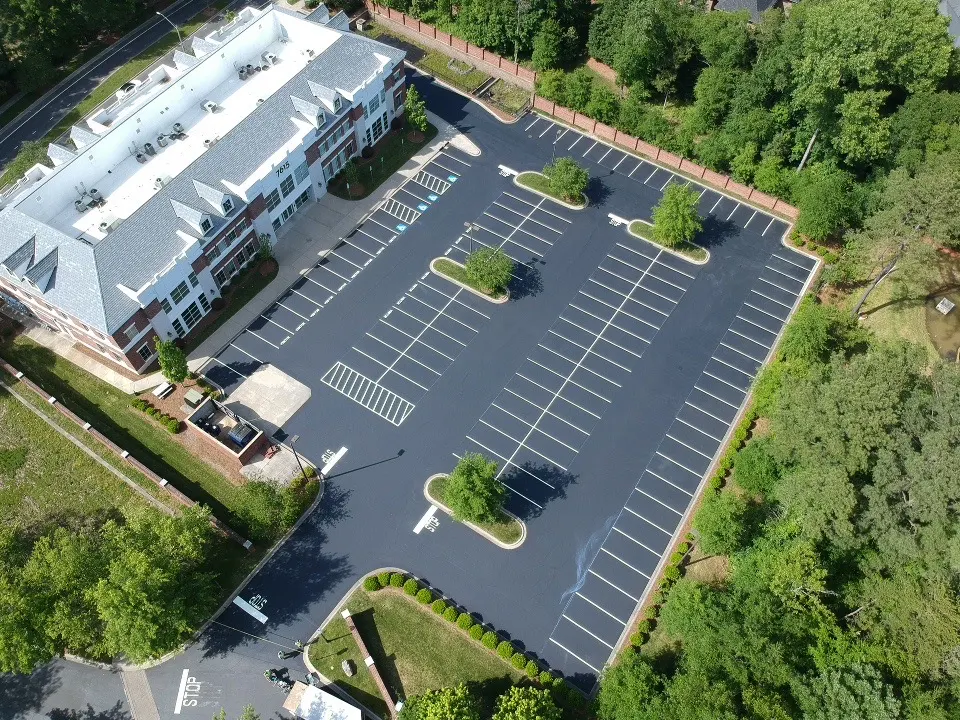
| Building-block | Each building owns a number range; for example Building 100 holds spaces 101-150, Building 200 holds 201-250 | Most mid-size to large multi-family communities | Requires reserving unused numbers in each block for future spaces |
| Zone or letter-prefix | Spaces get a letter tied to use, such as A1-A20 for visitor, R1-R80 for residents, and EV1-EV6 for charging | Mixed-use lots with visitor, reserved, ADA, and EV zones in the same area | Needs a posted legend or map so new residents and guests can decode it |
The numbering of the parking spaces links the parking space number directly to the building number, just as fire and EMS crews are trained to look for it, and this layout is the one that we recommend as the default when providing parking lot maintenance services at ProLine for any community that has more than one building.
Stenciling Specs That Meet Code and Actually Hold Up
It is less important to get the layout correct if the paint fades within a season, for three factors determine how long the stencil lasts and how visible it remains.
- In terms of cost, waterborne traffic paint has the lowest initial expense but generally requires recoating once every one or two years. Although thermoplastic is initially two to three times more expensive per area, it retains its color and shape for four to six years and is thus usually the more economical option over a five-year period on high-traffic lanes and on building numbers.
- The property known as reflectivity is achieved when glass beads are embedded in the paint or thermoplastic while it is still wet. This causes the headlights to reflect numbers clearly at night. Although the manual technically applies to public roads, the reflectivity standards set out in the Manual on Uniform Traffic Control Devices by the Federal Highway Administration are the ones that most commercial paving contractors use for private premises.
- The standard arrangement for a fire lane is red curb paint together with a “FIRE LANE, NO PARKING” stencil written in white or yellow block letters, although there can be variations in the exact wording and the spacing of the stencil from county to county, so it is necessary to check the details with the local fire marshal’s office before ordering the stencils.
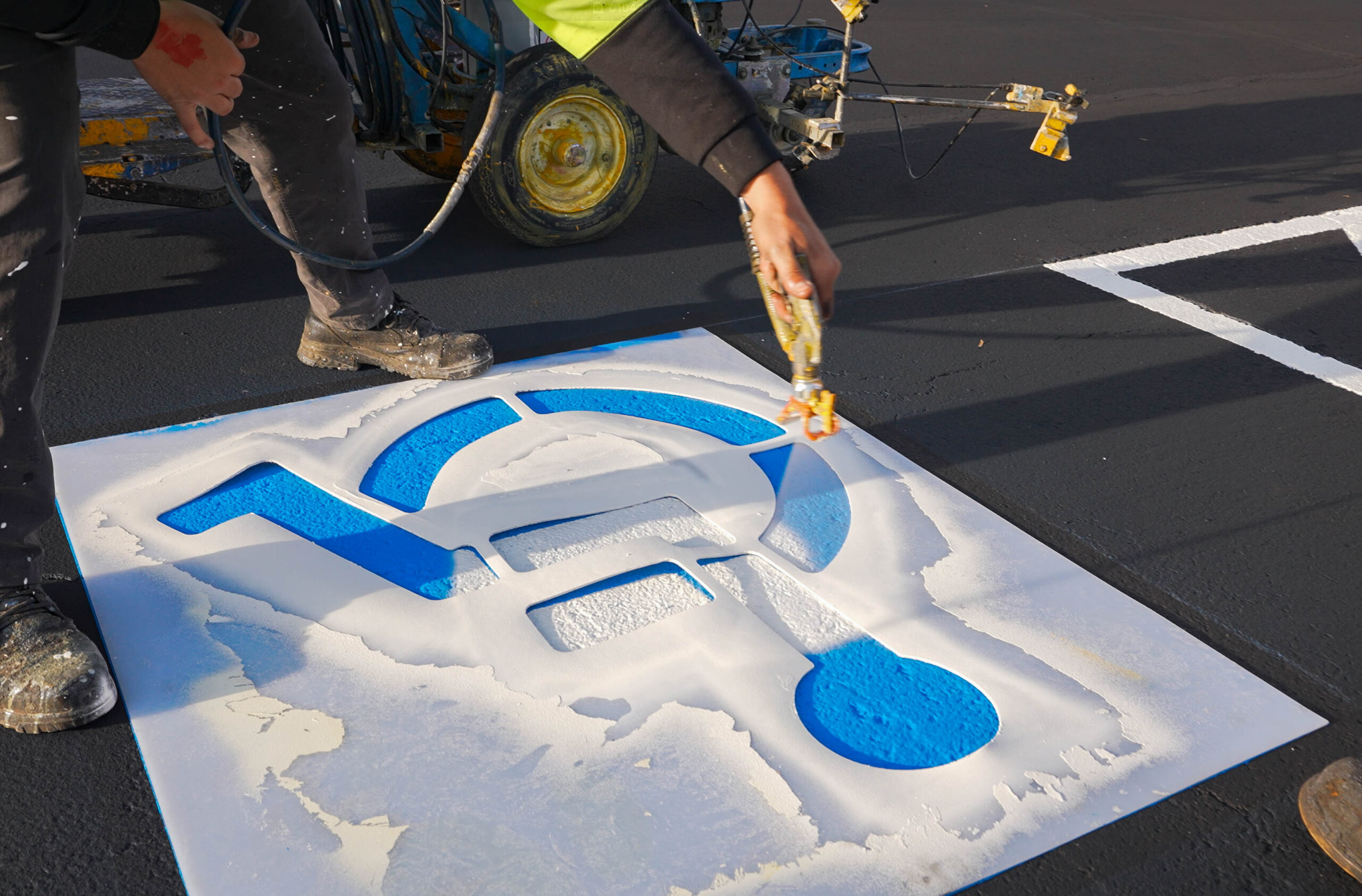
A common source of difficulty for many property managers relates to the fact that in order to be ADA accessible, a space must have both the International Symbol of Accessibility painted on the pavement and a vertical sign mounted beside it, not just one or the other. When the vertical sign is placed in a position where a pedestrian could stand in front of it, its bottom edge generally has to be at least 60 inches above the ground, since the symbol alone will be overlooked as soon as it is covered by snow, leaves, or a parked SUV.
Accessible Parking Ratios for Multi-Family Lots
There is no single rulebook that determines access to parking in an apartment community. The leasing office, the clubhouse, and the other amenities are generally open to the public and therefore come within the scope of ADA-type accessibility standards, whereas the parking associated with individual units in a “covered multifamily dwelling” (that is, most buildings with four or more units constructed for the first time after March 13, 1991) is covered by the design and construction requirements of the Fair Housing Act, which are enforced jointly by HUD and the Department of Justice. In practice, however, most state and local building codes apply the same ratio table to the entire parking area regardless of which federal law technically applies to a particular section, and this is the version that paving contractors use.
| Total Spaces in Lot | Minimum Accessible Spaces | Minimum Van-Accessible |
| 1-25 | 1 | 1 |
| 26-50 | 2 | 1 |
| 51-75 | 3 | 1 |
| 76-100 | 4 | 1 |
| 101-150 | 5 | 1 |
| 151-200 | 6 | 1 |
| 201-300 | 7 | 2 |
| 301-400 | 8 | 2 |
| 401-500 | 9 | 2 |
It is necessary to check the exact ratio with the local building department before finalizing a numbering plan, as some of the counties in Carolina apply amended ratios in addition to the standard base ratio.
The Mailbox Mismatch Problem Most Communities Never Catch
A problem that is seldom mentioned in standard parking area material is that the apartment unit number of a resident and the number of their cluster mailbox (CBU) slot usually do not agree. When developers assign unit numbers while building the property, the property management company later establishes the mail service using a different numbering system for the CBU bank, and as a result the two systems become mismatched over the years due to units being renumbered or mailbox agreements changing. This discrepancy is a major and mostly unseen reason for packages being delivered to the wrong address in multi-family communities.
- Cross-check that every CBU slot number matches the resident’s actual unit number, not the building number, at least once a year
- Make sure the CBU numbering is visible from a vehicle without a driver needing to exit and walk up to read it
- Coordinate any renumbering project with the local postmaster before repainting, since address changes affecting an established mail route generally require notification under USPS addressing standards
Carolina Climate Factors That Change the Maintenance Plan
A numbering and stenciling plan that works in a cooler and drier climate will not necessarily behave in the same way in the Carolinas.
- Every year, from June to November, the coastal areas ranging from Wilmington to Myrtle Beach and Charleston are included in the Atlantic hurricane season. The salt air and rain driven by wind speed up the deterioration of the paint, and as a result a single severe storm can completely cover or wash away the markings, so thermoplastic and a post-storm inspection checklist are worth the additional initial cost in coastal areas.
- The areas in Piedmont and the inland regions surrounding Charlotte, Raleigh, Columbia, and Greenville experience less salt air but still have to cope with a humid subtropical summer characterised by a high UV index, which causes standard traffic paint to deteriorate more quickly than it would in a cooler northern climate, as well as with occasional winter ice incidents that make retroreflective visibility important for commuters in the early morning.
- The coordinators responsible for E-911 address numbering in both states can verify the sequence of building numbers before the paintwork is applied, since a discrepancy between the community’s numbering system and the county’s official E-911 address can delay emergency dispatch even if the on-site signage appears completely clear.
Building a Simple Numbering Audit Into Your Maintenance Schedule
- Walk the property annually and check number visibility from a vehicle, not just on foot
- Confirm building numbers still meet the four-inch minimum height and remain legible from the fire access road
- Verify CBU mailbox numbers still match unit numbers after any leasing changes or renumbering
- Check accessible space ratios against current total space count, since adding or removing spaces during a resurfacing project can shift which ratio tier applies
- Photograph faded or damaged stencils and log them the same way a pavement condition log tracks cracking, so budget requests have documentation behind them
The Bottom Line
A parking lot numbering system proves its value well before anyone remarks on its appearance. When designing it, one should start with the needs of emergency responders, delivery people, and accessibility requirements, use materials that are suitable for the actual climate of the area where the property is located, and include a short annual audit in the maintenance schedule so that any mismatches are identified before they result in a missed package or a delayed emergency response. That is why the ProLine Parking Lot Maintenance team works with multi-family communities throughout Carolina to design and restripe numbering systems that comply with relevant codes and suit the climate.
Ready to Streamline Parking Management & Resident Navigation?
Faded numbers, ambiguous guest stalls, and poorly marked reserved spaces lead to resident frustration, parking disputes, and unauthorized vehicle parking. ProLine Parking Lot Maintenance delivers crisp, durable stenciling, clear stall numbering, and high-visibility custom paint layouts designed specifically for multi-family housing complexes. Contact our pavement marking team today to modernize your property’s traffic control and organization.
Frequently Asked Questions
What is the usual cost of having a professional company carry out numbering and stenciling of a parking lot in a multi-family community?
The cost of individual stencils, including numbers, layout work, and painting, generally ranges from $15 to $40 each, depending on size and material, with thermoplastic at the higher end and standard traffic paint at the lower end. For a mid-size community with 150 to 200 units and about 250 to 300 parking spaces, a complete numbering and restriping job usually falls between $5,000 and $15,000, depending largely on whether the quote includes ADA signage, fire lane marking, and directional arrows or lists these as separate charges. Request a detailed quote that separates the costs for numbering, accessible space signage, and fire lane work, as bundling these items makes it much harder to compare bids or budget for a project carried out in phases.
How big should parking space numbers be, and what font should we use for the best possible visibility at night?
For individual parking space numbers (as opposed to the four-inch minimum for building address numbers), most contractors suggest a minimum character height of 10 to 12 inches so the number can be read from a slowly moving vehicle, not only on foot. A bold, sans-serif block font is more durable than a script or condensed font as it wears, since the thinner lines in the latter fade unevenly and become blurred long before the rest of the stencil has worn down. For the best nighttime contrast, combine white or bright yellow paint with embedded reflective glass beads on dark asphalt, and avoid darker color combinations such as navy or dark green since, although they are legible during the day, they almost disappear under headlights.
How frequently do the parking lot numbers and stencils need repainting in the Carolinas’ climate?
In coastal areas of the Carolinas, where salt air and storms during hurricane season speed up paint deterioration, standard traffic paint usually needs recoating every one to two years to remain code-compliant and legible. Thermoplastic markings, under the same coastal conditions, generally last between four and six years before needing a full recoat, which is why many coastal communities use it for building address numbers and fire lane markings, even though the initial cost is higher. In inland Piedmont areas, standard paint can generally be used for two to three years and thermoplastic for five or six, but since a high-UV summer can still cause the paint to fade more quickly than anticipated, it is better to carry out a visual inspection each year rather than rely on a set calendar date in order to detect fading before it becomes a compliance problem.
Should home ownership associations or condo associations assign different numbers to visitor parking spaces than to parking spaces assigned to residents?
Certainly, the majority of communities make use of a clear visual distinction, typically involving a letter prefix such as “V” to indicate visitor spaces or a different painted color band, so that residents, guests, and staff responsible for enforcement or towing can tell the various categories apart at a glance without having to refer to a posted map. Both North Carolina and South Carolina have specific statutory rules concerning the size, wording, and phone number that must appear on the signage used for towing in private spaces, meaning that any numbering assigned to visitor spaces that is used in connection with towing enforcement must comply with these particular state regulations and not just with general wayfinding standards. Additionally, keeping visitor spaces in a separate numbering block, rather than spreading the letter prefix throughout the resident numbering sequence, makes it much easier for a towing company or courtesy patrol to quickly verify a vehicle’s parking status during a nighttime sweep.
Can property managers get in legal trouble for outdated or non-compliant signage?
Yes, they can face exposure from two angles. Where the community’s leasing office, clubhouse, or other facilities are open to the public, they are usually subject to ADA accessibility standards. If the accessible parking signage is outdated or missing in these areas, a complaint or private lawsuit could result, as courts generally have not treated an older standard as providing permanent protection when a property changes its parking lot. In addition, accessible parking associated with individual units in a covered multifamily dwelling is covered by the Fair Housing Act’s design and construction requirements, which HUD and the Department of Justice enforce jointly and include remediation obligations separate from those under the ADA. Since the two laws may apply to different parts of the same property and as this is general information and not legal advice, a property manager who is uncertain as to whether the existing signage and space ratios comply should get an accessibility consultant or an attorney to look at the site rather than assume that the older signage is protected by grandfathering.
Should the numbering system for EV charging spaces be separate, or should it be incorporated into the existing numbering system? of the standard numbering?
EV charging spaces work best with their own short prefix, such as EV1 through EV6, kept separate from the general resident and visitor numbering pools, since mixing them in creates confusion about which spaces actually have working chargers. Most communities pair the EV prefix with green-toned stenciling or a green border. This convention is common enough that residents and guests recognize it at a glance, even before reading the number, and pair it with a “Reserved for Electric Vehicle Charging Only” sign to support enforcement against gas-powered vehicles blocking the spot. Because accessibility rules for EV charging stations are still evolving at the federal level, a community installing new charging spaces should confirm current requirements with a local accessibility consultant or the equipment installer rather than assume the standard ADA parking ratio table above automatically covers EV-specific accessible charging requirements.
See also: How Line Striping Helps Define Accessible Routes at Multi-Family Properties, When Is It Time to Reconfigure Parking Spaces at a Multi-Family Property?