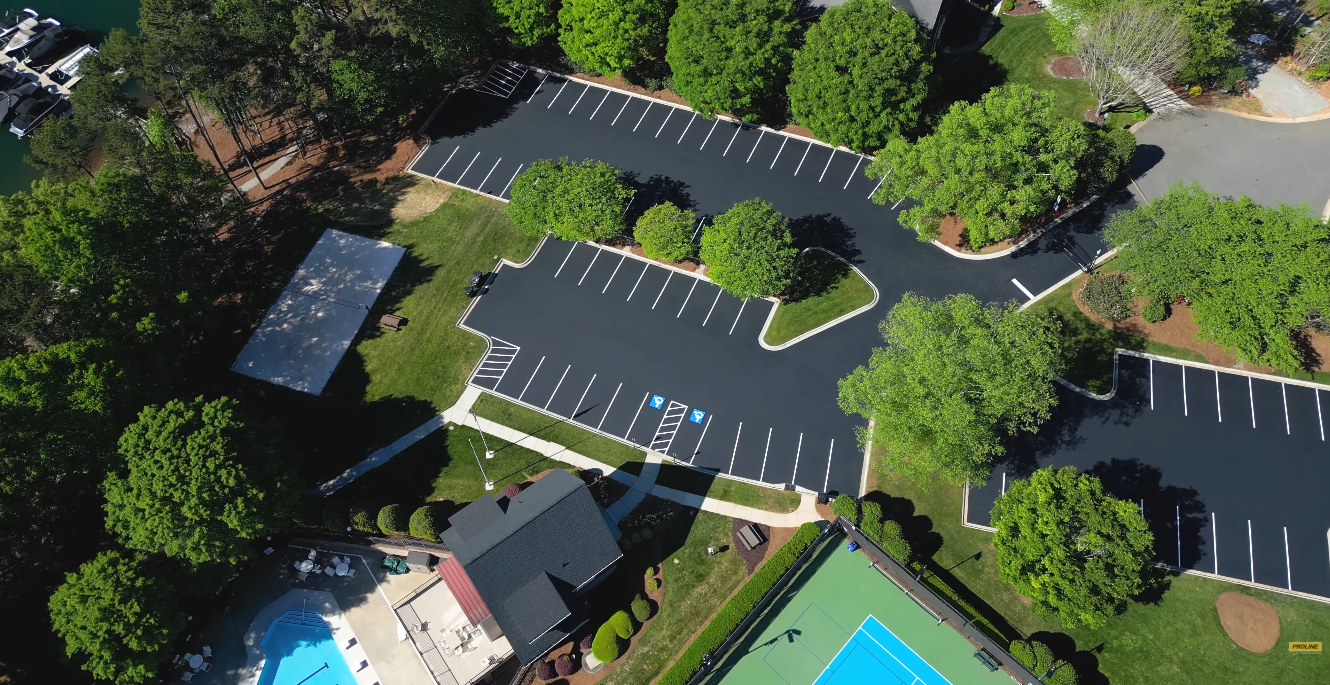

Pavement markings have a function beyond just giving an apartment parking lot an organized appearance; according to the Federal Highway Administration’s Manual on Uniform Traffic Control Devices, they are regarded as a means of communicating information to road users, and the ADA Standards specify the requirements for marked accessible parking spaces and access aisles.
In North Carolina and South Carolina apartment complexes property managers at times use the terms “striping” and “painting” as if they meant the same thing; contractors, on the other hand, usually give the terms different meanings, particularly when talking about a parking lot project.
The easiest way to understand the distinction is this:
The marking of a parking lot involves focusing on lines and layout markings, which are used to organize parking and the movement of vehicles. The term ‘parking lot painting’ is more general and includes striping as well as symbols, lettering, stencils, curb markings, arrows, and other pavement markings.
It becomes important when you ask for a quote; if you ask for ‘painting’ when in fact you need a complete restriping project, you might not make clear the full extent of the work required by your apartment property.
What Does Parking Lot Striping Include?
The practice of parking lot striping usually involves the painting of lines that specify the various areas of a paved parking area.
For an apartment community, striping can include:
- Individual parking stall lines
- Double or single parking lines
- Accessible parking space outlines
- Access-aisle markings
- Fire-lane lines
- Traffic lane markings
- Directional lane lines
- Loading-area boundaries
- No-parking area lines
- Crosswalk lines
- Other layout-defining lines
The main aim is to organize things; the lines show drivers where parking spaces start and stop and serve to separate the designated areas from the routes used by vehicles.
For instance, if the current parking arrangement of an apartment building still functions but the lines have faded, all that might be necessary would be a restriping rather than a full pavement-marking redesign.
What Does Parking Lot Painting Mean?
The term ‘parking lot painting’ can be used to refer to a more extensive range of pavement marking.
Depending on the contractor and project, painting may include:
- Parking stall lines
- Directional arrows
- ADA symbols
- Numbered parking spaces
- “FIRE LANE” lettering
- “NO PARKING” markings
- Curb markings
- Crosswalk markings
- Loading-zone markings
- Custom property markings
- Other pavement symbols and stencils
It therefore means that striping can form part of a parking lot painting job.
This distinction is particularly useful when talking about the scope of work with a manager who deals with multifamily properties; rather than taking it for granted that ‘painting’ refers to parking stalls, it is necessary to identify all the markings that the property requires.
Striping and Painting Are Not Two Completely Separate Services
A widespread misconception is to regard striping and painting as if they were competing services.
They are not necessarily alternatives.
Picture striping as just one type of the broader pavement-marking process.
A project can be described as parking lot striping since the main work consists of drawing parking space lines; it can also include painted symbols, arrows, accessible markings, and lettering.
The key issue in the case of an apartment complex is not which word is used in the proposal. The key issue is whether the proposal lists all the markings that are required for the property.
The Practical Difference for an Apartment Property
The difference becomes clearer if you look at the actual work.
| Project Need | Typical Scope |
| Faded parking stall lines | Striping |
| New parking stall layout | Striping and layout work |
| Accessible parking markings | Striping plus symbols and required markings |
| Directional arrows | Pavement marking or painting |
| Fire-lane lettering | Pavement marking or painting |
| Crosswalks | Pavement marking or painting |
| Curb markings | Painting |
| Numbered resident spaces | Painting or stenciling |
| Complete parking layout refresh | Striping plus additional pavement markings |
Instead, the contractor should recognise the particular markings rather than using a general label.
Why the Difference Matters When You Request a Quote
Imagining that you are the person in charge of a residential complex with 180 units in Raleigh, Charlotte, Greenville, Columbia, or Charleston.
You get in touch with a contractor and ask for “parking lot painting.”
If the contractor assumes you only want the parking stalls repainted, the quote may not include:
- Accessible symbols
- Access-aisle markings
- Directional arrows
- Fire-lane lettering
- Crosswalks
- No-parking areas
- Numbered spaces
- Other existing markings
This can cause confusion if you compare the proposals. Rather, give a description of the extent of the work; inform the contractor if you want the present layout to be refreshed or if you want all the pavement markings to be assessed and restored.
When You Need Parking Lot Striping
Striping makes a lot of sense as long as the current layout still works.
You may need restriping if:
- The parking lines have faded considerably.
- It’s become difficult to identify stall boundaries.
- The earlier markings have not worn in a even manner.
- Recent asphalt work removed existing parking lines.
- You want to bring back a uniform look.
- The present arrangement still fulfils the property’s operational requirements.
- You have to renew the designated parking areas.
What you are usually doing in this case is restoring a parking plan that is already in existence rather than altering it. The difference makes it possible for the property to avoid having to pay for unnecessary layout changes.
When a Broader Painting Project Makes Sense
A wider pavement marking scheme could be justified if the property requires more than just parking space lines.
For example, an apartment community may need:
- Parking stall restriping
- Accessible parking symbols
- Access-aisle markings
- Fire-lane lettering
- Directional arrows
- Crosswalks
- No-parking markings
- Visitor parking identification
- Loading-zone markings
- Numbered or reserved spaces
In that case, ‘parking lot painting’ might be more accurate when describing the entire project, even though the separate tasks still have to be given specific descriptions.
ADA Markings Require More Than Simply Painting a Symbol
Accessible parking should be given particular attention since the markings interact with the dimensions and location of the parking space. The 2010 ADA Standards state that marked car parking spaces must be at least 96 inches wide, and van spaces usually need a width of 132 inches, although there is an allowed exception if the access aisle is also 96 inches wide.
The standards also cover access aisles and accessible routes; for instance, access aisles must not overlap the vehicular way and the parking spaces and access aisles have to connect properly to the required accessible route. It therefore follows that a contractor should not regard an accessible parking symbol as merely a painting job.
All the aspects concerning space, the access aisle, the route, the slope, and the means of identification are important.
Fresh Paint Does Not Fix an Incorrect Layout
For apartment property managers this is one of the most important distinctions. Repainting existing parking lines doesn’t solve problems with the parking layout.
For example, suppose residents regularly struggle with:
- Confusing traffic flow
- Poorly positioned accessible spaces
- Difficult turns
- Inconsistent parking rows
- Vehicles blocking pedestrian routes
- Unclear fire lanes
A layout assessment might be necessary instead of just repainting the present markings. Painting makes markings more visible but does not automatically make the original parking plan more functional.
What Should You Ask a Parking Lot Contractor?
Before you approve a striping or painting job, request that the contractor specify the exact scope.
A useful proposal should clarify:
- Number of parking spaces
- Parking stall dimensions
- Type and location of accessible markings
- Access-aisle markings
- Fire-lane markings
- Directional arrows
- Crosswalks
- No-parking areas
- Curb markings
- Numbered or reserved spaces
- Surface preparation
- Paint or marking material
- Areas requiring layout changes
- Any pavement repairs that should occur before marking
This method makes it easier to compare different proposals.
Striping After Asphalt Work Is a Separate Timing Consideration
Apartment complexes often need striping after asphalt repairs, resurfacing, or other pavement work. The contractor should coordinate marking with the pavement project and not treat markings as an afterthought.
The property should have a clear plan to restore the parking layout if the asphalt repairs involve altering the surface or removing existing markings. This is especially important for large multifamily properties, since residents still need access while contractors carry out the work.
How Carolina Apartment Communities Can Approach the Project
When evaluating a multifamily property in North Carolina or South Carolina, the first step is to determine what has changed. If the pavement is in good condition and the layout is suitable, simple restriping might be enough.
If you need parking symbols, arrows, lettering, crosswalks, accessible markings, and other pavement markings, then ask for a wider marking scope. Before asking a contractor to repaint the current layout, address the problem if it no longer functions.
The goal isn’t just to apply new paint to the asphalt. It is to establish a clearly defined parking area that meets the property’s present needs. For apartment complexes, this difference helps property managers get more accurate quotes and avoid paying for work that doesn’t address the real problem.
Keep Your Apartment Parking Lot Clearly Marked
ProLine Parking Lot Maintenance provides professional parking lot striping and pavement marking services for multifamily properties throughout the Carolinas. From parking stall lines and accessible markings to directional arrows, fire-lane markings, and other pavement markings, our team can help keep your parking lot organized and easy to navigate. Contact ProLine Parking Lot Maintenance today to discuss the striping or pavement marking needs of your apartment community.
Contact UsFrequently Asked Questions
1. Is parking lot striping the same as repainting parking spaces?
It isn’t always the case. When people repaint parking spaces, they usually renew the existing stall markings. In contrast, striping is often used more broadly to describe applying lines that define the parking layout. Since the exact terms can differ from contractor to contractor, property managers should review the written scope rather than rely on the service name.
2. How long should apartment parking lot paint last?
The length of time the markings last depends on traffic volume, the weather they are exposed to, pavement condition, the type of paint used, application quality, and maintenance procedures. A heavily used apartment complex will see its markings wear out faster than one that is used sparingly. Rather than depending on a set calendar date, you should regularly inspect the markings and arrange maintenance when the key lines or symbols become hard to see.
3. Can parking lot striping be completed without painting the entire parking lot?
Yes, striping is typically aimed at areas needing new or renewed markings rather than covering the whole pavement surface. For instance, a contractor might restripe the parking stalls while at the same time refreshing the accessible symbols, arrows, crosswalks, or fire-lane markings. The exact scope will depend on which markings have deteriorated and on what the property requires.
4. Does parking lot painting include ADA parking spaces?
Although it can, the contractor must clearly specify the accessible spaces and access aisles in the project scope. Federal ADA requirements cover the dimensions and markings of accessible parking spaces, as well as the relationship between parking spaces, access aisles, and accessible routes.
5. Should apartment parking lot lines be repainted after asphalt resurfacing?
Yes. If the resurfacing removed or concealed the original markings, the new markings must conform to the approved parking layout and include accessible spaces, access aisles, traffic markings, and all other required areas. Property managers should coordinate pavement and marking schedules so the final parking lot has a complete, consistent layout.
6. Can a contractor change the parking layout during a striping project?
A contractor can restripe the property to an approved new layout, but changing the lines without evaluating the entire site can create problems. A layout change may affect parking dimensions, circulation, accessible parking, pedestrian routes, drainage, and other site requirements. Ask for the proposed layout before work begins so everyone understands exactly what will change.
7. What type of paint is used for apartment parking lot markings?
Contractors may use different pavement-marking materials depending on the surface, traffic conditions, project requirements, and environmental conditions. Water-based traffic paint and other specialized marking products are commonly used for pavement applications, but the appropriate material depends on the project. Your contractor should specify the material and application method in the proposal rather than leaving the marking system undefined.
8. Should parking lot striping be included with pavement maintenance?
It often makes practical sense to coordinate the two services when asphalt repairs or resurfacing affect existing markings. Completing the pavement work first allows the contractor to restore the parking layout on the finished surface rather than repeatedly replacing markings. The project schedule should account for pavement conditions and the time required before applying final markings.
See also: Handling Reserved, Guest, and Resident Parking With Professional Striping, What Should Be Included in Professional Apartment Parking Lot Striping?