In the United States all accessible parking spaces have to be at least 96 inches wide according to the 2010 ADA Standards for Accessible Design, and a property manager from Carolina who makes that one figure wrong could receive a complaint many years later when the paint has long since faded. If you also take into account the hurricane season defined by the National Hurricane Center as running from June 1 to November 30, together with the Piedmont’s red clay, the Lowcountry’s humidity, and the rare freeze that occurs in the Blue Ridge foothills, then a simple stripe ceases to be a one-off painting job and turns into a decision that has to be made every year.
At ProLine Parking Lot Maintenance we observe the same practice in housing associations and apartment complexes ranging from Mecklenburg County to Charleston—reserved, guest, and resident parking are all marked in the same way, using the same paint and following the same schedule—even though each of these areas addresses a totally different issue. This article explains the actual differences between the three zones and the specific way in which we deal with each one.
Three Zones, Three Different Problems
The designation of reserved, guest, and resident parking isn’t merely the application of three names to the same white line; each of these areas exists in order to address a particular and specific problem on the property.
- Reserved parking settles an ownership dispute since someone has paid for it or was allocated that specific space and the stripe has to prove it.
- Guest parking is a solution to the problem of overflow; it provides parking for visitors without them using up a resident’s assigned parking space or blocking a fire lane.
- Resident parking deals with the problem of long-term tracking. Instead of just linking a vehicle or a unit to a space for a single visit, property management has to do so over a period of months and years.
Here is how the three zones typically differ on paper, before a single stripe ever goes down:
| Zone | Typical Paint Color | Typical Stencil | Primary Job |
| Reserved | Yellow, white, or a property-branded color (never blue) | Unit number or resident name | Prove ownership of a specific stall |
| Guest | Green, or white with clear text | “GUEST,” “VISITOR,” or a stated time limit | Manage overflow near entrances |
| Resident/Permit | White | Unit or permit number | Track long-term assignment |
| Accessible (ADA) | Blue | Wheelchair symbol, “VAN ACCESSIBLE” where required | Federal compliance |
| Fire Lane | Red | “NO PARKING FIRE LANE” | Emergency access; overrides every other zone |
The most common mistake we observe on Carolina properties is to treat all three zones in the same way by using one paint color and one restriping schedule; this is generally the cause why towing complaints and parking disputes keep reoccurring.
Reserved Parking: Making Ownership Impossible to Argue With
A reserved stall is only valid if it cannot be misunderstood. For this reason, the stencil must exactly match either the unit number or the resident’s name.
Color is also important in this situation. Since the ADA design standards allocate blue paint solely for accessible areas, a stall that is not reserved under the ADA must be a different color, most often yellow, white, or the color of the property’s branding, together with a stenciled number at least 4 to 6 inches high so that it can be clearly seen from a moving car.
A standalone stripe usually won’t suffice when a property manager actually has to tow an unauthorized vehicle, and in North Carolina and South Carolina HOAs it is generally necessary to have a matching post-mounted sign situated alongside the reserved stripe before a tow can be carried out; this administrative requirement is one that the Community Associations Institute deals with in great detail for HOA boards. We consider the stripe and the sign to be a single unit and never treat them as being separate.
Guest Parking: Stopping Overflow Before It Reaches a Fire Lane
Guest parking always works in a predictable manner: visitors go around the parking area, see that no spaces are available near the entrance, and then park in a spot reserved for a resident, in the fire lane, or on the grass. The solution involves using a stencil and colour that a visitor can easily read at once, whether it’s at night or from a car travelling at ten miles per hour, so they don’t have to guess which parking spaces are available to them.
We usually paint the guest stalls in a color that is different from both the reserved and resident areas, often using green or white with the word “GUEST” or “VISITOR” clearly stenciled on it, and we position these stalls near the main entrance and the clubhouse rather than spreading them out over the entire property. Where a community includes a time limit on the stencil, for example, “24 HR GUEST” or “48 HR GUEST,” it provides the property manager and any towing company with a clear rule backed by paint, which they can apply to long-term “guest” vehicles that never, in fact, leave.
The number of guest stalls is just as important as the color. The property managers that we work with in Charlotte, Raleigh, and Columbia usually aim at having one guest stall for every three to four units, increasing that ratio where there is a recorded history of overflow complaints, a range that matches the visitor parking guidelines issued by the National Apartment Association.
Resident Parking: Built to Survive Carolina Weather, Not Just One Season
The resident stalls bear the greatest long-term burden of the three zones since the same stripe has to remain legible for years, not just for months. The weather in Carolina hinders that objective in a number of particular ways.
- In the Piedmont region, communities around Charlotte, Greensboro, and Winston-Salem must cope with runoff from red clay after heavy rainfall, which stains lighter paint colors and makes the numbers hard to read within a single season.
- The lowland and coastal areas have high humidity: properties situated near Charleston, Myrtle Beach, and Wilmington are subjected to nearly continuous humidity and salt air, both of which cause the paint to become less firmly attached over time and reduce the useful life of standard traffic paint.
- The hurricane season, according to the National Hurricane Center, runs from June 1 to November 30 along the Carolina coast, and heavy, continuous rain during that period can wash away fresh paint that has not fully bonded to the pavement.
- In the area around Asheville, foothills and mountain communities experience multiple winter freeze-thaw cycles, which can cause the asphalt to crack and bulge, breaking up striping lines even when the paint itself is still in good condition.
We match the unit or permit numbers from resident stalls with the property’s assignment records and select either paint or thermoplastic based on the actual stressors a property faces, rather than using the same material throughout.
ADA-Compliant Spaces Belong in Every Zone, Not Just One
A widespread misconception is that accessible parking consists of just one or two spaces near the leasing office, and no more than that. In fact, a property must allocate accessible spaces throughout reserved, guest, and resident areas, depending on each parking type’s location relative to the accessible path leading into the buildings.
For parking at every Carolina property, ProLine adheres to the specific dimensions specified in the 2010 ADA Standards and the U.S. Access Board’s parking guidance:
| Space Type | Minimum Width | Minimum Access Aisle | Vertical Clearance |
| Standard accessible (car) | 96 inches (8 ft) | 60 inches (5 ft) | Not required |
| Van-accessible, Option A | 132 inches (11 ft) | 60 inches (5 ft) | 98 inches |
| Van-accessible, Option B | 96 inches (8 ft) | 96 inches (8 ft) | 98 inches |
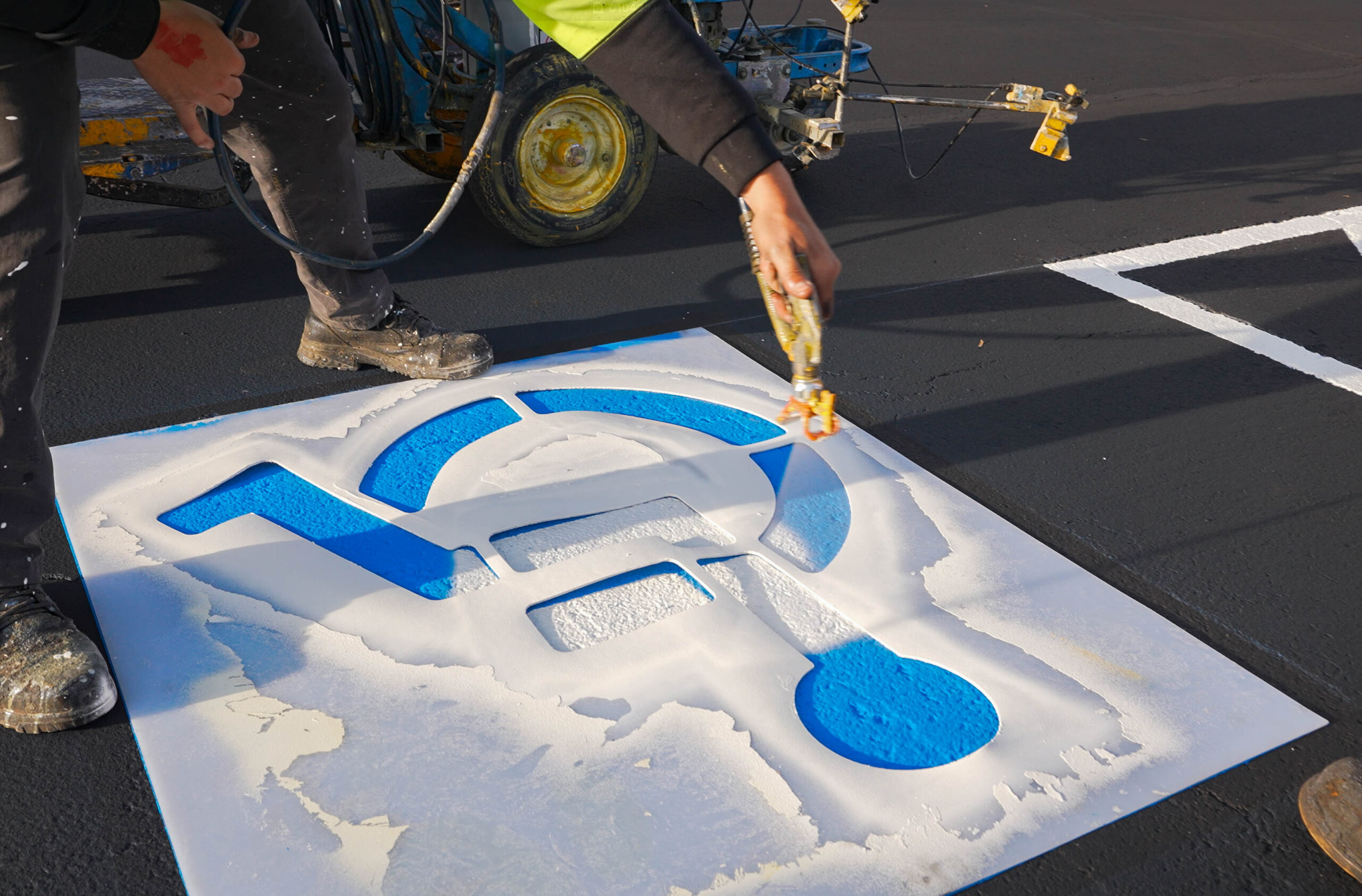
One in every six accessible spaces on a property must be van-accessible, and each property must have at least one van-accessible space, no matter how small the total number of accessible spaces is. We paint each accessible space blue, the international symbol for accessibility, and attach a ‘VAN ACCESSIBLE’ stencil where appropriate, placing it on the shortest accessible route to the nearest building entrance.
Fire Lanes Override Every Other Zone
Regardless of how a property allocates reserved, guest, or resident stalls, fire lanes have priority over all of these. In cities such as Charlotte, Raleigh, Durham, and Columbia, the local fire marshals generally won’t issue a certificate of occupancy for a new or refurbished community until the fire lane striping complies with code, a standard that is derived from the International Fire Code and which most municipalities in Carolina adopt either directly or with local modifications.
The fire lanes are painted red and have the message ‘NO PARKING FIRE LANE’ stenciled on them, with the message repeated at intervals that are determined by the local fire marshal rather than left to the discretion of a striping contractor. Before we lay a single line, we work out the fire-lane layout with the local fire department, since even a few feet off the required width can result in a failed inspection and a full repaint at the property’s expense.
Choosing the Right Striping Material for Carolina’s Climate
Different zones do not all require the same type of material; paint, thermoplastic, and epoxy withstand Carolina’s UV exposure, humidity, and heavy seasonal rainfall to differing degrees, and generally speaking, data from the pavement marking industry indicates the following performance ranges:
| Material | Typical Lifespan in Carolina Conditions | Cure Time | Best Suited For |
| Water-based acrylic traffic paint | 1 to 2 years | Touch-dry in 30-45 minutes | Guest parking, budget-conscious projects |
| Thermoplastic | 4 to 6 years | Hardens in 10-15 minutes as it cools | Reserved and resident parking, high-traffic entrances |
| Epoxy | 3 to 5 years | 2 to 4 hours, depending on pavement temperature | ADA symbols, fire lane stencils, high-precision markings |
We usually suggest using thermoplastic in areas that are designated as reserved and inhabited, since it is necessary for a stripe to last for two or three Carolina summers without having to be fully repainted, and we use standard traffic paint in guest areas, which are already restriped frequently enough because of the high level of turnover.
How ProLine Handles Each Parking Zone, Step by Step
Reserved Parking
- We check the current list of stall assignments kept by the HOA or the property manager and compare it with the actual lots to identify any mismatched or duplicate numbers.
- We create a stencil layout that exactly replicates the unit numbers or resident names as stated in the community’s governing documents.
- Before we paint, we draw out each stall using laser-guided chalk lines so the spacing remains consistent across the whole area.
- With each reserved stripe, we also attach a matching sign mounted on the post, since a stripe by itself usually can’t support a tow should the HOA need to remove an unauthorized vehicle.
- After the work is completed, we take photographs, record the number of each reserved stall, and provide the property manager with a written map for their records.
Guest Parking
- We walk the property with the manager to identify areas where guest overflow currently causes issues, typically near clubhouse entrances or the first row off the main drive.
- Instead, we suggest determining the number of guest stalls based on the community’s unit mix and current complaint record, rather than using a fixed ratio for all properties.
- The guest stalls are painted in a color and have a stencil pattern that can be easily read at night and from a moving vehicle, and that differs from the colors used for reserved and resident stalls.
- We make sure that the stencil text, for example, “GUEST” or the stated time limit, matches the towing signage that is already in place at the property so that enforcement remains consistent.
- We restripe the guest zones more frequently than the other zones because these stalls have the highest turnover.
Resident Parking
- We begin by assessing the pavement’s current condition, since in older areas of the Piedmont the asphalt is often cracked or heaving and must be patched before new roads can be constructed.
- We assign a number or letter to each resident stall to match the community’s permit system, coordinating directly with the property management software if it’s already in use.
- The choice between paint and thermoplastic depends on the climate conditions the material is exposed to, with thermoplastic preferred in coastal areas because salty air and humidity can shorten paint life.
- Wherever possible, we carry out the work either during Carolina’s hurricane season or in the weeks when pollen is at its peak, so debris and moisture do not interfere with a fresh cure.
- Each spring, we go in for a post-season inspection so we can catch any fading or cracking before it becomes a compliance or dispute issue.
Recommended Restriping Schedule by Zone
| Parking Zone | Recommended Restriping Frequency | Why |
| Guest parking | Every 12 to 18 months | Heaviest turnover and closest to main-drive UV exposure |
| Reserved parking | Every 18 to 24 months | Numbers must stay legible for enforcement to hold up |
| Resident/permit parking | Every 2 to 3 years | Long-term assignment with comparatively lower turnover |
| ADA spaces and fire lanes | Inspected every 6 months; repainted at first sign of fading | Non-negotiable for compliance and emergency access |
For properties located directly on the coast, intervals are shorter because salt air and humidity cause the paint to wear down faster than in the Piedmont or foothill areas.
Get a Striping Plan Built for Your Property, Not a Generic Template
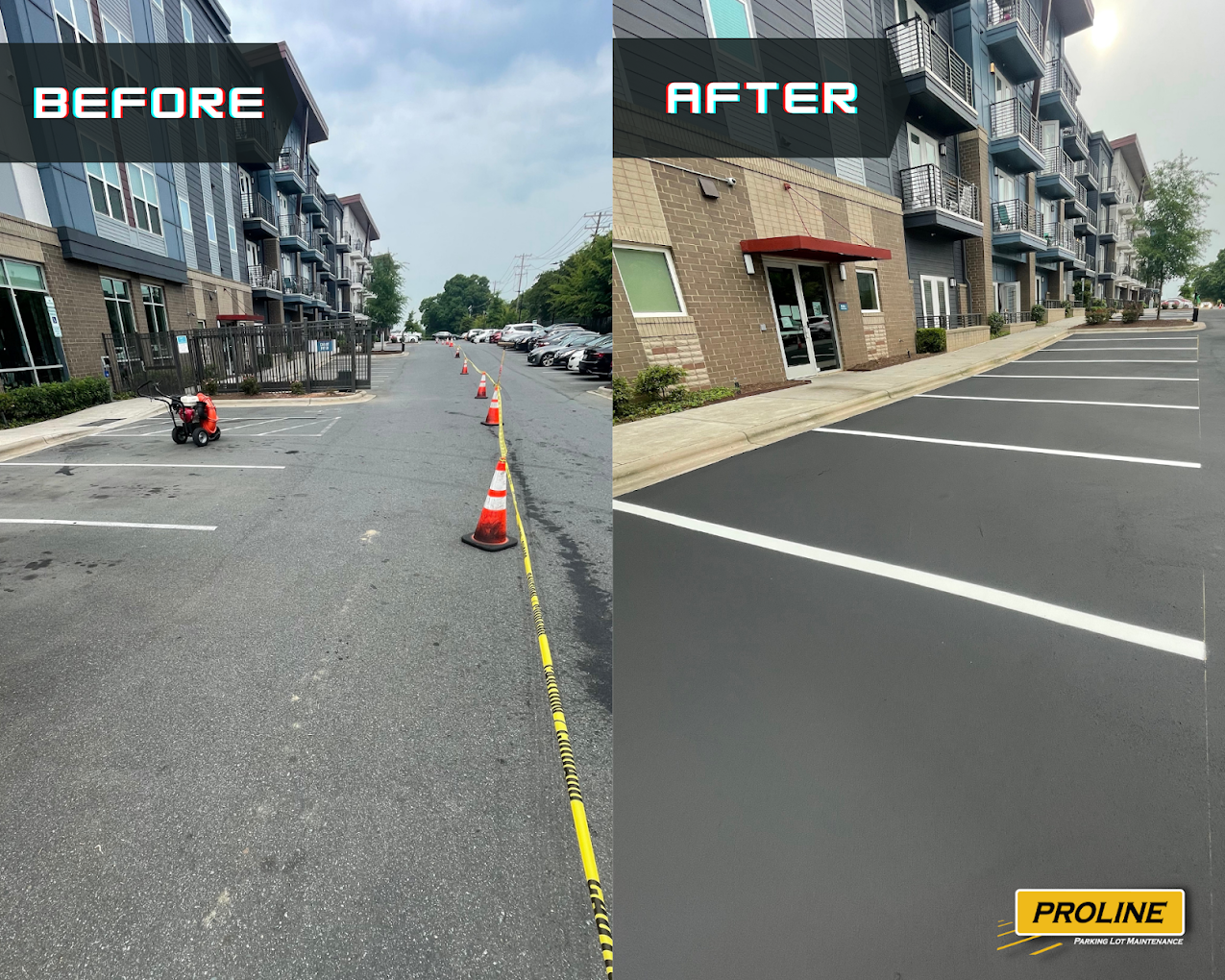
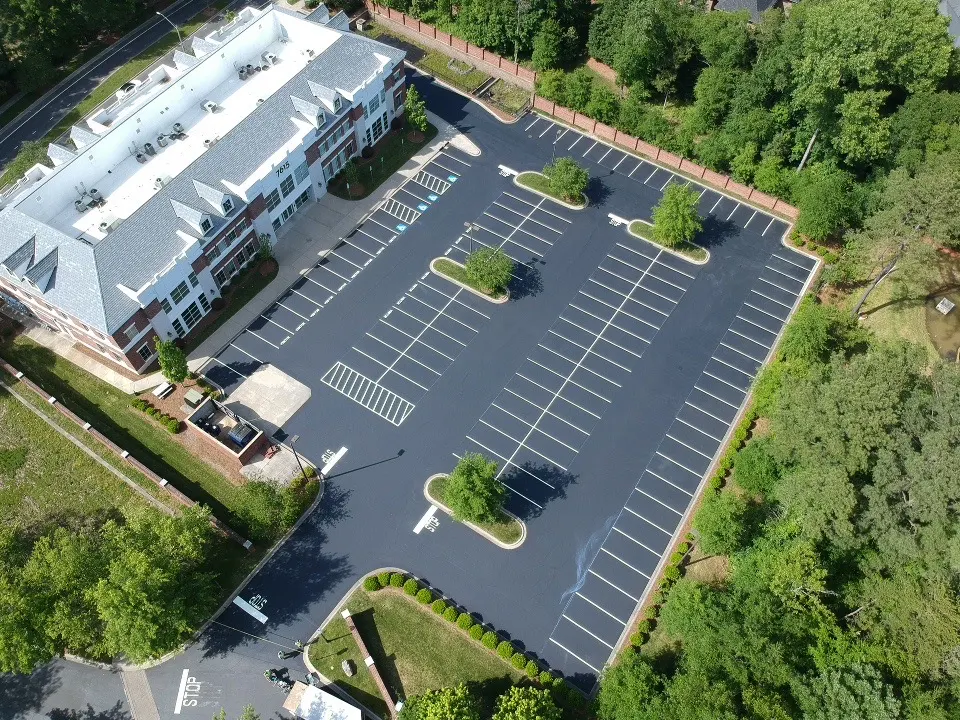
Reserved, guest, and resident parking areas each address different issues, and a striping plan that treats them the same way usually does little or nothing to solve them. ProLine Parking Lot Maintenance creates zone-by-zone layouts for housing associations and apartment complexes throughout North Carolina and South Carolina, from Charlotte and Raleigh to Charleston and Myrtle Beach, accounting for the specific weather conditions, code requirements, and enforcement needs each property faces.
Struggling With Parking Enforcement and Resident Disputes?
Ambiguous stall designations, faded visitor markings, and missing curb numbers lead to constant resident complaints, unauthorized parking, and towing headaches. Clear, professional stenciling for visitor zones, numbered resident spots, EV charging bays, and designated guest areas establishes immediate parking order and simplifies property enforcement. ProLine Parking Lot Maintenance applies crisp, highly durable, color-coded traffic paint and custom stenciling tailored specifically to your community’s parking layout. Contact our striping experts today to streamline your property’s parking organization.
Frequently Asked Questions
How many ADA-compliant parking spaces are legally required for my property in Carolina?
The 2010 ADA Standards specify the minimum number of accessible spaces required according to the total number of parking spaces in the car park, rather than applying a single flat percentage.
| Total Spaces in Lot | Minimum Accessible Spaces Required |
| 1-25 | 1 |
| 26-50 | 2 |
| 51-75 | 3 |
| 76-100 | 4 |
| 101-150 | 5 |
| 151-200 | 6 |
| 201-300 | 7 |
| 301-400 | 8 |
| 401-500 | 9 |
| 501-1000 | 2% of total spaces |
| 1001+ | 20, plus 1 for every 100 spaces over 1000 |
One in every six accessible parking spaces has to comply with van-accessible dimensions, and each property must have at least one van-accessible space even if the total number of accessible spaces is only one or two. Carolina housing ownership associations and apartment complexes that add or remove parking spaces as a result of a renovation should immediately recheck this table, since crossing a threshold such as 100 or 200 total spaces triggers an immediate change in the required number.
What is the cost of having a professional company carry out parking lot striping for a Carolina HOA or an apartment community?
The cost depends on several property-specific factors rather than a fixed amount per space. When hiring contractors in Carolina, they generally consider:
- Total square footage and number of stalls to be striped
- Whether the job is a new layout or a repaint of existing lines
- Material choice, since thermoplastic and epoxy cost more upfront than water-based paint but last several times longer, a tradeoff documented across the pavement marking industry by groups like the American Traffic Safety Services Association
- Stencil complexity, such as unit numbers, ADA symbols, or custom HOA branding
- Site accessibility, including how far the property sits from a contractor’s base of operations, which affects mobilization cost in more rural parts of the Carolinas
When the various types of striping—reserved, guest, resident, and ADA—are bundled into one project, the cost per stall is generally lower than if each zone were scheduled separately, since mobilization and layout setup are done only once. A written, itemized quote that lists the costs for materials, labor, and stenciling separately for each zone provides a property manager or HOA board with a much clearer understanding than a single total amount does.
For how long should people living in the area and visitors refrain from parking on newly striped tarmac in the heat and humidity of Carolina?
Under normal conditions, water-based traffic paint usually becomes touch-dry within 30 to 45 minutes. Still, the higher humidity in Carolina, particularly in the Lowcountry and in coastal areas, can lengthen that time when compared to a drier climate. Although the paint may appear and feel dry long before this point, most paint manufacturers and pavement marking contractors—those whose practices are guided by standards cited by the American Traffic Safety Services Association—advise that vehicles should be kept off newly painted lines for a full 24 to 48 hours to allow the paint to achieve its full cure strength. Thermoplastic, on the other hand, hardens as it cools and is generally safe for light traffic after 10 to 15 minutes, which is one reason ProLine prefers it for high-turnover areas where it’s not practical to close guest parking for two full days. Property managers who wish to close off a section of the parking lot for restriping should schedule the closures around the 24 to 48 hour cure period rather than the shorter time when the surface appears dry.
Does either North Carolina or South Carolina need a permit to restripe a private parking lot?
In most municipalities in North Carolina and South Carolina, it is generally not necessary to obtain a building permit when carrying out a routine restriping of an existing area—that is, when repainting the same layout already in place—because the action does not modify the structure or increase the amount of impervious surface. However, a permit would be required if the project includes new parking spaces, moves ADA-accessible stalls, or expands the lot’s total paved area, as those changes could trigger a site plan review under a city or county zoning and land development code. Requirements differ from one municipality to another, and property managers can find the specific regulations for their city or county using resources such as the Municode Library, which contains adopted ordinances for many jurisdictions in North Carolina and South Carolina. Those homeowners’ associations located in unincorporated areas should contact the county planning department directly, as the county’s requirements may differ from the rules of the nearest city even when the properties are just outside the city limits.
Who has the legal power to enforce breaches of reserved or ADA parking rules on private properties owned by Carolina?
Generally, private property owners, homeowners’ associations (HOAs), and property management companies can have unauthorized vehicles removed from reserved and ADA-marked stalls. Still, this power usually relies on having the correct signage placed next to the painted stripe. In North Carolina, the state’s motor vehicle law, as set out in its General Statutes, deals with the removal of vehicles from private property, and in South Carolina similar rules regarding towing and vehicle storage are found in Title 56 of the State Code of Laws; in both states, the tow is only considered legal if both the sign and the stripe are in place. Local police departments will not usually remove a vehicle from private property at request; instead, they generally instruct the property manager to use a licensed towing company, since towing vehicles from private property in both states is governed by state-regulated towing and storage laws, not ordinary police enforcement. If the signage and striping are correctly combined the first time, the property manager will not think that the stall is enforceable and will only discover this later when a resident challenges the tow.
What visibility standards should Carolina parking lot striping meet for nighttime safety?
The Federal Highway Administration’s Manual on Uniform Traffic Control Devices sets national standards for pavement marking visibility, including guidance on maintaining markings. This helps them stay visible to drivers at night and in wet conditions. Most professional-grade traffic paint and thermoplastic used on Carolina properties includes embedded reflective glass beads, tiny glass spheres mixed into or applied on top of the wet paint that bounce headlight beams back toward the driver instead of scattering the light. This reflective quality, called retroreflectivity, matters most in guest parking areas and along fire lanes, where a driver unfamiliar with the property needs to read the lines clearly at night without relying on memory of the layout. Retroreflectivity fades faster than the paint’s visible color does, so a stripe can look fine in daylight while offering very little nighttime visibility, which is one reason ProLine inspects reflectivity separately from general appearance during routine site visits.
Can a Carolina community add QR-code or app-based guest parking permits alongside physical striping?
Yes, and a growing number of Carolina apartment communities and HOAs pair a physical guest stall stencil with a digital registration system, where a visitor scans a QR code posted near the guest zone or a resident logs a license plate through an app before the guest arrives. The physical stripe and stencil still do the primary job of showing a visitor exactly where to park. At the same time, the digital layer gives the property manager a timestamped record of who parked where and for how long, which helps enforce time limits like a 24-hour guest policy. Industry groups such as the International Parking & Mobility Institute track this shift toward pairing physical markings with digital permit systems across both commercial and residential properties. ProLine designs guest stall layouts to work with or without a digital system, so a property considering adding one later doesn’t need a full restripe to accommodate it.
Does pollen season or cooler mountain temperatures affect when Carolina properties should schedule striping?
Yes, in two very different ways depending on where a property sits in the state. Coastal and Piedmont communities deal with heavy pine pollen coating every outdoor surface, including freshly painted pavement, for several weeks each spring, typically peaking in March and April according to seasonal tracking from the State Climate Office of North Carolina, and a pollen film on curing paint can weaken adhesion if a contractor stripes the lot in the thick of it. Mountain and foothill communities around Asheville face the opposite challenge, since most traffic paint and thermoplastic need a pavement surface temperature of roughly 50°F or higher to bond and cure properly, a threshold that can rule out early morning or winter striping at higher elevations even when the rest of the state is warm enough. ProLine schedules restriping around both constraints instead of defaulting to a single statewide calendar, timing coastal and Piedmont projects to avoid peak pollen weeks and mountain projects to land in pavement-temperature windows that support a full cure. Getting the timing wrong does not usually show up right away; it shows up six months later as premature peeling or a stripe that never really bonded to the asphalt.
See also: What Should Be Included in Professional Apartment Parking Lot Striping?, Planning a Line Striping Project for a Busy Apartment Community