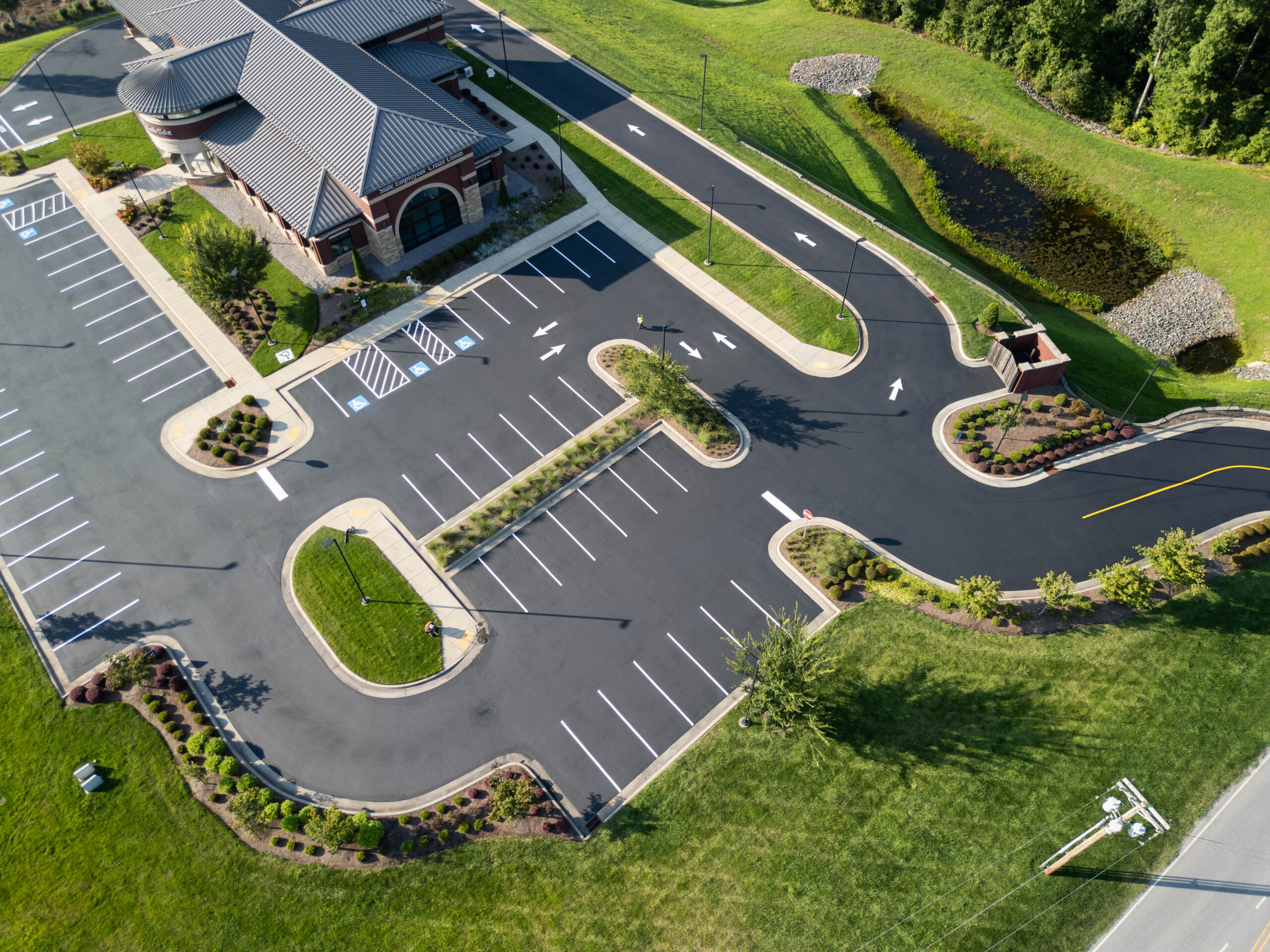

Tire friction, constant turning,, and frequent braking gradually deteriorate pavement markings over time, especially in high-traffic parking areas where vehicles take the same routes every day. This is especially true in apartment parking lots around entrance gates, tight corners, the ends of parking stalls, speed bumps, and intersections. In NC and SC, property managers also have to factor in seasonal rainfall, summer heat, and heavy traffic, which all affect pavement condition and marking visibility.
At ProLine Parking Lot Maintenance, we go far beyond faded paint when assessing tire scuffing in apartment communities. Dark tire marks can make a fresh stripe look worn through, and repeated tire friction can contribute to the degradation of some marking materials. The problem often occurs where the vehicle turns sharply, reverses into a space, or accelerates from a stop.
Preventing premature wear begins with identifying the movements causing it. You can protect your striping investment and make parking areas easier to navigate by improving turning space, using the right marking materials, preparing the pavement correctly, and maintaining a regular inspection regime.
Overview of Tire Scuffing Prevention
- Identify high-friction areas where vehicles repeatedly turn, brake, reverse, and accelerate.
- Select the appropriate pavement marking material for the existing surface and the anticipated traffic.
- Prepare the asphalt or concrete properly before applying the new striping.
- Improve parking layouts and turning movements to reduce unnecessary tire friction.
- Inspect the markings regularly and be able to tell the difference between surface tire deposits and actual marking failure.
Understanding Tire Scuffing in Apartment Parking Lots
Tire scuffing results from tires rubbing against the road surface during cornering, braking, acceleration, or tight movements. This rubbing leaves dark rubber marks on the road and across painted lines. In some instances, the marks are purely cosmetic. In others, scuffing and vehicle movement will remove the marking material, particularly where the coating has not bonded to the surface.
The difference is that dark marks don’t necessarily mean the paint has worn off. A tire deposit can sit on top of a mark that’s still there underneath. True coating loss will expose the asphalt/concrete beneath. Applying another coat without knowing the real issue will waste your maintenance budget and leave the original problem in place.
We recommend looking at the affected markings very carefully before deciding on a repair. If the stripe is continuous underneath the rubber deposit, cleaning or monitoring may be the appropriate course of action (again, this depends on the marking material and the manufacturer’s instructions). If the line is chipped, peeled, or missing in sections, we look at surface prep, material compatibility, traffic exposure, and application conditions.
The FHWA pavement marking guidance is a useful reference for understanding the role of pavement markings in conveying roadway information. For apartment properties in particular, it’s important to maintain clear markings so drivers can see parking zones, turning lanes, and traffic controls.
Identifying Areas Most Vulnerable to Tire Friction
Tire scuffing doesn’t affect every part of an apartment parking lot the same way. Vehicle movement concentrates friction in certain areas, so we focus on where vehicles turn and stop most.
Entrance and exit lanes are prone to wear as vehicles go through narrow openings, brake for gates, and then accelerate onto adjacent roads. Parking stall ends can also develop quite dark scuffs as vehicles make tight turns into the stalls or correct their position after reversing. Intersections and corners are no different when you have larger SUVs, pickups, delivery vans, and service vehicles all requiring a bit more space to get through.
The layout can exacerbate these problems. Narrow drive aisles, awkwardly placed islands, tight corners, and inconsistent stall spacing can force the vehicle to turn more than necessary. The marking will take more friction if the vehicle continually crosses the line than if it turns in a smoother pattern.
We recommend recording where the tire marks keep reappearing rather than looking at each one in isolation. A pattern of scuffing at the same corner may indicate that the turning radius is the issue. Repeated wear right up to an entrance may indicate that drivers are braking and/or turning directly over the stop bars and other pavement markings.
Selecting Marking Materials for High-Traffic Areas
The material you use for parking lot striping directly affects its durability, drying time, compatibility with the pavement, and performance under repeated vehicle traffic. No single marking product will work in every apartment parking lot. The right product depends on the pavement surface, traffic level, site conditions, your budget, and the manufacturer’s application specifications.
Waterborne traffic paint is often the go-to for conventional parking lot striping. Still, property managers should not assume every paint will perform the same way under repeated turning and braking. Other marking systems may have very different durability, but their suitability is application-specific and depends on surface prep and installation conditions.
Before we select any material, we assess whether the area requires standard parking lines or lines that will be subject to a high degree of friction. A busy entrance has very different requirements than a fairly quiet parking bay. We also assess whether the existing coating has bonded and whether the pavement needs cleaning or repair before applying the new material.
The FHWA pavement marking research provides some additional technical background on pavement marking materials and performance. The highway findings don’t in themselves establish the best product for a private apartment parking lot. Still, they do provide some useful background on why the selection of the right material and the performance of that material are important.
Comparison of Maintenance Options
| Maintenance option | Best application | Important consideration |
| Surface cleaning | Rubber deposits covering otherwise intact markings | Use a cleaning method compatible with the coating and pavement. |
| Targeted restriping | Isolated areas with genuine marking loss | Match the existing layout and allow proper curing before reopening. |
| Full restriping | Widespread fading, inconsistent lines, or a revised layout | Confirm the approved plan and coordinate access restrictions. |
| Layout adjustment | Repeated scuffing caused by tight turns or poorly placed markings | Check available pavement, traffic flow, and applicable requirements before changing the design. |
| Material upgrade | Areas with recurring wear despite proper application and maintenance | Confirm compatibility, installation requirements, and expected service life with the manufacturer. |
Improving Turning Movements Around Painted Lines
Reducing unnecessary tire friction often comes down to how the vehicle moves through the parking lot. A very durable marking material can still wear out prematurely if drivers continually turn across the same painted area under heavy steering loads.
We’d recommend checking the turning paths at the entrances, at the intersections, and at the ends of the parking stalls. If drivers are continually crossing a line (because the aisle is too narrow or the corner is too tight), the property manager should consider whether the site layout can be modified to allow easier vehicle movement. On some sites, this may be possible by repositioning stalls, changing traffic flow, or repositioning certain markings.
Clear directional arrows and consistent traffic control can help drivers approach the turn correctly. Property managers should assess the visibility of entrance and exit markings to see how the pavement markings support driver decision-making at these transition points. For intersections, stop bars and yield markings can provide additional traffic control if crews install them in accordance with the approved layout and relevant requirements.
We wouldn’t recommend moving lines to remove a few tire marks without considering the full parking layout. A change that reduces friction in one area may create confusion elsewhere or adversely affect accessible parking, pedestrian crossings, or emergency access. The area in question is always assessed as part of the overall layout to ensure the proposed improvement is safe and predictable.
Preparing Pavement for Better Marking Adhesion
Good surface prep is essential for the pavement marking material to bond to the asphalt or concrete. Dust, loose material, oil, moisture, and incompatible residues can interfere with the bond and increase the likelihood of premature peeling or loss. The resulting surface will then be prone to exposing weaknesses present in the original application due to repeated tire friction.
Before you restripe, inspect the pavement and identify any conditions that would preclude a good application. The crews will, of course, remove any loose material and contaminants using the appropriate method for the surface and marking system. They will also need to adhere to the manufacturer’s requirements for pavement dryness, temperature, application thickness, and cure time.
Freshly applied markings need time to dry/cure before vehicles can drive over them. Opening a parking area too soon can result in tracking, smearing, and displacement, particularly where vehicles turn their wheels while stationary or make sharp maneuvers. The property manager should work with the contractor to arrange a temporary closure rather than opening the lot based on the paint looking dry on the surface.
Surface condition is also an issue. Crumbling asphalt, loose aggregate, oil-soaked areas, and degraded concrete will all need to be remedied before new striping can be applied. Painting over a failing surface with additional paint will not fix the problem.
Establishing a Tire Scuffing Inspection Schedule
A consistent inspection regime will help you spot recurring damage before it impacts large areas of the parking lot. We recommend inspecting the entrance lanes, corners, intersections, and high-use parking rows after any significant traffic change or maintenance work, as well as during your regular property inspections.
The inspection should identify one of three conditions: dark deposits on the intact marking, partial loss of the coating and/or partial loss of the line, and complete loss of the line. Each has different implications and requires a different response. Deposits can be cleaned, damaged markings may require targeted restriping, and in cases of widespread deterioration or scuffing due to the layout, a more comprehensive assessment may be required.
Property managers should take dated photos of affected areas and note traffic patterns, pavement condition, and previous repairs. This will help you assess whether a particular area is degrading unusually quickly and whether a material or layout change is warranted.
Traffic patterns across the various apartment communities in Charlotte, Raleigh, Columbia, Greenville, and the other Carolina markets can differ significantly. A community with controlled access and many gate stops will have very different traffic patterns than a community with long drive aisles and open entrances. We use those site conditions to guide our recommendations rather than applying a one-size-fits-all restriping schedule to every property.
Protecting Striping Investment Through Preventive Maintenance
Tire scuffing can become an avoidable cost if you constantly repaint the same areas without addressing the root cause. A better approach combines proper installation, appropriate material selection, traffic flow assessment, and regular inspection.
At ProLine Parking Lot Maintenance, we help apartment property managers figure out why markings wear out so quickly and what the sensible next steps are. We look at whether it’s surface deposits, coating failure, pavement deterioration, or simply vehicles continually driving over the same lines.
For multifamily communities throughout NC and SC, preventative maintenance helps keep parking lines readable and supports a more orderly parking situation for residents, guests, and service personnel. It helps property managers make better maintenance decisions by understanding the root causes of tire scuffing, reducing unproductive repeat work.
Contact ProLine Parking Lot Maintenance to discuss your apartment parking lot striping needs and develop a maintenance plan suited to your pavement, traffic patterns, and property layout.
Protect Your Apartment Parking Lot Markings From Tire Scuffing
Frequent turning, braking, and vehicle movement can cause tire scuffing that gradually wears down parking lines and pavement markings. At ProLine Parking Lot Maintenance, we help apartment communities maintain clear, durable markings through professional line striping, appropriate traffic paint selection, and routine pavement marking maintenance. We can help property managers identify high-wear areas and keep parking spaces, directional arrows, and other markings visible for residents and visitors. Contact our team to discuss your apartment parking lot striping needs.
Contact UsFrequently Asked Questions
Can tire scuffing make parking lot markings less visible at night?
Yes. Dark rubber deposits, worn paint, dirt, and moisture can all make the markings very difficult to see against the surrounding road surface, particularly in poor lighting. Visibility will also depend on the color of the marking, its condition, its contrast, and any reflective qualities the product has. We would advise inspecting high-friction areas under both day and night conditions so the property manager can identify markings that no longer clearly guide the driver.
Does hot weather in North Carolina and South Carolina cause tire scuffing to damage striping faster?
Hot weather can affect pavement surface temperatures and the application/curing characteristics of some marking products. Heat alone doesn’t dictate how quickly tire scuffing will damage a stripe. Traffic volume, turning movements, pavement condition, product formulation, and whether the coating cured properly all affect performance. We recommend following the marking manufacturer’s temperature and curing specifications and scheduling work for appropriate conditions, rather than assuming a summer application will produce a more durable stripe.
Should property managers remove old tire marks before applying new parking lot striping?
Property managers need to identify what the dark marks are (rubber deposits, residue from prior coatings, or actual degradation) before choosing the right surface-preparation method. Painting over contamination can reduce adhesion, and overly aggressive cleaning could damage the pavement or existing markings. We recommend choosing a cleaning and preparation method appropriate for both the surface and the marking product, then confirming the pavement meets the manufacturer’s requirements before applying the new material.
How can property managers tell whether tire scuffing comes from a poor parking lot layout rather than weak paint?
A common pattern will be the first indicator. If you’re getting scuffs at tight corners, stall entrances, gate approaches, and intersections, the vehicle turning path is likely the culprit. If the markings are peeling or generally disappearing all over the place with no obvious correlation to vehicle movement, the contractor should also look at surface contamination, application conditions, material compatibility, and curing. We recommend documenting exactly where and how the damage is occurring before choosing a repair, since simply replacing the paint will not address a layout issue.
How should property managers prioritize tire-scuffed markings when the maintenance budget is limited?
Start with markings that communicate important traffic controls or guide vehicles through conflict points, including entrance and exit lanes, intersections, stop bars, and pedestrian crossings. Next, assess parking stall lines and directional markings in heavily used areas where deterioration causes drivers to park incorrectly or creates uncertainty about traffic flow. Property managers should also document less urgent cosmetic damage and monitor it during routine inspections, while ensuring that budget decisions do not compromise applicable accessibility, fire access, or other legal requirements. This approach directs maintenance funds to the locations where clear markings matter most.