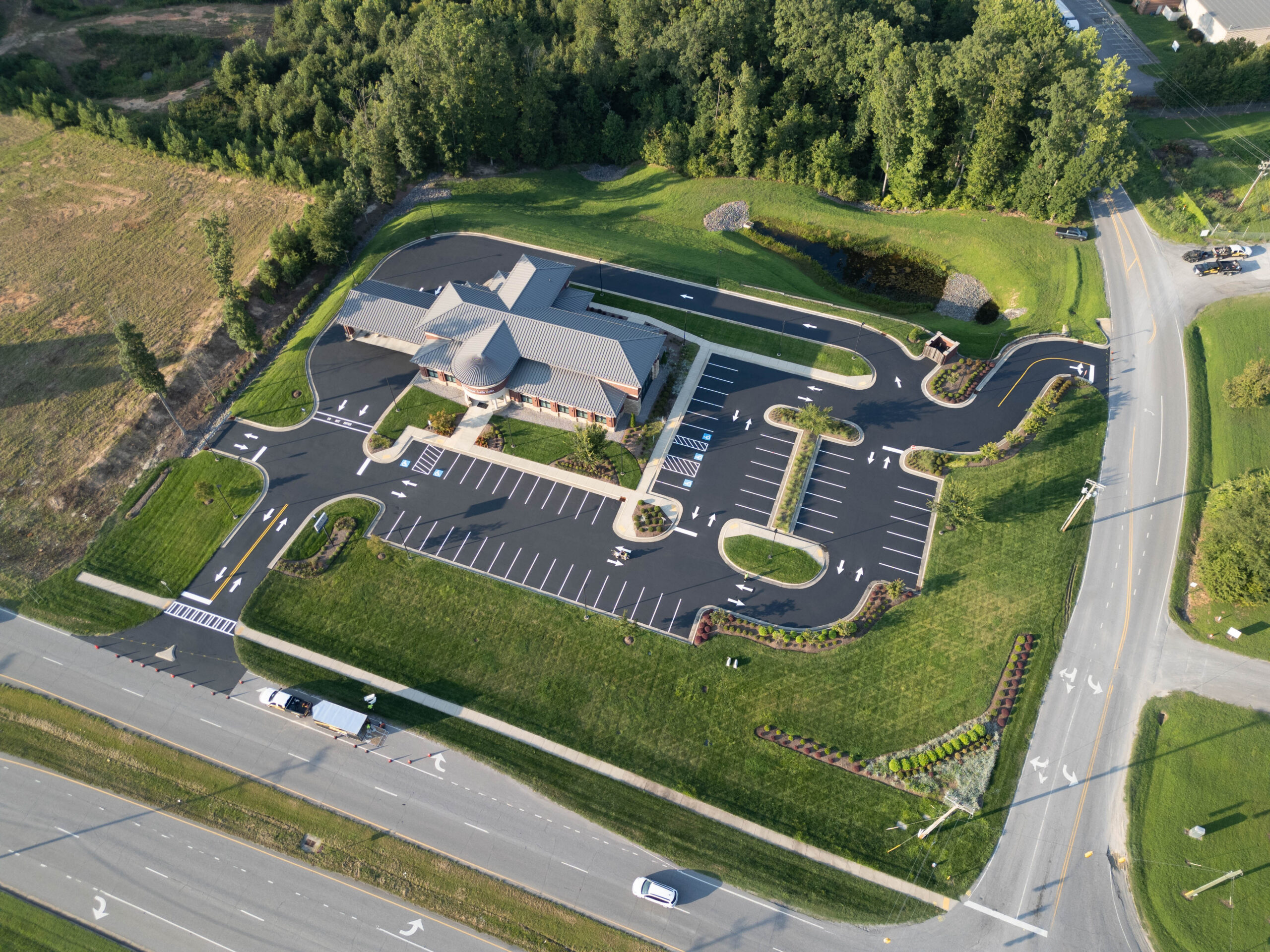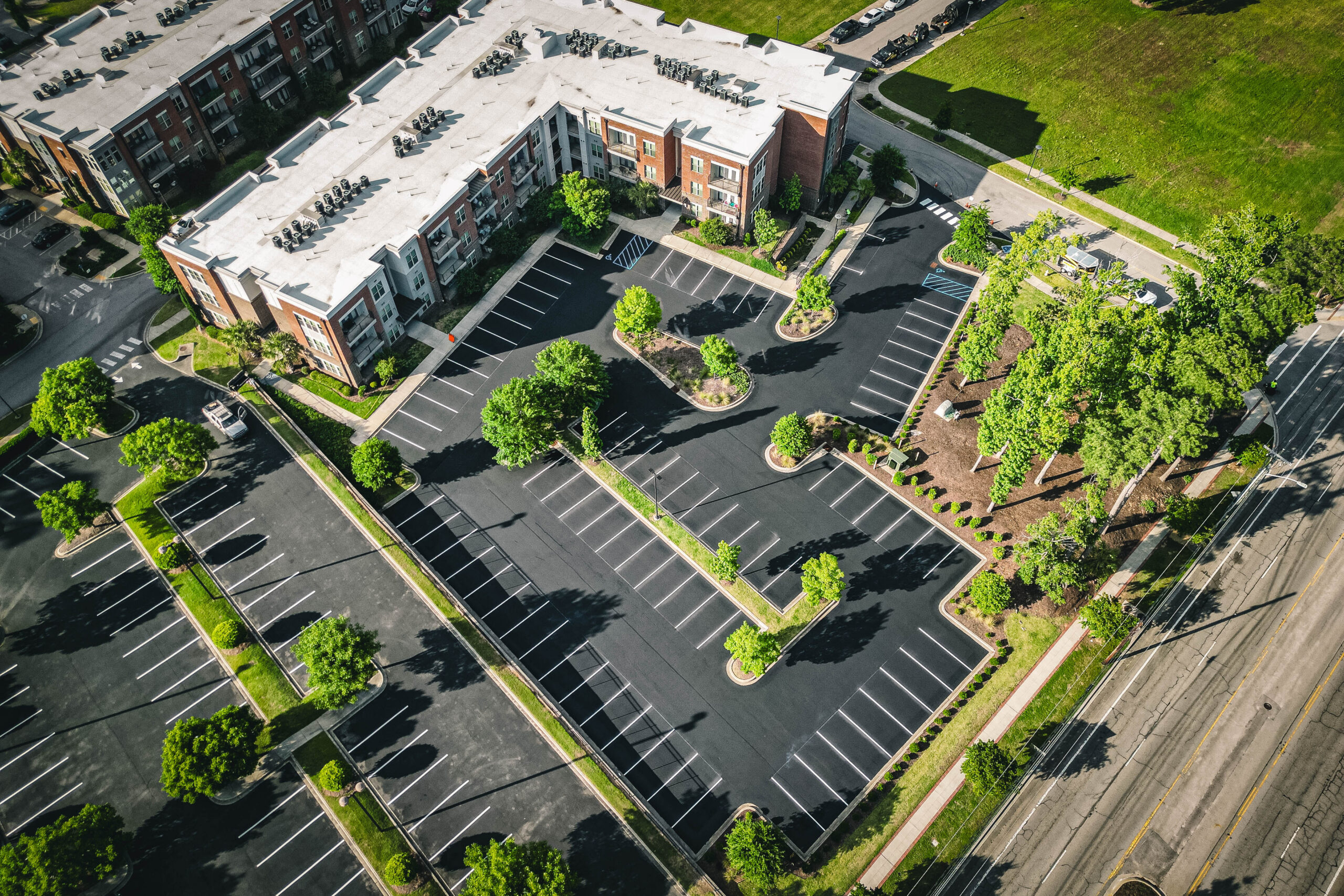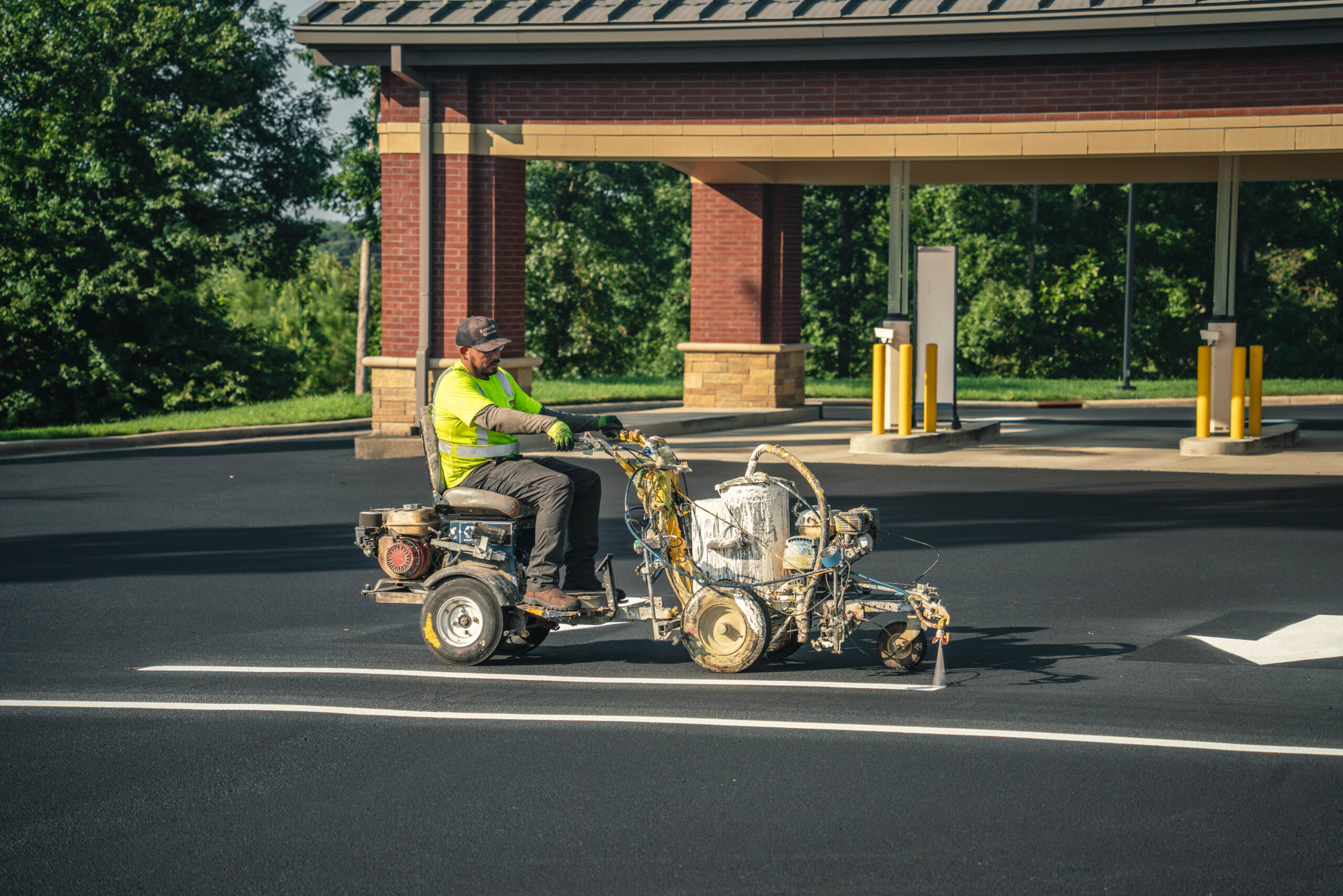

The 2010 ADA Standards limit the running slope of a curb ramp to 1:12, and a typical curb is about 6″ high. So every curb on your property is either going to guide a vehicle or catch a tire. A single apartment community in Charlotte or Greenville can have hundreds of feet of curb around islands, entrances, mailbox kiosks, dumpster pads, and sidewalk crossings. Most property managers treat that curb as a structural edge and don’t appreciate its function as a traffic signal. We at ProLine Parking Lot Maintenance paint curbs all over North and South Carolina, and we use them to guide traffic, protect pedestrians, and reduce the number of scraped bumpers that are the source of resident complaints. This article explains how we plan and apply curb markings to direct traffic without confusion.
Quick Overview
- Curb color tells drivers what to do before they even reach the sign, so you need consistent color coding.
- Island noses, entry radii, and one-way exits each warrant their own marking pattern.
- Curb ramps and detectable warning surfaces need careful treatment, and we never paint over them.
- Surface type dictates the preparation required, so we treat concrete, extruded asphalt, and granite curbs differently.
- Carolina humidity, algae, and red clay stains all change how we clean before painting.
Why Curbs Deserve a Marking Plan
A drive aisle has stripes, arrows, and stop bars. A curb has nothing on it unless it’s been marked. At dusk, the grey concrete island is virtually indistinguishable from the grey asphalt, and a driver who turns too wide will end up climbing it. The resident vehicles will then have sheared tires, cracked bumpers, and bent rims, and your leasing office will be inundated with complaints. Good, well-placed curb markings give drivers a visual reference to steer around, and they work even when the stripes on the pavement have faded.
Curbs also control traffic in areas where you can’t put pavement markings. They define the path around a building corner, can be used to narrow an entrance to slow down incoming traffic, and can separate traffic from the footpath. We plan curb markings the same way we plan arrows and stop bars, since they are all part of the same guidance system.
Building a Curb Color Code for Your Community
Private apartment communities don’t have a single statewide curb color standard, and the MUTCD generally leaves curb-color interpretation to states and localities. That freedom is a benefit, but it also creates risk: each building and contractor could be using a different scheme. We recommend picking one color code and using it throughout the property. To confirm you are using the correct scheme, contact your local fire marshal or code enforcement office to review your proposed curb color plan. Ask for their guidance or written approval before painting, especially for red or yellow curbs, as those may have legal meanings. Once you have their feedback, record the approved color code in your property’s operations manual to make sure new staff and vendors stay consistent with the system. The table below shows the code we use most frequently, and we’ll of course modify it to meet local fire marshal requirements and your community’s policies.
| Curb Color | Typical Meaning We Use | Common Apartment Locations |
| Red | No stopping, standing, or parking | Fire lanes, hydrants, sprinkler connections |
| Yellow | Loading or no parking zones | Delivery areas, building corners, mailbox kiosks |
| White | Short stops for passenger pickup | Leasing office entrance, clubhouse drop-off |
| Blue | Accessible parking only | Accessible stalls and access aisles |
| Green | Limited-time parking | Guest spaces, package pickup stalls |
| Yellow and black bands | Hazard or obstruction warning | Island noses, bollards, protruding corners |
We confirm every color with your fire dept. and local code office before painting, as a color that may be one thing in Raleigh could be another in Charleston. Once we’ve got approval, we record the color code in a one-page property guide that your team can pass on to any new staff, vendors, and residents.
Marking Islands, Radii, and One-Way Flow
Island noses get the most abuse, so we do them first. We paint the first few feet of the curb at each approaching end with alternating yellow and black stripes, and we run a solid color along the side that faces traffic. That gives the driver a clear edge at night and in the rain and tells them to steer wide. The islands at the entrances and at the ends of the parking rows benefit most, since that’s where drivers are going to cut the corner.
Entrance and exit radii require a different treatment. A tight radius at a one-way exit is a recipe for drivers cutting across the curb, so we paint the inside curve in a high-contrast color and add directional arrows on the road just before it. At an entrance, we mark both curb returns so the driver has a full opening to see and can position the vehicle correctly before turning. This reduces curb strikes and supports the one-way flow you’re after, as a driver who sees a painted curb on the wrong side knows they’ve got it wrong.
We also mark curbs at building corners and around dumpster enclosures. Trash trucks swing wide in those areas, and a painted curb helps the driver stay clear so they can complete the turn. If you’ve got mixed commercial in your community, our guide to mixed use parking striping will show you how we use the same visual language to separate the resident and customer zones.
Protecting Curb Ramps and Pedestrian Crossings
Curb ramps link parking areas to sidewalks, and people with mobility devices rely on them. We never paint over the textured detectable warning surface, as the paint would fill in the raised domes and thus remove the tactile element, which is so important for people with low vision. We’ll only paint the ramp slope itself if the product has slip resistance, as a smooth painted ramp becomes very slick when it rains. We mark the curb edges adjacent to the ramp and place the pavement markings at the approach, which is what we do.
We also check that painted curbs don’t prevent access to the ramp. A red curb spanning the ramp opening confuses both drivers and pedestrians, so we stop the paint at the edge of the ramp and note the transition. That takes a bit of extra time per ramp but prevents the type of non-compliance that would crop up in an ownership inspection.
Preparing Each Curb Type for Paint
Curb material determines how we prepare the surface. All three (concrete, extruded asphalt, and granite) will take paint; they just react differently to moisture, texture, and age. The table below shows the three curb types we encounter most frequently and the prep steps we take.
| Curb Type | Where We See It | Prep We Perform | Special Considerations |
| Poured concrete | Most apartment islands and building edges | Pressure wash, scrub algae, let dry fully | New concrete may need extra cure time before painting |
| Extruded asphalt | Budget-friendly lot edges and older communities | Sweep, wash, patch crumbling sections | Soft or oily asphalt bleeds through light colors |
| Granite | Upscale communities and downtown properties | Wash and degrease | Polished faces resist paint, so we scuff lightly |
Carolina conditions add another dimension. The humidity in Charlotte, Raleigh, and Charleston leads to algae and mildew growth on shaded curbs, and paint won’t stick to a green film. The red clay in the Piedmont stains curbs after a good rain, and we scrub those stains off before we paint so they don’t bleed through. We also wait until pollen season is over in the spring, as the yellow dust will coat a wet curb and will weaken the bond.
To keep curb markings looking good and effective year-round, we recommend scheduling curb inspections and maintenance at least twice a year—once in the spring after pollen season and once in the fall before winter sets in. During these inspections, look for faded paint, dirt buildup, mildew, algae, or red clay stains and address them promptly to ensure the paint adheres properly and stays visible. This routine schedule helps maintain safety, minimizes long-term repair costs, and lets you budget for touch-ups or cleaning in advance.
How We Paint Curbs Step by Step
We start with a walk of the entire property and sketch each curb segment onto the site plan. Our team then cleans, dries, and masks the edges so that the paint line is crisp against the pavement and the sidewalk. We then apply the base color with brushes and rollers on tight sections and with a spray rig on long, straight runs. We then stencil in any required text (e.g., NO PARKING, FIRE LANE, etc.) and paint the island bands with a taped template to ensure consistent spacing. We cone off the area until the paint has set and photograph each curb for your records.
Add Clear Curb Guidance With ProLine
Well-defined curbs protect vehicles, guide the driver, and give your community a much more finished appearance. ProLine Parking Lot Maintenance provides curb maintenance services to apartment communities throughout NC and SC, and we design curb color schemes that fit your layout, your code, and your budget. Combine that with our guide to speed hump striping and you’ve got a complete traffic calming solution.
Give us a call for a site assessment, and we’ll come out, walk the site, map every curb, and recommend the markings that will make the most difference. After the assessment, we typically provide a full proposal within two business days. Once you approve the plan, we can usually schedule your project to begin within one to two weeks, depending on weather and current workload. Most curb marking projects at apartment communities are completed in one to three days, based on property size and the amount of prep required. We keep you updated at every stage so you can plan and communicate next steps to your team and residents.
Improve Traffic Guidance With Clearly Marked Parking Lot Curbs
Clearly marked parking lot curbs help guide drivers, define traffic lanes, and identify restricted areas throughout apartment communities. At ProLine Parking Lot Maintenance, we provide professional parking lot striping and pavement marking services to help multifamily property managers maintain organized parking areas and improve traffic flow. Let our team help keep your apartment property’s pavement markings clear and easy to follow.
Contact UsFrequently Asked Questions
Do we need approval before we paint curbs on our property?
In most cases, you’ll need approval from your local fire marshal or code office before painting any curb red or installing fire lane markings, as those colors have a legal meaning. Other colors (e.g., yellow, white) are generally covered under your own property policies, although a city or county ordinance may still apply. We recommend you contact your local fire department and planning office before starting the work and obtain written approval. We’ll also help you gather the plan and photos the reviewers will request so the process moves as smoothly as possible.
How long does curb paint last in the Carolinas?
Curb paint typically lasts between one and three years (again, that depends heavily on sun exposure, traffic, and how much cars actually rub the curb). The corners and island noses wear first because tires scuff them, and shaded curbs often develop algae, which makes the paint look old before it actually fails. In coastal communities like Charleston, Wilmington, and Myrtle Beach, you’ll often see paint fade much faster because of the combined effect of salt air and sun. We recommend a visual check each spring and fall, and touch up high-wear areas before they become a safety issue.
Can painted curbs support towing enforcement?
Paint alone rarely works for towing, as most jurisdictions require a posted sign stating the rule and the towing policy. Painted curbs help residents understand the rule at a glance and can reduce the number of violations you have to deal with. We recommend checking the towing rules in NC and SC with your attorney or towing company, then matching the signs to the paint colors. When the curb color, sign wording, and lease language all match, enforcement becomes easier, and disputes decrease.
What should we do if the curb is crumbling or damaged?
Repair the curb prior to painting, as paint won’t adhere to loose concrete or soft asphalt. Small chips and spalls can be dealt with using patch compound, but larger areas may require cutting out and replacing. Severely crumbled extruded asphalt curbs may require new material, and a damaged concrete curb adjacent to a ramp may require full replacement to maintain the route’s accessibility. We work with the paving and concrete teams to complete the repairs first, then paint the repaired curb as part of the same project.
Can we make curb markings easier to see at night?
Yes, we have several options. We can add reflective glass beads to the wet paint on the island noses and corners to improve visibility under headlights. We can also use light colors on the key edges and fit reflective delineators on the bollards or posts adjacent to the curb. Good lighting is obviously important, so we recommend reviewing the pole lighting near the islands and entrances, since even the best markings won’t help if the area is dark.
What affects the cost of curb marking at an apartment community?
Four things determine most curb painting costs: total linear footage, number of colors, curb condition, and amount of cleaning. A long run of clean concrete curb will cost less per foot than a short run of stained, mildewed, or damaged curb with multiple color changes. Stenciled text and island banding will add to the labor, and so will masking around the ramps and landscaping. We’ll provide a full itemized estimate after a site visit, and we’ll show you exactly where you get the most value per dollar.