Parking lot striping does more than separate one vehicle from another. According to the Federal Highway Administration’s Manual on Uniform Traffic Control Devices, parking space markings encourage more orderly and efficient use of parking areas and can help prevent vehicles from encroaching into restricted areas, curb ramps, loading zones, and other clearance areas.
In a busy apartment community, that distinction matters every day. A faded stall line, misplaced directional arrow, confusing fire-lane marking, or poorly positioned parking space can create a small hesitation that becomes a much larger traffic problem when dozens of residents make the same maneuver.
This is especially relevant for multi-family properties in Charlotte, Raleigh, Greensboro, Huntersville, Mooresville, and Greenville, South Carolina, where apartment communities may experience heavy resident traffic, deliveries, visitors, contractors, and service vehicles within the same parking area. For property managers, the issue is not simply whether the lot looks freshly painted. The real question is whether the markings help drivers understand where to park, where to turn, and where not to drive.
The Hidden Connection Between Striping and Traffic Flow
Traffic bottlenecks are often blamed on too many vehicles or too few parking spaces. Sometimes, however, the problem is how the available pavement is organized.
Imagine an apartment entrance where two rows of parking face a narrow drive aisle. If stall lines are faded or inconsistent, drivers may park farther into the aisle than intended. Another driver approaching from the opposite direction then slows down or stops to determine who has enough room to pass.
One vehicle may cause only a few seconds of delay. Multiply that hesitation by dozens of vehicles during the evening rush, and the entrance can quickly become congested.
The problem can become even more noticeable when residents are unfamiliar with the property. Visitors, delivery drivers, rideshare operators, and moving crews depend heavily on visible pavement markings to understand the intended traffic pattern.
Faded Lines Can Cause Drivers to Park Outside the Intended Pattern
Parking space markings organize vehicle placement. The FHWA notes that parking markings encourage more orderly, efficient parking and can reduce encroachment into restricted areas.
When lines become difficult to see, drivers have less visual guidance.
That can lead to:
- Vehicles sitting too close to drive aisles
- Cars crossing into neighboring spaces
- Larger vehicles occupying multiple spaces
- Drivers stopping temporarily in travel lanes
- Residents using pedestrian areas as informal parking
- Vehicles blocking turning areas
- Confusion around visitor parking
- Delivery vehicles stopping where they obstruct circulation
The result is not necessarily one dramatic obstruction. Instead, poor striping can create a chain of small parking decisions that gradually reduce the usable width of the lot.
The “Phantom Lane” Problem in Apartment Parking Lots
One unique problem property managers should watch for is what some call a phantom lane. A phantom lane occurs when faded or conflicting markings make drivers believe a travel path exists where there is not enough pavement to support it.
For example, an old directional arrow may still be partially visible after a parking configuration changes. A resident sees the arrow and begins driving in that direction, while another resident follows the newer traffic pattern. Both drivers believe they are using the correct route. This type of confusion can create unnecessary stops, awkward turns, backing maneuvers, and conflicts near intersections.
The FHWA explains that pavement words, symbols, and arrow markings guide, warn, or regulate traffic. That makes outdated markings more than an appearance issue. They can communicate information that no longer matches how the parking lot is supposed to operate.
Poorly Aligned Stall Lines Can Shrink the Drive Aisle
A parking lot can have adequate pavement on paper while feeling unusually tight in practice. This can happen when stall lines are misaligned or when repeated patching and restriping gradually shift the layout. If parking spaces creep farther into an aisle, drivers lose maneuvering room even though the pavement hasn’t changed.
The problem is particularly noticeable with modern SUVs and pickup trucks. Consider a row where several vehicles are consistently parked beyond their intended stall boundaries. A driver approaching from the opposite direction may need to slow down, move closer to parked vehicles, or wait for another vehicle to pass.
This creates a bottleneck without reducing the number of parking spaces.
Parking Angles Can Influence Bottleneck Locations
The relationship between parking angle and circulation is another factor property managers should consider.
Perpendicular, angled, and parallel parking produce different turning movements. The current MUTCD recognizes parking space markings as part of the broader system of pavement markings used to organize traffic movement.
In an apartment community, problems can arise when the striping does not clearly communicate the intended direction of movement around those spaces.
For example:
| Striping Issue | Potential Traffic Effect |
| Faded directional arrows | Drivers hesitate or travel the wrong way |
| Uneven stall lines | Vehicles encroach into drive aisles |
| Missing visitor markings | Guests occupy resident spaces |
| Unclear fire lanes | Vehicles stop where access must remain open |
| Poorly marked loading areas | Delivery vehicles obstruct circulation |
| Conflicting old and new markings | Drivers receive mixed instructions |
| Weak crosswalk markings | Pedestrians and vehicles compete for space |
| Poorly positioned accessible markings | Vehicles may interfere with accessible routes |
The important point is that striping problems tend to compound one another. One faded marking may not cause congestion by itself, but several unclear markings throughout the same property can make the entire parking system harder to navigate.
Fire-Lane Striping Can Affect More Than Emergency Access
Fire lanes deserve particular attention because vehicles stopping in these areas can create immediate circulation problems. A resident may think that stopping near a building entrance for “just two minutes” is harmless. When several residents do the same thing during move-in weekend, package delivery periods, or evening pickup times, a designated access route can become a temporary waiting lane.
Clear markings help communicate that the area is not intended for ordinary parking or stopping. The MUTCD explains that pavement markings can convey guidance and warnings to road users, but they work best when they are visible and applied consistently with applicable standards.
For apartment managers, that means fire-lane markings should be evaluated as part of the property’s overall traffic-control strategy, not as decorative curb paint.
Accessible Parking Is Also a Traffic-Flow Issue
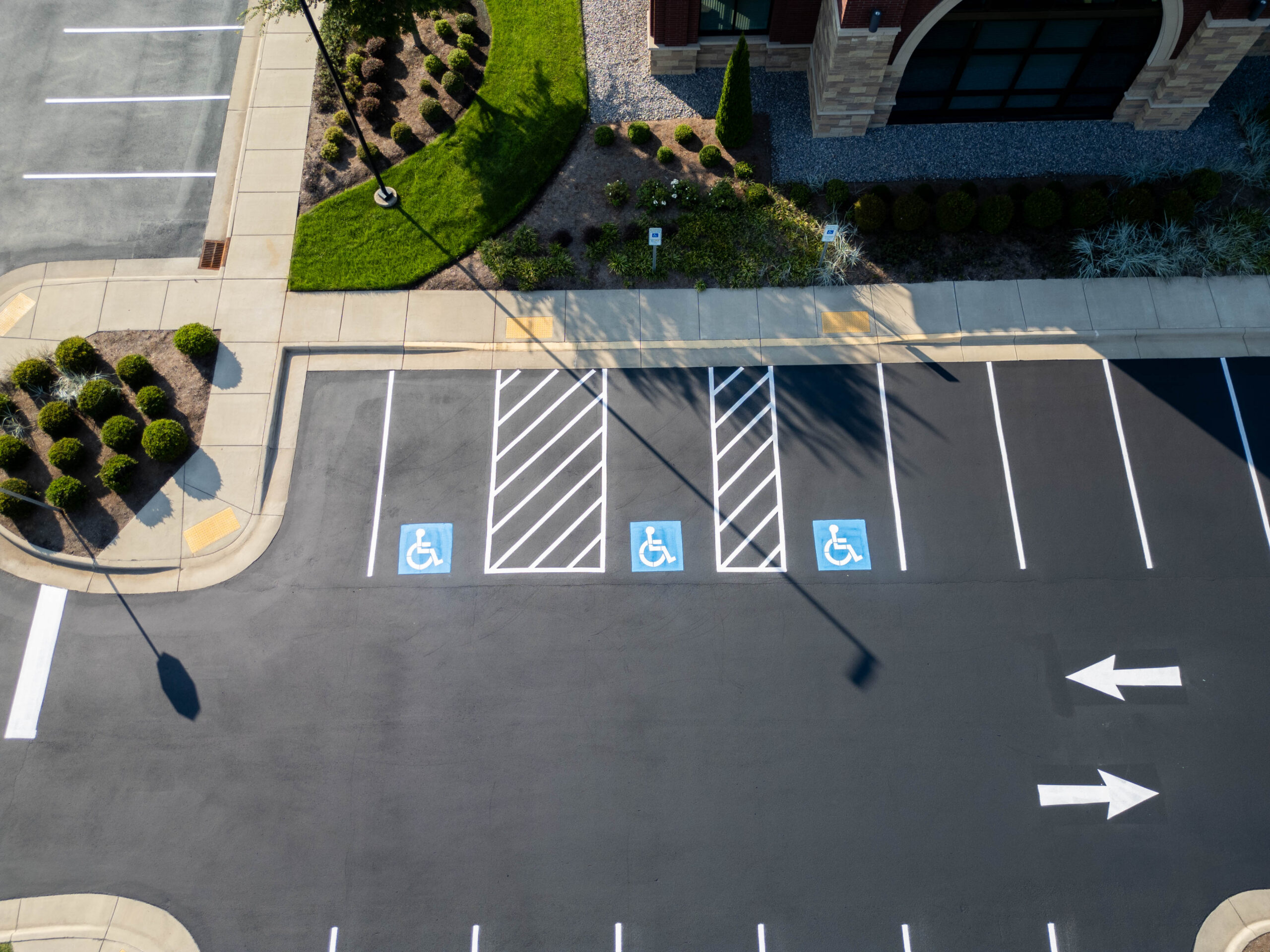
Accessible parking should not be considered separately from circulation. The ADA Standards require accessible parking spaces to be marked and establish specific dimensional requirements for car and van spaces and their access aisles.
If an accessible space is poorly positioned, faded, or partially obstructed, the consequences can extend beyond accessibility concerns. Vehicles may stop in access aisles, pedestrians may be forced into vehicle travel paths, and drivers may have to maneuver around improperly occupied spaces.
A clear, accessible parking layout, therefore, supports both accessibility and predictable movement through the property.
Crosswalks Can Reduce Pedestrian-Related Bottlenecks
Apartment parking lots are not vehicle-only environments. Residents walk from their cars to buildings, children cross drive aisles, employees move between maintenance areas, and visitors may walk toward leasing offices or amenities. When crosswalk markings fade, pedestrians may choose less predictable crossing locations.
Drivers then encounter pedestrians in places where they do not expect them. Clearly marked crossings can help establish predictable pedestrian movement. Property managers should also evaluate whether the crossing location makes sense based on actual resident behavior rather than assuming that the original crossing remains the best option years later.
The Entrance Is Usually Where Small Striping Problems Become Big Problems
If a property manager wants to identify where poor striping is causing the most trouble, start at the primary entrance and exit.
The entrance typically concentrates several activities:
- Vehicles entering the community
- Vehicles leaving the community
- Residents searching for spaces
- Visitors looking for building numbers
- Delivery drivers stopping temporarily
- Pedestrians crossing
- Vehicles turning into parking rows
- Drivers waiting for gates or access controls
A faded line near the far end of a parking lot may inconvenience one driver. A confusing line at the entrance can affect everyone behind that driver.
That is why a striping inspection should follow the property’s actual traffic patterns instead of evaluating each parking space independently.
Apartment Communities Have Peak Traffic Windows
Another useful strategy is to inspect parking circulation during the busiest periods.
A parking lot may appear perfectly functional at 10 a.m. on a weekday. The same property could become difficult to navigate between 5 p.m. and 7 p.m. When residents return from work, deliveries arrive, and visitors begin entering the community.
Property managers can document recurring congestion by observing:
- Where vehicles queue
- Which spaces are repeatedly difficult to access
- Where residents make U-turns
- Where vehicles stop temporarily
- Which entrances experience backups
- Where delivery vehicles interfere with traffic
- Where pedestrians frequently cross outside designated areas
This information can be more valuable than simply counting faded lines.
Striping Should Be Evaluated Alongside Pavement Condition
Poor striping is sometimes a symptom of a larger maintenance problem. Cracks, potholes, utility cuts, pavement patches, and resurfacing work can affect the appearance and alignment of parking markings. If the pavement needs substantial repair, repainting the existing configuration first may mean paying for striping that will later be disturbed.
A better maintenance sequence may involve:
Inspect → Repair → Prepare → Stripe → Verify
The exact sequence depends on the property’s pavement condition and scope of work, but coordinating pavement repairs with striping can reduce unnecessary rework.
Why “Just Paint Over the Old Lines” Can Make Congestion Worse
One of the most common mistakes is assuming that the existing layout is automatically the correct layout.
If the property has seen years of changes—new buildings, shifting traffic patterns, larger vehicles, modified entrances, or redesigned visitor parking—the original striping may no longer make sense.
Painting over the old lines without evaluating the layout can preserve the very problem the property manager is trying to solve.
Instead, ask:
- Are residents consistently ignoring certain markings?
- Are vehicles routinely crossing stall boundaries?
- Are visitors confused about where they can park?
- Are delivery vehicles blocking travel lanes?
- Are turning movements difficult near certain buildings?
- Are old markings still visible beneath new ones?
- Are pedestrians using unofficial crossing points?
These observations can reveal whether the problem is simply faded paint or an outdated parking strategy.
A Fresh Striping Project Can Be an Opportunity to Improve Traffic Flow
Restriping does not have to mean reproducing the existing parking lot exactly as it is.
A property manager can use the project to clarify confusing areas and make the parking system easier to understand.
Potential improvements may include:
- Re-establishing consistent stall boundaries
- Removing obsolete pavement markings
- Adding or refreshing directional arrows
- Clearly defining visitor parking
- Refreshing fire-lane markings
- Improving crosswalk visibility
- Correcting inconsistent stall alignment
- Reorganizing confusing parking zones
- Refreshing accessible parking markings
- Clarifying loading and service areas
Review any changes against applicable local requirements and accessibility standards before implementation.
A Practical Bottleneck Audit for Carolina Apartment Properties
Before scheduling restriping, property managers can perform a quick traffic-flow review.
| What to Check | What to Look For |
| Main entrance | Queues, hesitation, awkward turns |
| Drive aisles | Vehicles stopping or struggling to pass |
| Stall lines | Faded, inconsistent, or misaligned markings |
| Directional arrows | Missing, conflicting, or outdated instructions |
| Fire lanes | Temporary parking or loading activity |
| Accessible spaces | Faded markings, blocked aisles, route conflicts |
| Crosswalks | Pedestrian activity outside marked crossings |
| Visitor parking | Guests circulating repeatedly to find spaces |
| Loading areas | Delivery vehicles obstructing traffic |
| Pavement | Repairs needed before restriping |
The goal is not simply to find faded paint. It is to identify where the markings fail to communicate the intended movement of vehicles and pedestrians.
The Bottom Line for Apartment Property Managers
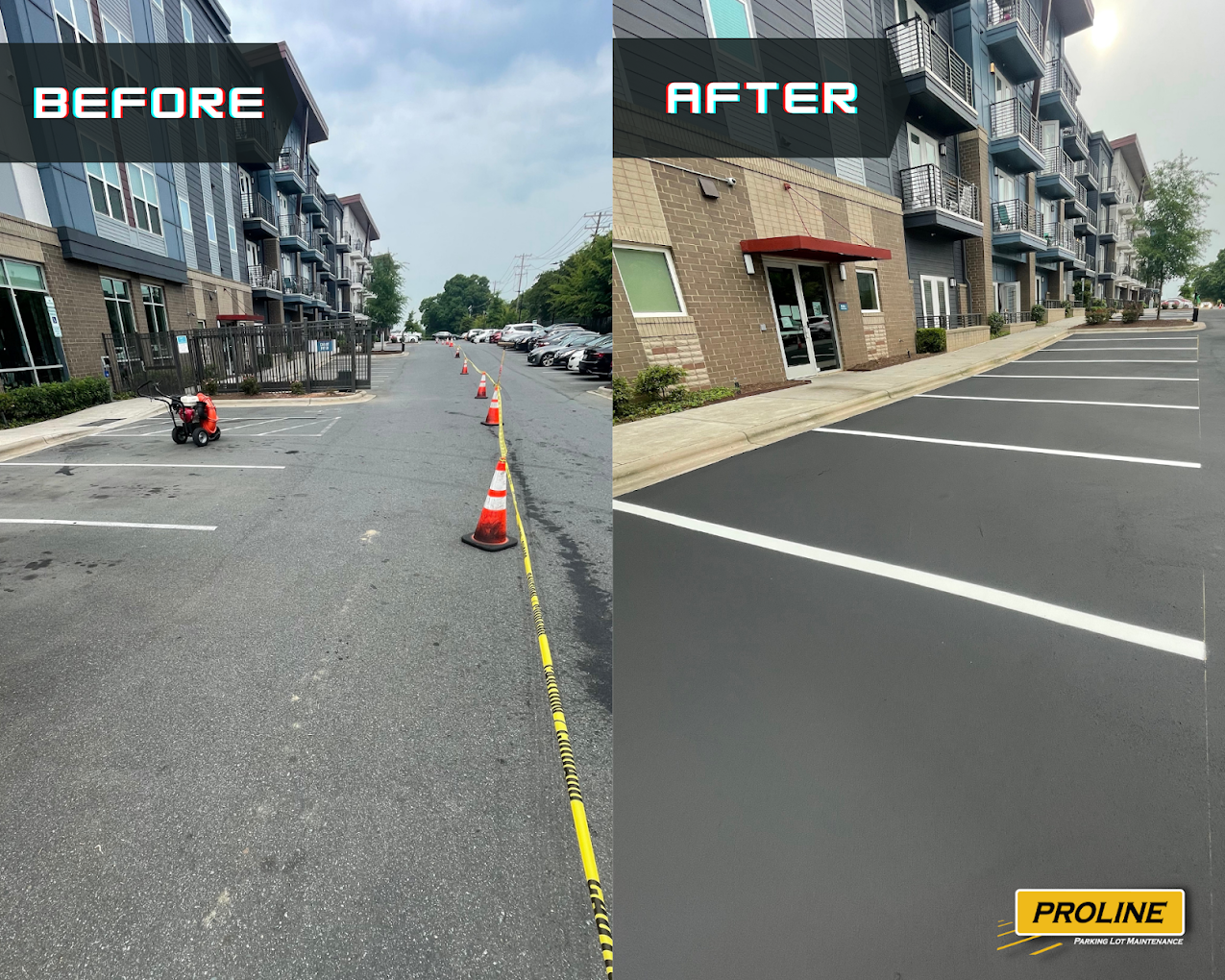
Poor parking lot striping can turn an otherwise functional apartment parking lot into a series of small traffic conflicts. When stall lines disappear, arrows become confusing, fire lanes lose definition, and pedestrian crossings fade, drivers have to make more decisions.
Those decisions can create hesitation, unnecessary backing, improper parking, blocked aisles, and eventually traffic bottlenecks.
For multi-family properties throughout Charlotte, Raleigh, Greensboro, Huntersville, Mooresville, and Greenville, a professional restriping project should therefore be viewed as a traffic-flow improvement opportunity—not simply a cosmetic upgrade.
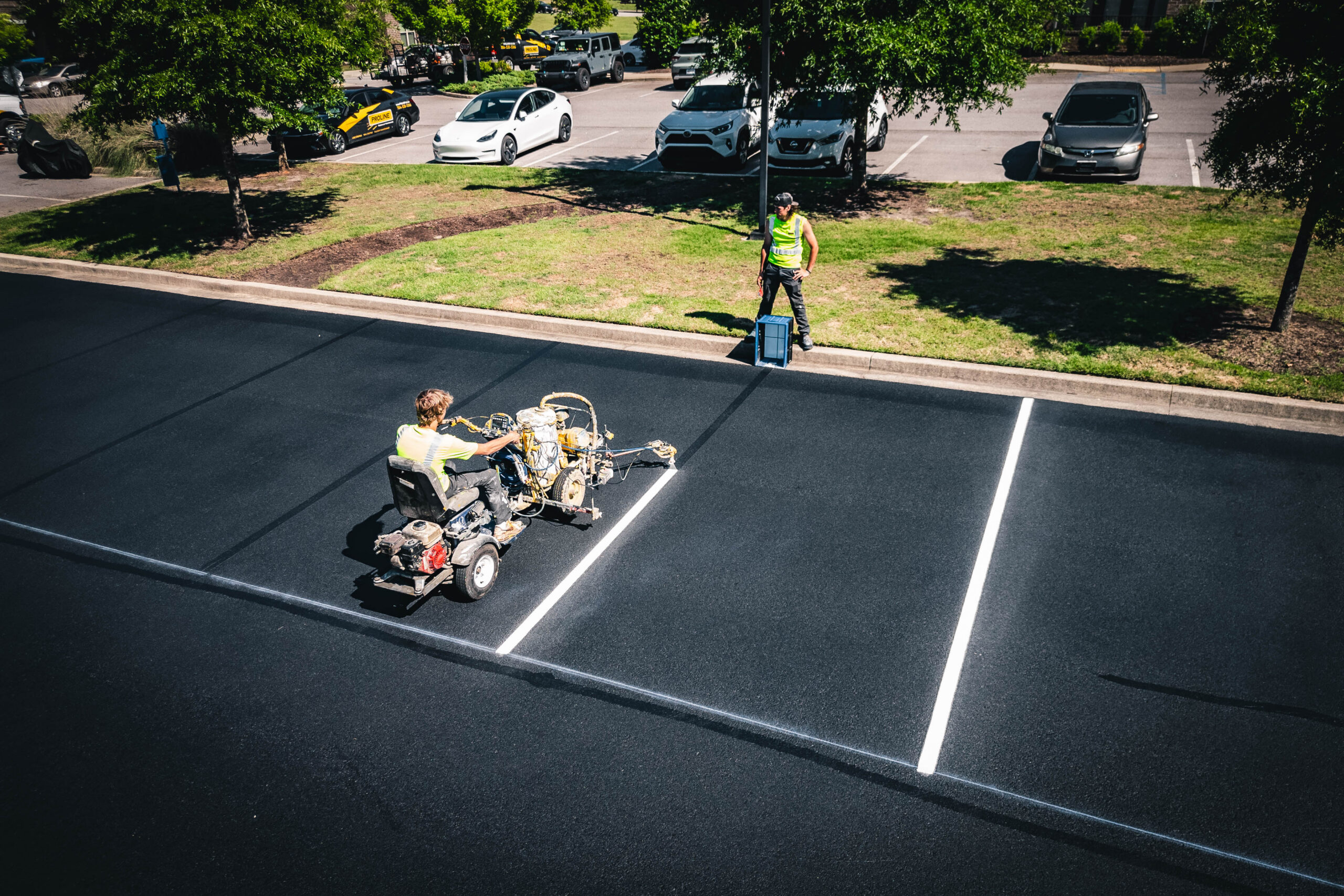
ProLine Parking Lot Maintenance can help property managers evaluate parking lot conditions and coordinate striping and pavement maintenance around the needs of an active apartment community.
Frequently Asked Questions
Can poor parking lot striping increase the risk of minor vehicle accidents?
Yes. Unclear markings can increase uncertainty about where vehicles should park, turn, or travel, particularly in busy areas with limited maneuvering space. While striping alone does not determine accident risk, clear pavement markings can provide important visual guidance to drivers. Property managers should also consider lighting, signage, pavement condition, traffic volume, and site geometry when evaluating collision-prone areas.
How can property managers tell whether congestion is caused by striping or insufficient parking?
Look at when and where congestion occurs rather than focusing only on the total number of spaces. If vehicles repeatedly stop at the same turns, cross stall boundaries, or struggle to pass despite available spaces, the layout or markings may be contributing to the problem. If the lot remains congested even when every usable space is occupied, however, the property may also have an underlying parking-supply issue that striping alone cannot solve.
Can restriping change the number of usable parking spaces in an apartment community?
It can, depending on the existing layout and applicable requirements. Reconfiguring stall boundaries, removing inefficient spaces, or changing traffic patterns can sometimes improve how effectively the existing pavement is used, while other changes may reduce the number of spaces to improve circulation. Evaluate any proposed change against local regulations, accessibility requirements, fire access, and the property’s actual operational needs.
Should apartment parking lots be restriped during the busiest resident hours?
Generally, scheduling work during peak resident traffic can create unnecessary disruption. A better approach is to coordinate the project around the property’s occupancy patterns, resident schedules, deliveries, trash collection, and other operational demands. ProLine’s published customer testimonials specifically highlight scheduling flexibility and communication as important parts of its project experience.
Do larger SUVs and pickup trucks make old apartment parking layouts less effective?
They can. A parking layout designed for smaller vehicles may feel much tighter when larger vehicles routinely occupy the same stalls and maneuver through the same aisles. Property managers should observe actual vehicle behavior before assuming that faded markings are the only cause of congestion.
What should managers do when old parking lines are still visible after a layout change?
Managers should not leave old markings in place if they conflict with the current traffic pattern. Conflicting markings can give drivers competing instructions and make the intended circulation route less obvious. The obsolete markings should be properly addressed as part of the restriping process so the finished lot communicates one clear layout.
Can parking lot striping improve the experience for delivery drivers?
It can make navigation more predictable. Clearly defined parking areas, loading zones, directional arrows, and travel paths can reduce the amount of time delivery drivers spend searching for appropriate stopping locations. This is especially useful in large apartment communities, where package deliveries happen throughout the day, and delivery vehicles can otherwise interfere with resident traffic.
How does poor striping affect pedestrians in apartment communities?
Faded crosswalks and unclear parking boundaries can make pedestrian movement less predictable. Residents may choose informal crossing points when designated routes are difficult to see, increasing interaction between pedestrians and moving vehicles. Property managers should evaluate pedestrian paths alongside parking markings rather than treating striping as a vehicle-only concern.
Does restriping alone solve apartment parking bottlenecks?
Not always. Striping can improve organization and clarify circulation, but congestion may also stem from narrow drive aisles, insufficient parking, poor entrance geometry, gates, delivery activity, pavement deterioration, or site design limitations. A property assessment should identify the underlying cause before managers assume that repainting will solve the entire problem.
How often should apartment property managers inspect parking lot striping?
No single interval works for every property because traffic volume, weather, pavement condition, paint quality, and maintenance practices vary. Instead of relying solely on a calendar, managers should inspect markings when they become difficult to distinguish, after significant pavement work, and whenever residents repeatedly report parking or circulation problems. Regular inspections allow property managers to address small visibility and layout issues before they become larger operational problems.
See also: The Operational Benefits of Professional Multi-Family Line Striping Services, Common Line Striping Mistakes Apartment Property Managers Should Avoid