Ask a property manager what happens when a parking lot’s lines start disappearing, and you may hear a familiar list: residents parking too close to neighboring vehicles, visitors using the wrong spaces, blocked areas, and complaints about parking. It is easy to think of those issues as separate problems. In reality, they can start with something as simple as faded or poorly defined pavement markings.
The Federal Highway Administration (FHWA) recognizes pavement markings as an important part of traffic control. Its Manual on Uniform Traffic Control Devices (MUTCD) explains that parking-space markings can encourage more orderly and efficient use of parking spaces while helping prevent vehicles from encroaching into restricted areas. Federal Highway Administration — MUTCD
An apartment parking lot is used by residents, guests, delivery drivers, maintenance crews, contractors, and emergency responders. Everyone has somewhere to go, and most people expect to figure out the parking lot without needing instructions from the leasing office.
Clear line striping helps make that possible.
Parking Lots Need Visual Order
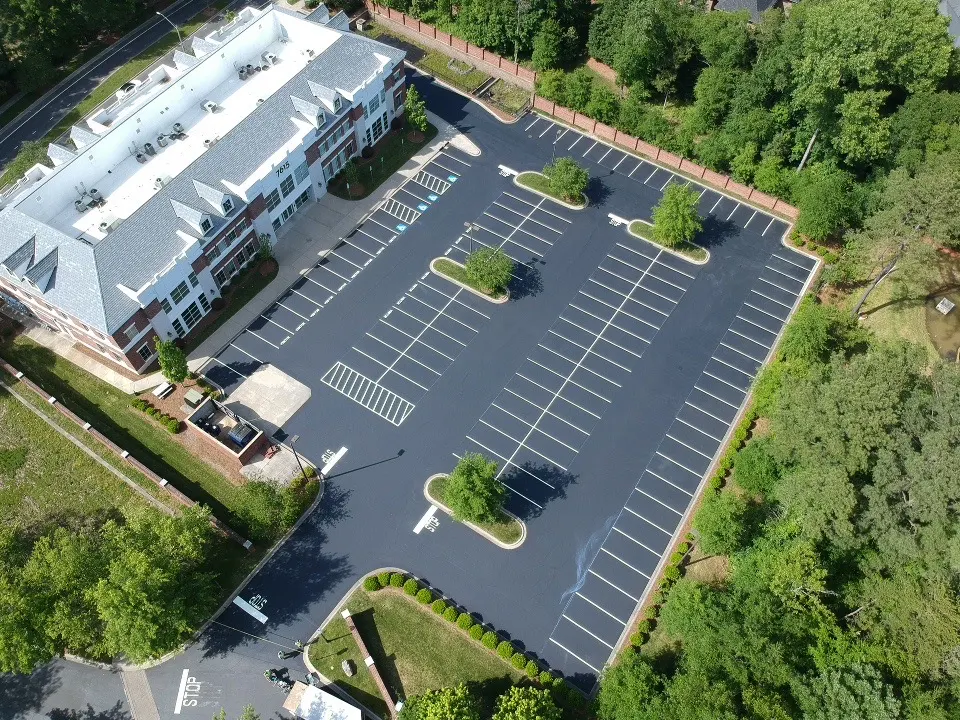
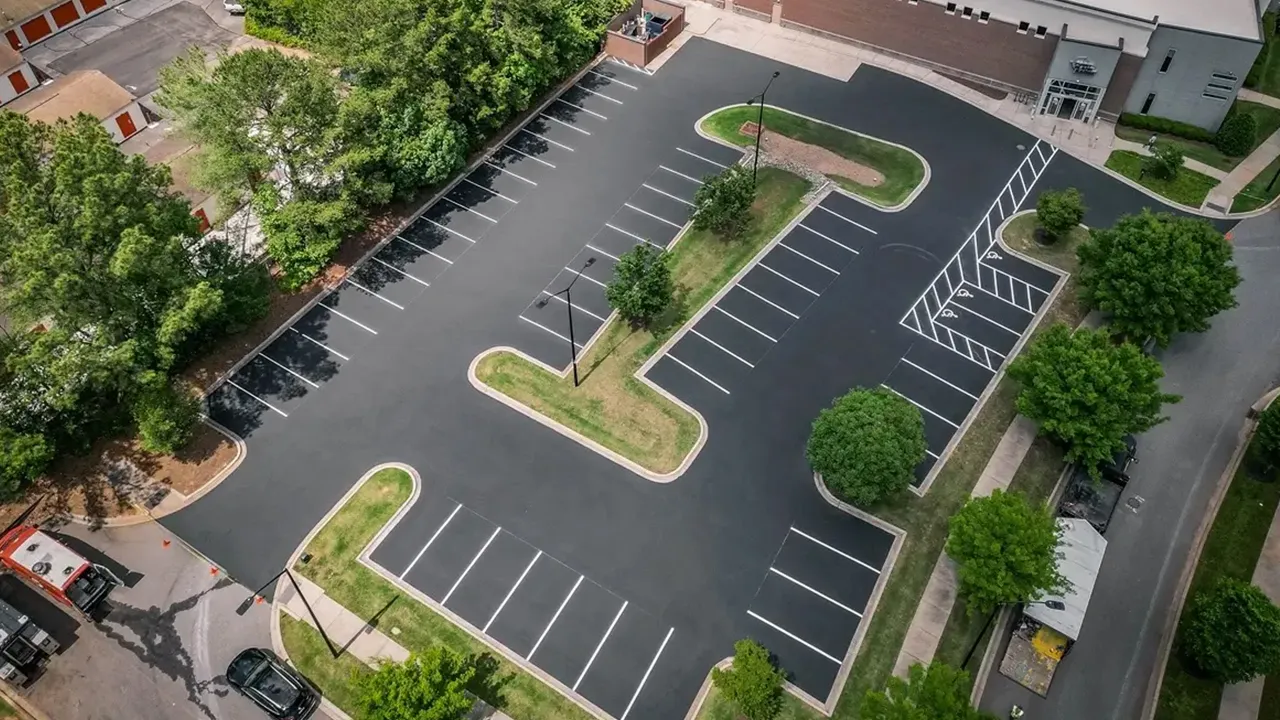
A large apartment parking lot can look straightforward from above. On the ground, it is a different story. There may be several buildings, multiple entrances, visitor spaces, accessible parking, fire lanes, loading areas, drive aisles, pedestrian crossings, and designated parking zones.
Without clear markings, drivers have to make more decisions for themselves.
Where does this parking space begin?
Is this area a driving lane or a parking area?
Can I turn here?
Is that space reserved?
Where should I stop?
Good striping answers many of those questions without requiring a sign or conversation. That is one of the reasons pavement markings are so useful. They communicate directly with drivers while they are moving through the property.
Clearly Defined Spaces Help Keep Vehicles in Their Place
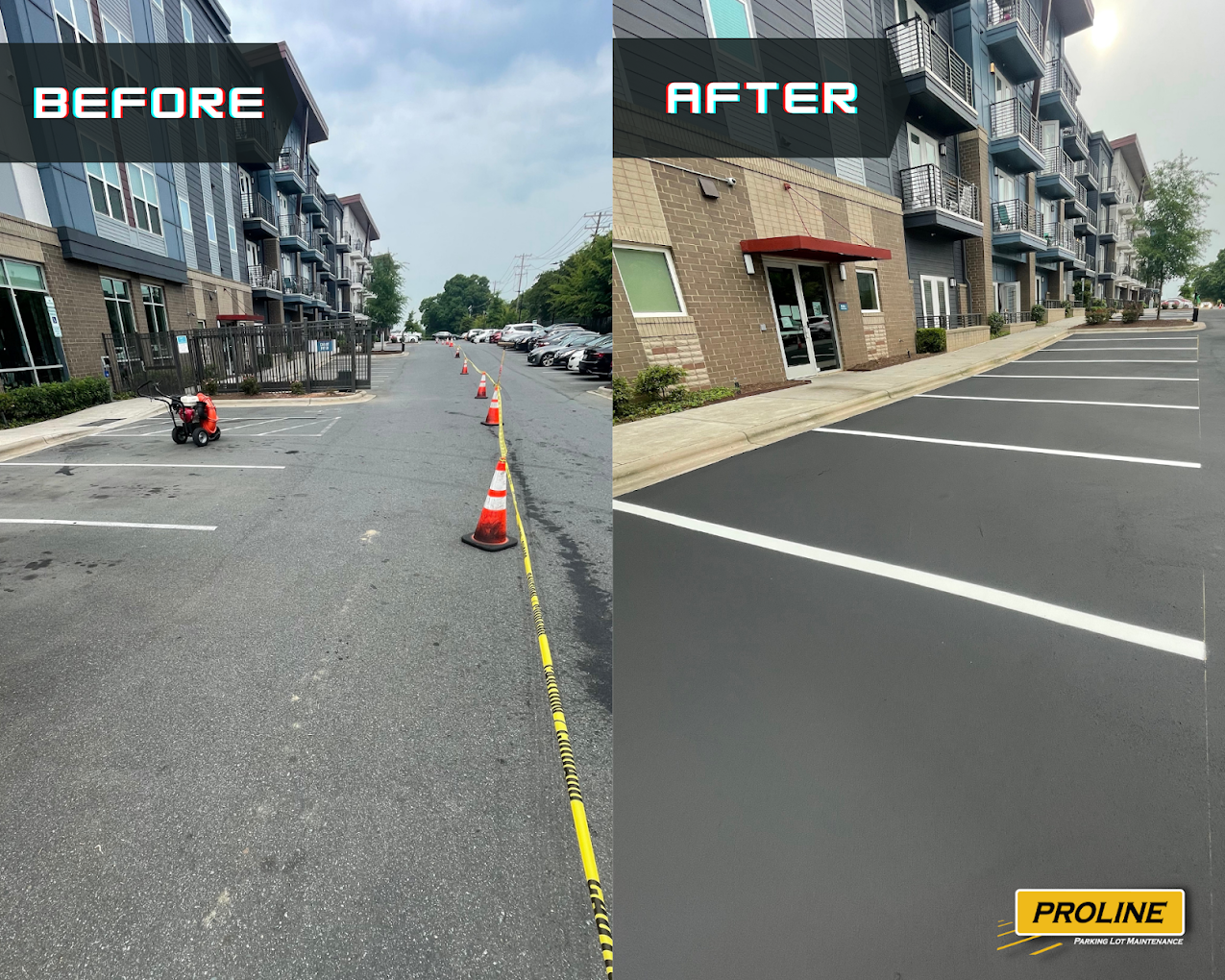
Parking stalls are the foundation of an organized parking lot. When stall lines are crisp and easy to see, drivers have a clear visual boundary for positioning their vehicles. When those lines fade, parking can become less consistent.
One resident parks a little too far to the left. Another compensates by moving right. A third vehicle ends up close to the drive aisle. How Line Striping Supports Better Parking Lot Organization in Multi-Family Communities
Consider a 200-unit apartment community
Suppose a community has 300 parking spaces serving 200 apartments. During a busy evening, most spaces are occupied. A handful of residents park slightly outside the intended boundaries because the lines are difficult to see.
That small amount of inconsistency can affect several spaces around them. Fresh striping will not solve every parking issue, but it restores the visual boundaries that help residents position vehicles consistently.
Line Striping Makes Different Parking Areas Easier to Understand
Not every parking space serves the same purpose.
Multi-family communities may have the following:
- Resident-assigned spaces
- Visitor parking
- Accessible parking
- Guest loading areas
- Short-term parking
- Motorcycle spaces
- Fire lanes
- Loading zones
- Reserved spaces
When those areas are clearly marked, drivers have fewer opportunities to misunderstand how the parking lot is supposed to work. This becomes especially important for visitors.
A resident may know that spaces near Building C are reserved for residents, while a first-time visitor may not. Clear markings and complementary signage can make that distinction much easier to understand.
Directional Arrows Can Make a Complicated Lot Feel Simpler
Some apartment communities have parking lots that function almost like small road networks. A driver may enter through one entrance, follow a one-way drive aisle, turn around a building, and exit through another section of the property.
Without directional markings, visitors may not realize that a particular lane is intended for one-way traffic. Directional arrows provide a quick visual cue.
The MUTCD includes pavement arrows and other symbols among the markings used to communicate traffic information to road users. Federal Highway Administration — Pavement Markings
Example: A large community with multiple entrances
Imagine an apartment community with two entrances and a central parking area. Residents know that the interior drive aisle should be traveled in one direction, but new residents and delivery drivers frequently enter from the wrong side.
The property manager receives complaints about drivers going the wrong way. Adding or refreshing directional arrows can reinforce the intended circulation pattern and make the layout easier for unfamiliar drivers to understand.
Organized Parking Can Make Visitor Parking Easier to Manage
Visitor parking is often one of the biggest sources of frustration at multifamily properties. The problem is not always a lack of spaces. Sometimes, the issue is that visitors cannot easily tell which spaces are intended for them.
Clear markings can help distinguish visitor parking from resident or reserved spaces. That does not replace a community’s parking policy or enforcement process, but it gives those policies a physical presence in the parking lot.
A sign saying “Visitor Parking” is helpful. A sign combined with clearly marked visitor spaces is even easier to understand.
Line Striping Helps Create Consistency Across Large Properties
Large apartment communities often contain several parking areas that were built or modified at different times. As a result, one section may have bright, visible markings while another has faded lines and outdated pavement symbols.
That inconsistency can make the property feel disorganized. A comprehensive striping project gives property managers an opportunity to review the parking areas together. Instead of asking, “Does this section have enough paint?”Management can ask a more useful question:
“Does the entire property communicate parking rules consistently? ”
That shift in perspective can lead to better long-term parking management.
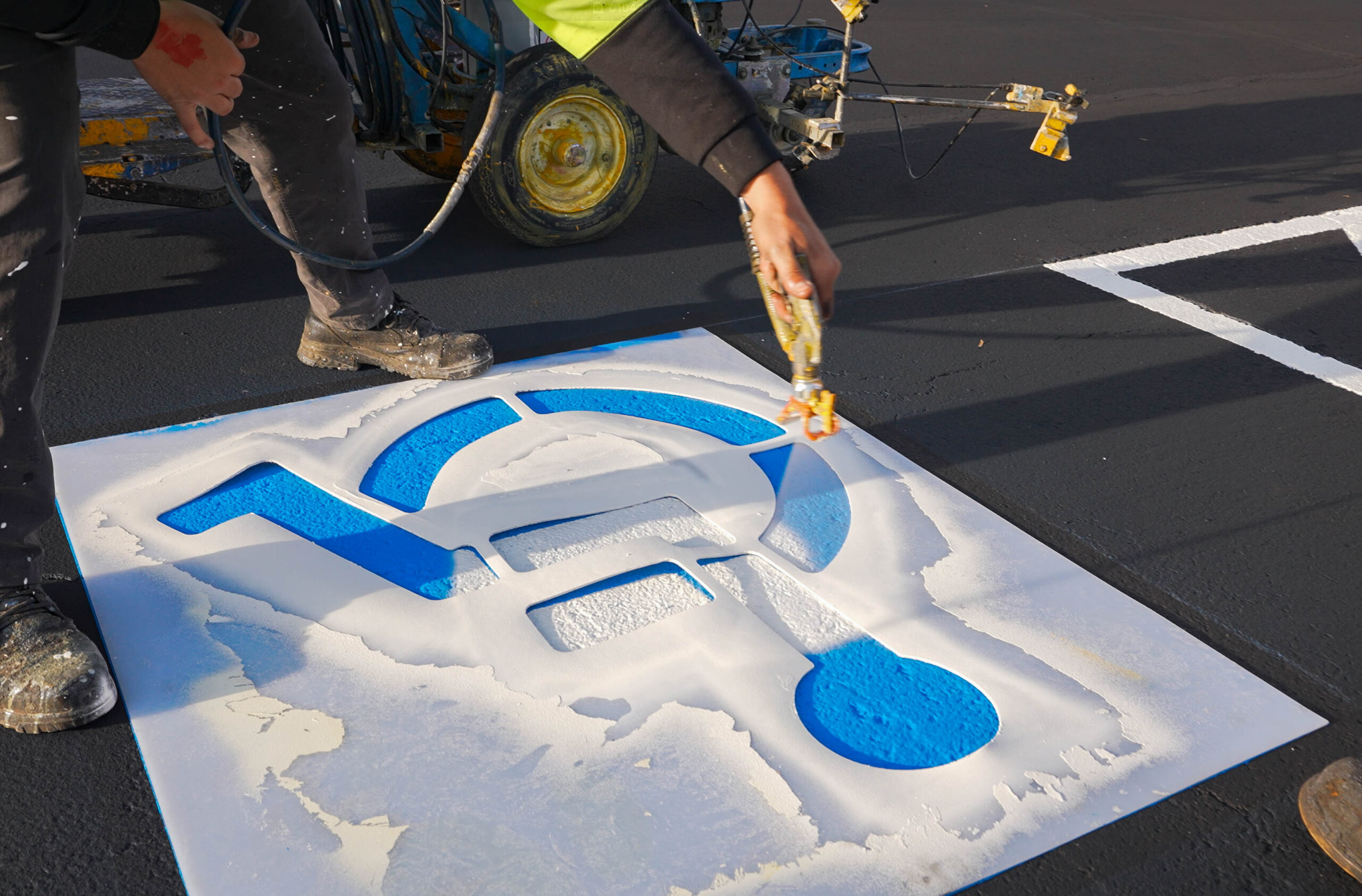
Accessible Parking Requires More Than a Painted Symbol
Accessible parking spaces are another important part of parking-lot organization. The U.S. Department of Justice explains that accessible parking requirements can include the number and location of accessible spaces, access aisles, dimensions, signage, and connections to accessible routes. U.S. Department of Justice — Accessible Parking
That means property managers should look beyond the wheelchair symbol when evaluating these spaces.
Example: An accessible space with a faded access aisle
A property may have a clearly visible accessible parking symbol, but the adjacent access aisle has faded almost completely. A driver unfamiliar with the property could mistake that area for another parking space.
Regular striping inspections can help identify these issues before the markings become difficult to recognize.
Property managers should always verify current federal, state, and local requirements for their specific property rather than assuming that repainting alone establishes compliance.
Fire Lanes and Restricted Areas Need to Be Obvious
Parking organization is also about showing drivers where they cannot park. Fire lanes, loading areas, intersections, curb areas, and other restricted zones should be clearly identified according to the property’s applicable requirements.
When markings fade, residents may treat restricted areas as temporary parking spots.
Picture a busy Saturday afternoon
A resident pulls into a fire lane for “just five minutes” while carrying groceries into the building. Another resident sees the same thing and assumes the area is acceptable for short-term parking.
Before long, the restricted area becomes an informal loading zone. Clear markings, signs, and consistent enforcement can help prevent that pattern from becoming normal.
Better Organization Can Make Property Management Easier
Parking lot organization does not only benefit drivers. It can make the property easier for managers and maintenance teams to oversee.
When spaces and restricted areas are clearly defined, property staff can more easily identify the following:
- Unauthorized parking
- Vehicles outside designated stalls
- Blocked access areas
- Misused visitor spaces
- Faded markings
- Damaged pavement
- Areas needing maintenance
In other words, good striping gives property managers a clearer picture of how the parking lot is being used.
Striping Can Support a More Professional Property Appearance
There is also an aesthetic benefit. Residents and prospective renters see the parking lot frequently. In many communities, it is one of the first exterior areas visitors encounter.
Fresh, straight, consistent markings can make an older parking lot look significantly more organized. That does not mean paint should be used to hide pavement problems. If asphalt is cracked, failing, or experiencing drainage issues, those conditions should be addressed as part of a broader maintenance plan.
But when the pavement is in reasonable condition, professional striping can be a relatively straightforward way to refresh the property’s appearance.
Line Striping Can Be Especially Valuable After Property Improvements
Apartment communities change. A property may renovate its clubhouse, add package lockers, change its leasing office, modify entrances, or add new amenities.
Those changes can alter traffic and parking patterns.
Example: A new package center
An apartment community converts an underused storage area into a package pickup center. Suddenly, delivery drivers and residents are visiting that area throughout the day.
The old parking configuration was designed before the package center existed. During the next striping project, management can evaluate whether additional loading spaces, pedestrian markings, directional arrows, or short-term parking areas would make the new traffic pattern easier to manage.
The point is not simply to paint over old lines. It is to make sure the pavement markings still make sense for the property as it exists today.
Good Striping Does Not Replace Good Parking Policies
Even the best-marked parking lot cannot prevent every parking problem. Residents still need clear policies regarding assigned spaces, visitor parking, overnight parking, towing, loading areas, and unauthorized vehicles.
The physical parking layout and the property’s rules should work together. For example, a sign may tell residents that a particular area is reserved for visitors. Pavement markings can reinforce that message by clearly identifying the visitor spaces.
When policies and physical markings agree, residents have fewer opportunities to claim that a rule was unclear.
Annual Reviews Help Keep Organization From Gradually Breaking Down
Parking lots rarely become disorganized overnight. Instead, markings fade gradually. Signs become weathered. Pavement gets repaired. New buildings are added. Traffic patterns change. Residents develop informal parking habits. That is why periodic parking lot assessments are useful.
ProLine Parking Lot Maintenance recommends incorporating parking-lot inspections into an ongoing maintenance program and evaluating markings alongside pavement, drainage, lighting, and other site conditions. ProLine Parking Lot Maintenance
An annual review can help property managers identify small problems before they become part of the property’s normal routine.
Professional Line Striping Gives Multi-Family Parking Lots Structure
A well-organized apartment parking lot does not happen by accident. It depends on a combination of good layout, visible pavement markings, appropriate signage, maintenance, and consistent parking policies. Line striping provides the visual structure that ties many of those elements together.
For property managers, the goal should not simply be to have parking spaces that look freshly painted. The goal is to create a parking environment where residents and visitors can quickly understand where to park, where to drive, where to stop, and which areas require special attention.
That can mean fewer moments of hesitation, fewer preventable misunderstandings, and a parking lot that feels easier to use.
For multi-family communities throughout North Carolina, ProLine Parking Lot Maintenance can evaluate existing pavement markings and recommend a striping approach based on the property’s layout, traffic patterns, parking needs, and overall maintenance condition.
Eliminate Parking Chaos with Strategic Multi-Family Line Striping
Without defined pavement boundaries, parking lots quickly dissolve into disorder—leading to resident disputes over reserved bays, blocked access lanes, and overcrowded parking zones. Clear, professional line striping establishes structured organization across your community by cleanly demarcating tenant spaces, visitor zones, EV charging stalls, and oversized vehicle parking.
ProLine Parking Lot Maintenance designs and paints organized layout systems that maximize space utilization, improve resident convenience, and simplify parking enforcement.
- Maximized Parking Capacity: Precision stall spacing and layout re-engineering to fit more usable vehicle spaces without compromising safety.
- Clear Zone Designations: Custom stenciling for assigned tenant spots, guest bays, maintenance zones, and EV charging stations to eliminate parking confusion.
Frequently Asked Questions
Can line striping help property managers identify unused parking spaces?
Yes, a properly documented parking layout can make it easier to evaluate how different portions of a property are being used. Managers can compare marked spaces with occupancy observations to identify areas that consistently remain underused or become congested. This information can be useful when reviewing future parking policies or considering changes to the property’s layout.
Should apartment parking spaces be numbered?
Numbering can be useful when a community assigns specific parking spaces to residents or uses designated parking zones. However, the decision depends on the property’s parking policy and how spaces are managed. Numbers should be applied consistently and maintained alongside the physical stall markings so residents can easily match their assigned space with the property’s records.
Can striping help with apartment parking enforcement?
Clear markings can make it easier for property staff to determine whether a vehicle is occupying a designated space or restricted area. They can also provide a physical reference when management communicates parking rules to residents. Enforcement still depends on the property’s policies, lease terms, signage, and applicable local requirements, so striping should be viewed as a supporting tool rather than an enforcement system.
How should property managers handle parking lots with several different pavement surfaces?
Different pavement surfaces may require different preparation and marking considerations. Before restriping, the contractor should evaluate the condition and type of each surface to determine whether repairs, cleaning, or other preparation are necessary. Treating every section the same without considering surface conditions can lead to inconsistent results.
Can line striping make a small parking lot feel less crowded?
It can make the space easier to understand, but striping does not physically increase the number of parking spaces available. Clear boundaries can help drivers use the existing layout more consistently and reduce unnecessary encroachment into drive aisles or neighboring spaces. If a property has a genuine parking shortage, management may need to consider broader parking-management or site-planning solutions.
What should managers photograph during a parking lot organization assessment?
Useful photographs can include faded stall lines, damaged pavement markings, unclear directional arrows, accessible spaces and access aisles, visitor parking areas, fire-lane markings, and confusing intersections. Photos of the entire parking section can also provide context that close-up images may miss. Keeping dated photographs can help managers compare conditions from one inspection to the next.
Can restriping help after asphalt repairs?
Yes, but the timing matters. If pavement repairs alter or remove existing markings, the affected areas may need to be restriped after the repair work has been completed and the pavement is ready for marking. Coordinating the two projects helps ensure that new markings accurately reflect the finished pavement surface.
What information should an apartment manager give a striping contractor?
The contractor should receive information about the property’s parking layout, known problem areas, assigned and visitor parking policies, accessible parking locations, anticipated changes, resident access requirements, and any upcoming pavement work. Sharing site plans or previous striping layouts can also help the contractor understand the property’s existing configuration. A site walkthrough is particularly useful when the parking lot has multiple buildings or complicated circulation patterns.
Does better parking organization improve resident satisfaction?
A well-organized parking environment can remove some of the everyday frustrations associated with finding and using parking spaces. It cannot guarantee resident satisfaction because parking availability, pricing, assigned spaces, and enforcement policies also influence how residents feel about parking. Still, making the physical parking environment easier to understand can eliminate some avoidable sources of confusion.
How often should multifamily property managers evaluate parking lot organization?
There is no single inspection interval appropriate for every property, but incorporating a parking review into an annual maintenance cycle is a practical approach. Properties with heavy traffic, harsh weather exposure, frequent pavement work, or recurring parking complaints may benefit from more frequent inspections. The important point is to identify changes in marking visibility and parking behavior before the layout becomes difficult for residents and visitors to follow.
See also: Why Professional Line Striping Is Essential for Multi-Family Apartment Communities, Why Professional Line Striping Improves Safety at Multi-Family Properties