The National Safety Council says that over 50,000 crashes take place each year in parking lots and parking garages all over the United States. It is precisely the situations found in high-density apartment communities—such as those with more turns, more blind corners, and more vehicles competing for the same drive aisle—that result in a greater number of these crashes. The Federal Highway Administration’s Manual on Uniform Traffic Control Devices specifies a standard line width of 4 inches for parking stall markings, a standard originally intended for public roads that most paving contractors continue to use as their reference when carrying out work on private apartment parking lots, since drivers interpret a 4-inch white line in the same way whether they are on Main Street or entering their own residential complex. At ProLine Parking Lot Maintenance, we are more frequently asked by high-density communities than by any other kind of property. This is because when more units are fitted into the same area, it usually means there are more parking decisions to be made within a few hundred feet of pavement.
The article sets out in detail the differences between striping in a high-density apartment development and striping in a spread-out suburban one and explains exactly what changes we make on the ground in order to reduce confusion. For communities that are increasing the number of units within the same area or converting a low-density site into a higher-density one, this is the list that we go through before the striping team arrives.
Why High-Density Lots Create More Decision Points Per Hundred Feet
In a garden-style community with wide individual plots, a driver might have to make a turn once every 20 spaces. But if you put the same number of units onto a smaller area, then that same driver will now have to deal with a turn, a merge, or a pedestrian crossing every 8 to 10 spaces. At each of these points, the driver has to make a quick decision—whether this aisle goes that way, if that space is free, or whether that line allows me to park there. When you pile up several such decisions over a short length of road, even a driver who has lived at the property for years begins to make errors, not due to carelessness but because the layout is requiring more of them each minute than a less dense arrangement ever would.
Stall Angle and Aisle Width Decide How Much Confusion You Build In
The angle that is used for the stalls affects both the number of spaces that can fit and the amount of mental effort each driver has to put in order to park correctly. Parking design guides, such as those published by the Institute of Transportation Engineers, usually recommend these typical ranges:
| Stall Angle | Typical Aisle Width Needed | Traffic Flow | Best Fit For |
| 90 degrees | 24 to 25 feet | Two-way | Lower-density lots with room to spare |
| 60 degrees | 18 to 20 feet | One-way only | High-density retrofits needing more stalls per foot |
| 45 degrees | 13 to 15 feet | One-way only | Very tight infill sites maximizing stall count |
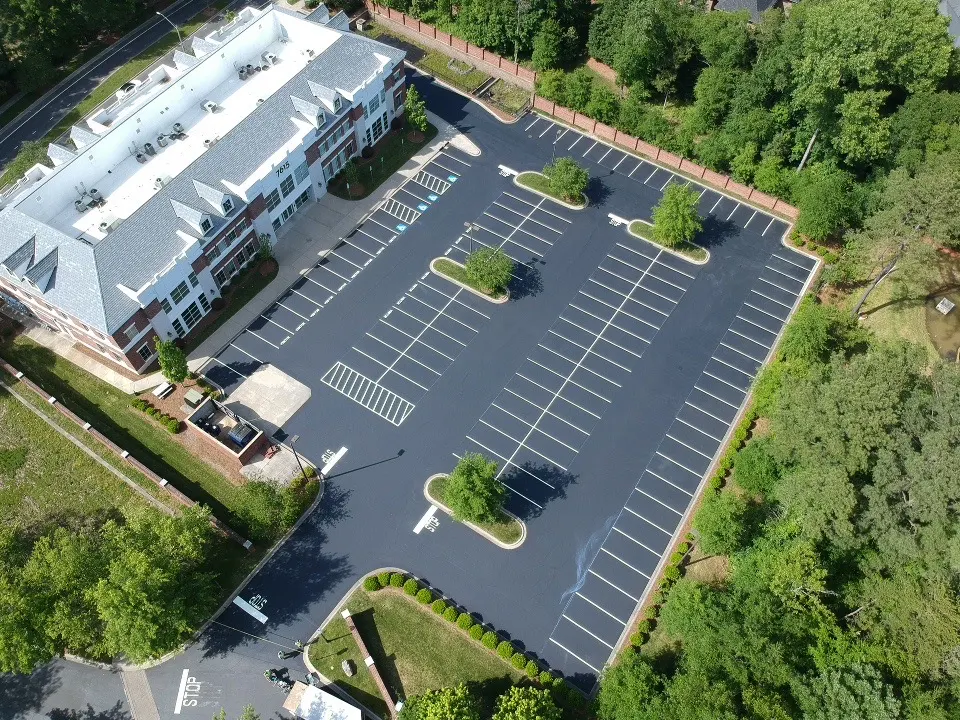
Stalls that are angled allow a given area to accommodate more cars even though the space is smaller, but this advantage only applies if there is a one-way aisle, and that aisle can only function in one direction if the parking stripes actually indicate to drivers the way they should go. We often come across communities that have changed to 60-degree angled parking in order to get more stalls but have not included the one-way arrows and entrance signage that the layout requires, so residents continue to drive in against the flow out of habit, resulting in a higher number of head-on collisions than those caused by the previous 90-degree layout.
Directional Arrows and One-Way Striping Prevent Head-On Conflicts
One-way aisles with angled parking spaces help reduce confusion only if the striping specifies direction, not merely the parking angle. We include a through arrow at the entrance of each one-way aisle and another at the midpoint as well, so a driver who misses the first arrow still gets a second hint before deciding to go the wrong way. When a one-way aisle joins a two-way collector lane, we put a ‘DO NOT ENTER’ stencil facing the wrong-way approach, since a driver coming from the collector lane has no means of knowing that the aisle only goes one way without that stencil. All the aisles on the premises use the same arrow design and placement because if a resident had to relearn the striping rules in each part of the car park, they would create exactly the kind of confusion this arrangement is meant to eliminate.
Line Width, Color, and Retroreflectivity Standards That Actually Get Read at Night
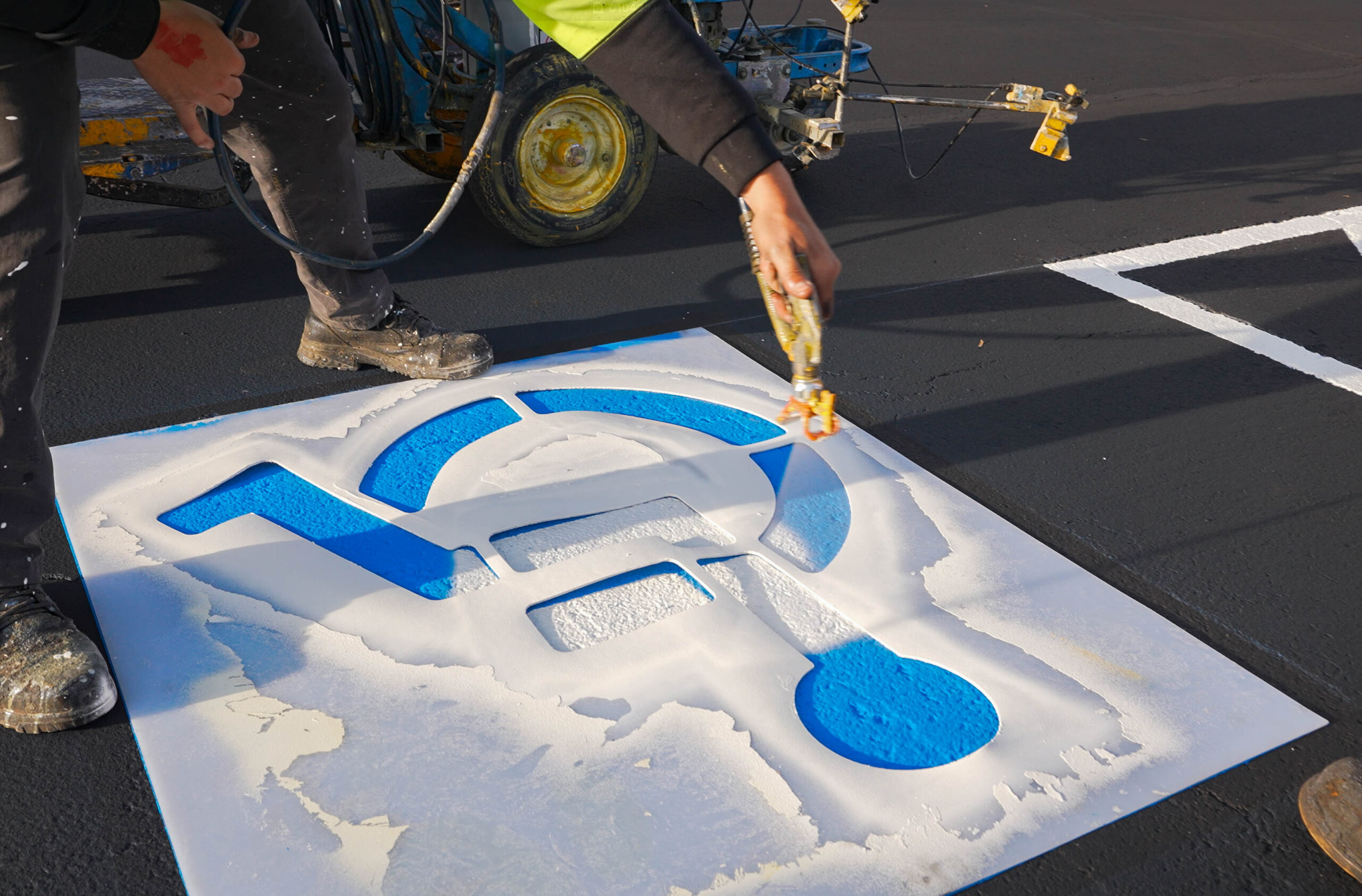
A driver must be able to understand a line’s meaning without thinking about it, and for that to happen, the color must stay consistent throughout the property. We apply white to ordinary stalls, blue to accessible stalls and the striped access aisles associated with them in accordance with the 2010 ADA Standards, and use red or yellow for fire lanes and no-parking areas, never altering this system from one part of the site to another. The retroreflective glass beads, which comply with the material standards published by ASTM International for traffic paint, are added to the paint. At the same time, the paint remains wet, so headlights reflect light to the driver rather than the line becoming invisible after sunset. In high-density areas, there is greater nighttime traffic turnover due to shift workers and latecomers than in low-density areas, and a line that still appears clear in the daytime can already be almost invisible at night when the beads have worn thin, long before the paint itself has faded enough to require repainting.
Numbered and Assigned Space Stenciling Reduces Resident Disputes
Dense communities exhaust their spare parking spaces more quickly than dispersed ones and therefore allocate or reserve particular spots rather than allowing all spaces to be used on a first-come, first-served basis. The numbers or letters are stenciled onto the assigned parking spaces in such a way that they are easily readable through a windscreen when a driver is backing into the space, not only when driving in with the front of the car, since most of the residents park with the nose of their vehicles facing in and need to check the number as they leave, not just when they arrive. Clear, consistent stencils give the leasing office and the local towing company a common reference point if a dispute arises, rather than relying on one resident’s statement against a neighbor’s about who owns which space. Before painting, we match the stencil arrangement to the property’s current parking assignment list because retouching old, incorrect numbers only relocates the dispute without solving it.
Crosswalk Striping Where Density Increases Foot Traffic
Having more units within the same area means that more residents will need to walk from their cars to the building, to their mailboxes, or to the dumpster area, usually having to cross a live drive aisle in order to do so. We choose to use ladder-style crosswalk striping—that is, wide parallel bars placed at right angles to the direction of travel—rather than simply two parallel lines because the ladder pattern remains visible to a driver’s peripheral vision from a greater distance. Crosswalks are most important in situations where a drive aisle also serves as a fire lane, since that particular section of pavement has to remain clear for fire equipment while at the same time handling the highest amount of foot traffic on the property. We put the crosswalk striping on the shortest and most direct route between a building entrance and the nearest parking row because residents will take the shortest path regardless of whether it is marked, and an unmarked shortcut across a blind corner is worse than having no crosswalk at all.
Restriping Frequency in High-Turnover Lots
Rubbing from tire contact, not just the passage of time, causes wear, so a high-density site with a constant flow of vehicles experiences considerably more wear on its striping than a smaller, lower-density site of the same size does over the same period. We examine wear first at entry points, corners, and any parking space near the leasing office or mailboxes, since these areas see the most tire movement each day and fade long before the rest of the site does. A community that believes it can follow the same fixed restriping schedule as a lower-density property it has as a sister often finds its directional arrows have faded. Its ADA striping is only just visible well before the scheduled repaint, exactly when both confusion and violations begin to increase.
Striping Confusion Audit Checklist
Walk your property with this list before deciding whether it needs a full restripe or just touch-ups:
- Confirm every one-way aisle shows a through arrow at the entry and again at the midpoint
- Check that “DO NOT ENTER” stencils face any wrong-way approach where a one-way aisle meets a two-way lane
- Verify stall color stays consistent property-wide: white for standard, blue for accessible, red or yellow for fire lanes
- Test line visibility at night with headlights, not just in daylight, since faded reflectivity shows up after dark first
- Confirm assigned space numbers or letters are read clearly from a driver’s seat while backing in
- Check crosswalk striping at every point where a walking path crosses a live or fire-lane drive aisle
- Compare wear at entry points and high-traffic turns against the rest of the lot to catch uneven fading early
- Confirm angled stalls have working one-way signage and arrows, not just angled lines
How ProLine Designs Striping Plans for High-Density Communities
We begin by touring the property both in the midday and in the evening, since a layout that is easy to understand during the day can still cause confusion to drivers when it gets dark and they have only the reflectivity to rely on. Once we’ve done that, we identify all the decision points on the property—each turn, merge, and crossing—and check them against a uniform color, arrow, and stencil standard before any member of the crew opens a can of paint. Moreover, we compare the present layout with the community’s current number of units and the list of assigned parking spaces, as a parking scheme that was appropriate at a lower density usually fails when a community increases the number of units without also modifying the aisles and angles below. If your community now seems more confusing to park in than it did before, have us visit to walk it over before you conclude that the solution is simply some fresh paint on the same old lines.
Tired of Parking Disputes and Traffic Bottlenecks on Your Property?
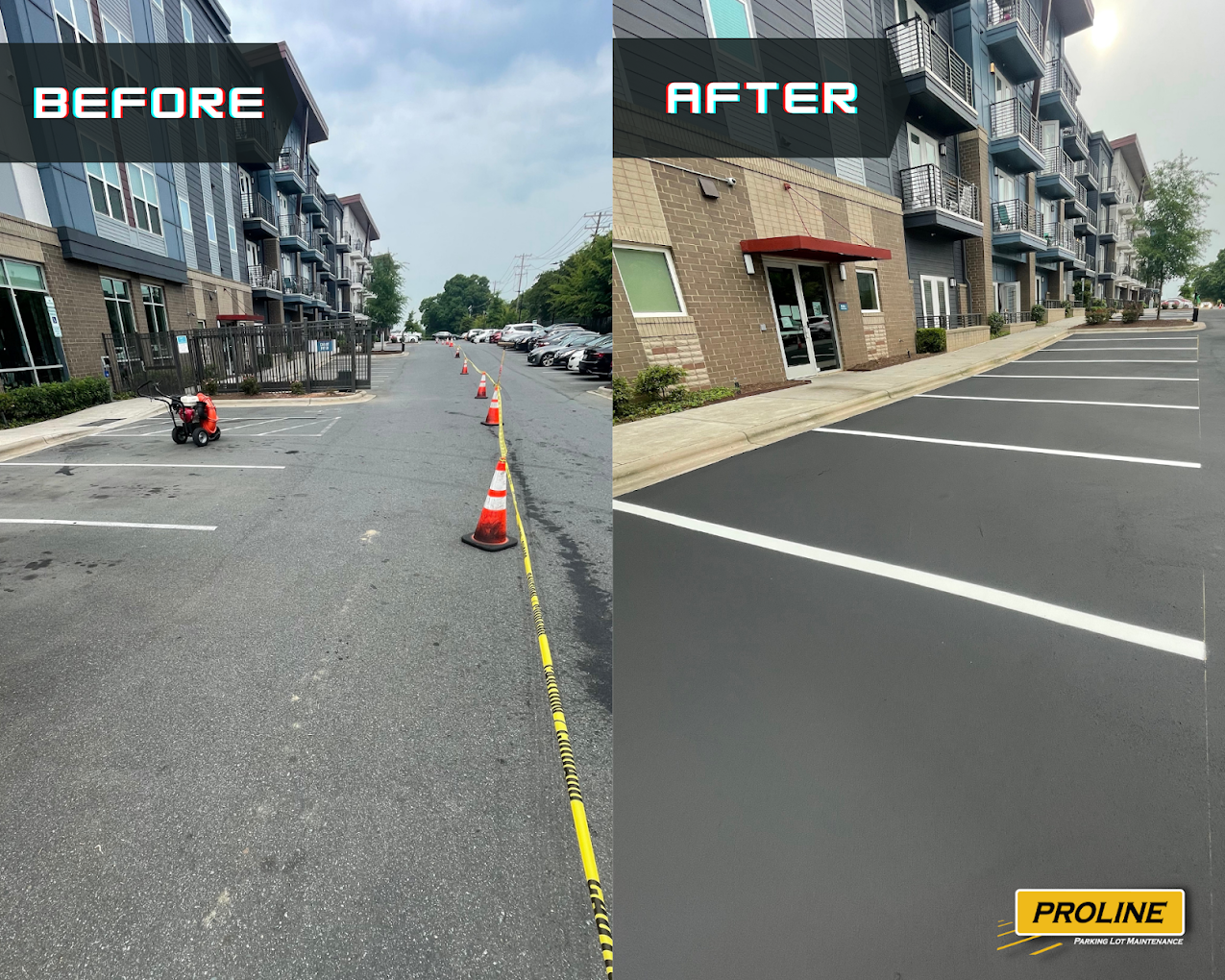
In high-density apartment complexes, faded lines and unmarked zones lead to illegal parking, blocked access aisles, and daily tenant frustration. Precision line striping—complete with high-visibility directional arrows, clearly designated visitor stalls, and crisp lane boundaries—eliminates driver confusion and keeps traffic moving safely. ProLine Parking Lot Maintenance delivers durable, heavy-duty paint striping designed to restore order to your property. Contact our pavement marking team today to improve traffic management across your lot.
Frequently Asked Questions
Which paint is most durable in high-traffic apartment car parks?
Waterborne acrylic traffic paint is the most common and most economical option and generally remains in good condition for one to three years, depending on traffic levels and climate, so it is a sensible choice for areas of the property that experience less wear. Thermoplastic, which the workers heat up and melt onto the pavement rather than spraying it like ordinary paint, has a much higher initial cost but usually lasts for four to six years or even longer, which means it is more suitable for high-wear areas such as entrances, crosswalks, and turns in a densely populated site. Epoxy striping falls somewhere between the two in cost and durability, and many contractors choose it when a community wants greater wear resistance than standard paint without paying for the equipment and setup that thermoplastic requires. For most high-density communities, we suggest a combined approach—using thermoplastic or epoxy at the points of highest wear and standard waterborne paint in all other areas—since it balances initial cost with how often the crew will need to return.
What is the typical cost of professional line striping for an apartment complex?
The cost varies greatly depending on the lot size, the surface’s current condition, and how much existing striping must be removed before applying the new lines. However, many contractors give a general range of $8 to $20 per stall as a starting point for standard stall restriping. Contractors usually charge separately for ADA stalls, accessible symbols, directional arrows, and text stencils such as “DO NOT ENTER” or the unit numbers because each of these takes up more time and requires a different stencil from that needed for a simple straight line. A lot with serious oxidation, oil stains, or old striping that must be ground off so the new paint can stick properly will cost more than one with a clean surface that only needs a fresh coat over faded lines. The only way to get an accurate price for your property is with a site visit, since two lots with the same number of stalls can end up with very different prices depending on the surface condition and the extent of any layout redesign.
How long after striping does it take before residents can park on it?
Normal water-based traffic paint usually reaches a point where it won’t be smudged by light foot traffic within about 30 minutes to an hour in good weather. Still, it generally takes 24 to 48 hours to fully cure so it can withstand the friction of a vehicle turning and braking without being damaged. Thermoplastic cures much faster because it hardens as it cools instead of air-drying, and in many cases, strips applied with thermoplastic can be driven over within an hour of application. Humidity, cooler temperatures, or shaded areas of the site can cause the curing time to go well beyond the same-day estimate, which is why we usually advise leaving cones or barricades in place over newly painted lines for a full day in a high-turnover community rather than reopening the area as soon as the paint appears dry. One of the most common reasons striping looks scuffed or uneven in the first week is that a section was reopened too early.
Can wheel stops replace clear striping?
Not at all; wheel stops and striping serve entirely separate functions, and one does not replace the other. A wheel stop merely indicates to the driver where the front of the vehicle should come to a stop; it doesn’t set out the side boundaries of the parking space as a painted line does, and so a car can still park crooked between two wheel stops and thus occupy space next to the adjacent bay. When wheel stops are not clearly striped, drivers have no visual indication of the stall width. This situation becomes a more serious issue in areas with a high density of parking spaces since the bays there are already narrower than average and even a small amount of crooked parking can prevent a neighbor’s door from swinging open. In fact, many high-density communities are now giving up on using wheel stops altogether, as they interfere with sidewalk clearance and drainage and present a tripping hazard, opting instead to use striping on its own or to combine striping with curb painting.
Will weather affect the timing of striping?
Yes, both temperature and humidity affect how well striping paint bonds to asphalt and how long it takes to cure properly. Because moisture trapped beneath freshly applied paint can cause peeling or a hazy finish that reflects light poorly at night, most traffic paints require the surface to be above about 50 degrees Fahrenheit and dry, with no rain forecasted for several hours after painting. Contractors also aim to avoid painting when humidity is high or immediately after a hot afternoon on dark asphalt, as a large change in surface temperature can affect how evenly the paint levels out and how well the reflective beads embed. Painting in the early morning during the cooler months or at night in areas where the property cannot close off the parking lot during the day generally provides the best curing conditions without interfering with residents’ schedules.
How should striping be dealt with in the case of speed bumps or speed humps on a crowded site?
Speed bumps and humps should have their own dedicated striping, usually in the form of diagonal yellow and black or white and black hazard stripes that span the full width of the bump and are kept visually separate from the surrounding stall lines so that the bump appears to be a hazard even when it is dark or there is low light. In the case of a high-density parking area, putting a speed bump too near a stall entrance or beside a blind turn can confuse rather than eliminate it, as a driver concentrating on the bump in front of them might fail to notice a pedestrian crossing or a car reversing nearby; for this reason we generally advise placing the bumps in the middle of the aisle rather than near intersections or crosswalks. The striping on and around a speed bump wears out faster than striping on flat pavement, since each vehicle’s tires roll directly over the bump’s highest point with every pass; therefore, these markings usually need refreshing more often than the rest of the parking area. Most municipalities combine painted hazard stripes with a reflective sign, and it is also worthwhile on private property, since it gives the driver an extra visual warning before they feel the bump.
See also: How Line Striping Helps Define Accessible Routes at Multi-Family Properties, New Construction vs. Existing Apartments: Different Line Striping Considerations