
Parking lots are areas where vehicles travel at low speeds and involve a high level of conflict. The only traffic control is painted lines and signs, with no traffic signals and no police officers. This is one reason the National Safety Council has identified parking areas as a source of a disproportionate number of incidents involving vehicle backup and conflicts with pedestrians, compared to the small amount of road space they occupy. About maintenance, research into pavement preservation. Something frequently referenced by bodies such as the American Public Works Association—states that the return on timely and proactive maintenance, such as restriping before the lines completely disappear, is somewhere between $4 and $10 saved for every $1 that is spent, as compared to waiting until a full rehabilitation is needed. When you combine those two facts, striping becomes not just a cosmetic expense but a safety and budget consideration.
What we’ve found after many years of dealing with striping apartment and condo lots in the Carolinas is that most property teams treat striping as if it were a commodity. They get three quotations and go for the lowest price per stall when, in fact, it’s a scope of work involving a number. The paint doesn’t define a professional striping service. A professional striping service isn’t determined by the paint; it’s defined by all the steps that take place before and after the painting. This is the point most articles on the subject omit, and it’s what really decides whether your property looks good for two years or only six months.
Striping Isn’t a Commodity—It’s a Scope of Work
Two contractors could give the same quotation for a ‘restripe the lot’ job and yet produce completely different results since the cost per stall gives no information regarding surface preparation, the quality of the material, the verification of the layout, or the situation if it rains on the day of the work. In apartment complexes in particular, since residents’ cars are left on the premises every night. The painting process is just as important as the paint itself.
What a Professional Striping Service Includes vs. a Bargain Repaint
| Service Component | Professional Striping Service | Bargain “Paint & Go” Job |
| Pre-work audit | Layout checked against current code and traffic patterns before work begins | The crew paints over whatever lines already exist |
| Surface prep | Lot swept/blown clear of debris, oil spots addressed | Painted directly over dirt, leaves, and residue |
| Layout verification | Compliance items (including ADA-required markings) confirmed as part of the job | Assumed to already be correct |
| Material selection | Paint/thermoplastic matched to traffic volume and climate | Whatever’s cheapest or on the truck |
| Application method | Machine-applied for straight, consistent lines | Handheld roller or brush, inconsistent width |
| Curing & closure management | Managed drying window with clear resident communication | “Should be dry by tomorrow” |
| Final walkthrough | Punch-list review with property team before crew leaves | The crew leaves once paint is down |
| Documentation | Photos and scope notes left with the property | Nothing on file |
| Warranty | Written warranty terms | Verbal assurance, if any |
The Pre-Work Steps Most Quotes Skip
- An actual layout audit — one that verifies the present striping still matches the way the property is really being used, not just the act of repainting what already exists.
- Surface cleaning involves blowing or sweeping away leaves, sand, and debris so the paint can adhere to the asphalt.
- The old line management procedure involved removing or covering conflicting or outdated lines rather than leaving them to create double markings.
- Scheduling is based on dry weather, since paint applied before a storm usually has to be redone completely.
Materials & Methods That Separate a Professional Job
Not all striping paint is created equal, and the difference shows up fast in a climate like ours:
- Water-based traffic paint dries fast and is cost-effective, but it has the shortest lifespan when exposed to UV radiation and heavy rain.
- Solvent-based paint is more durable than water-based paint and has a longer cure period.
- Thermoplastic is much more durable and should therefore be used only in high-traffic areas and on accessible routes.
- Machinery ensures uniform line width and mil thickness; the MUTCD sets national reference standards, and most state DOTs base their marking specifications on them.
- Use the correct paint thickness, no matter the brand—because thin, diluted paint fades quickly; professionals apply it to spec, not just until it looks covered.
Local Considerations for Carolina Apartment Communities
Densely built communities, for example, Charlotte’s South End and Uptown; Raleigh’s North Hills; downtown Charleston; Columbia’s Vista district; or Greenville’s West End—usually have neither excess nor overflow parking, which affects how a striping project must be carried out. Among the aspects we take into account:
- Because overflow lots are limited, we close small sections rather than half the property at once.
- The hurricane season, from June to November, reduces the number of reliable dry periods available for scheduling.
- Humidity along the coastal areas of the Lowcountry and the Grand Strand results in longer cure times than in drier inland areas.
- The norms regarding notification for the HOA and the city differ. In some municipalities in Carolina and in communities governed by HOAs, advance notice is expected before work on lots starts, even when it comes to routine striping.
How ProLine Structures a Striping Project for Apartment Communities
- We will check the site walk and layout to ensure the plan matches the current situation before placing any paint order.
- Coordinating resident notices — ensuring that, in conjunction with the property team, we deal with the timing and communication so that residents are not caught unaware.
- Closing the area in phases by dividing up the site so that the residents always have access to parking while the project is going on.
- Application and inspection — carried out in accordance with specifications, with a walkthrough before we consider the job complete.
- The documentation handover included dated photographs and scope notes, which were left at the property for inclusion in its maintenance file.
Questions to Ask Before You Hire a Striping Contractor
- Will you check the current layout, or only repaint the lines as they are now?
- What material are you planning to use, and is this material specifically rated for use in high-traffic or accessible areas?
- How do you plan to prepare the surface before painting?
- What would occur if it is raining during the planned work?
- What notice will be given to the residents, and how will the closures take place?
- Is a warranty available, and if so, what does it include?
Let’s Scope Your Project the Right Way
When your community’s parking lot needs refreshing, it’s a good idea to ask the same questions of a striping contractor that you would ask of any other capital project—namely, what is included, what the procedure will be, and what will happen if anything goes wrong. ProLine’s Carolina team will be pleased to visit your parking area, give you an honest account of what is needed, and provide a genuine scope of work with the price—not just a figure for each stall.
Ensure Complete Quality with Comprehensive Multi-Family Striping Services
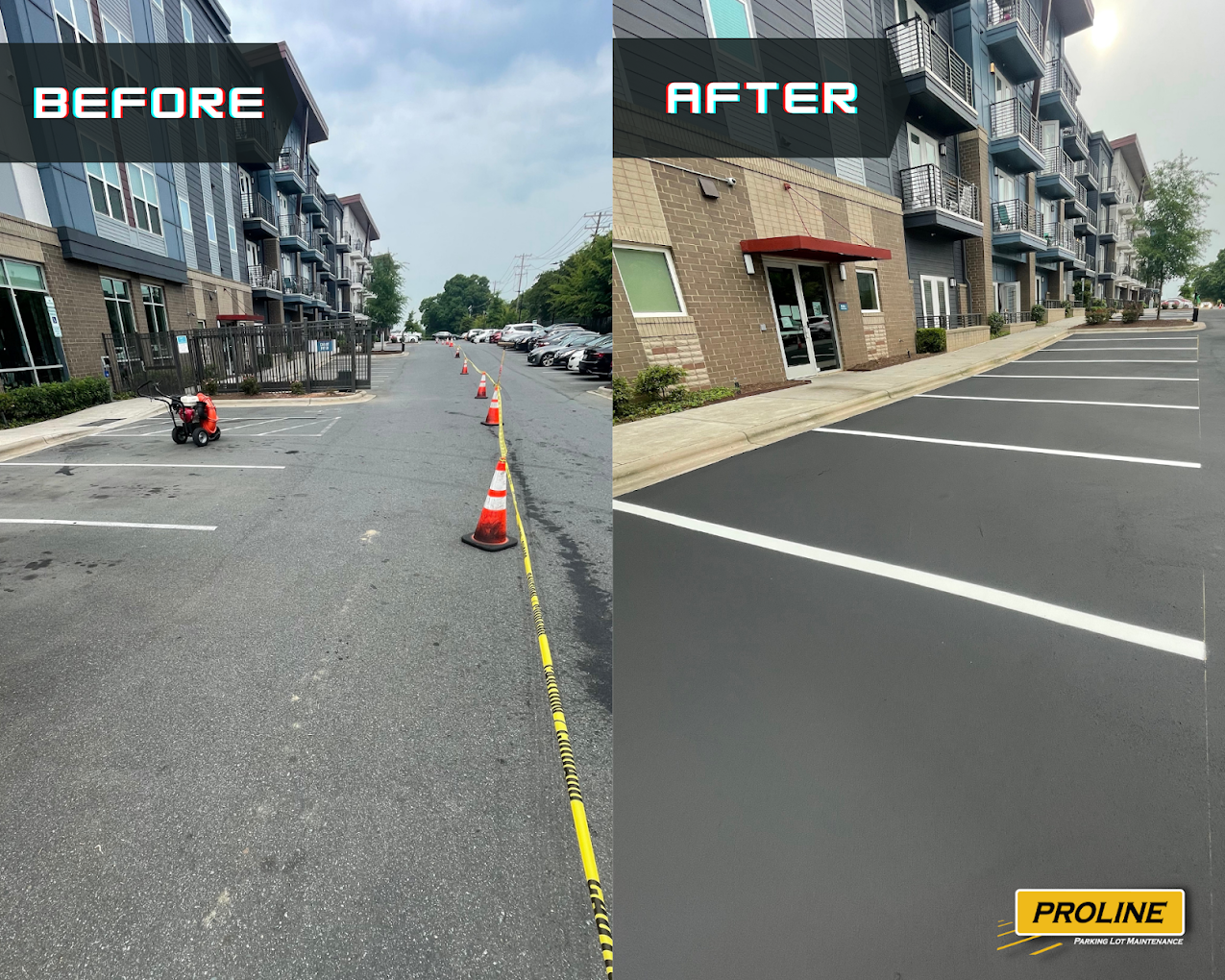
A truly professional line striping project involves far more than simply painting lines over dirty pavement. Without thorough surface preparation, high-spec traffic paint, precise layout measurements, and complete marking updates—including ADA stalls, fire lanes, and directional arrows—fresh paint will rapidly peel, fade, or fail to pass municipal inspections.
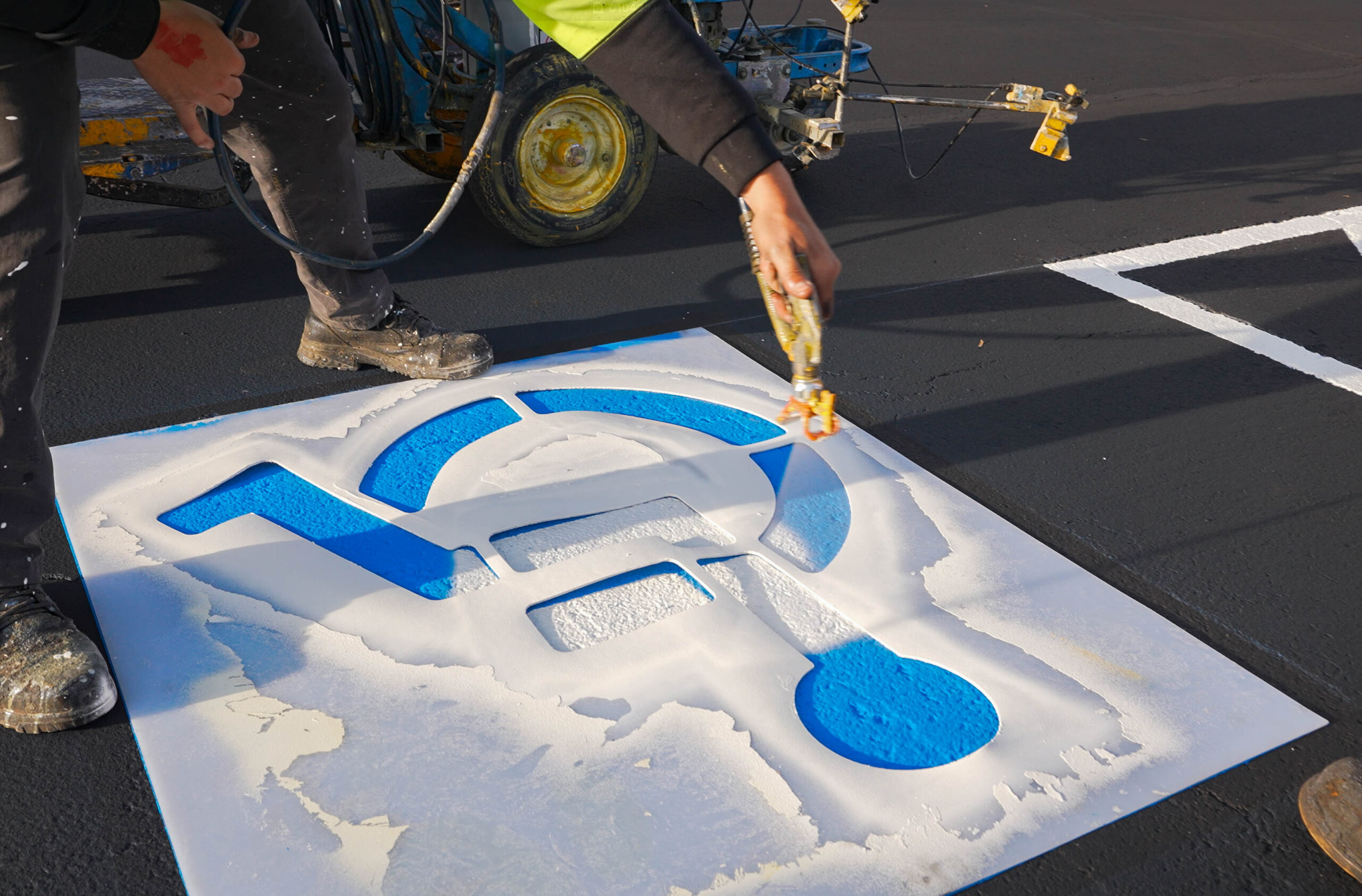
ProLine Parking Lot Maintenance delivers turnkey, end-to-end striping solutions that cover every critical step—from heavy power-washing and paint scarification to ultra-durable commercial paint application and custom stenciling.
- Complete Surface Preparation: Mechanical wire-brushing, oil spot treatment, and high-pressure cleaning to guarantee maximum paint adhesion and long-term lifespan.
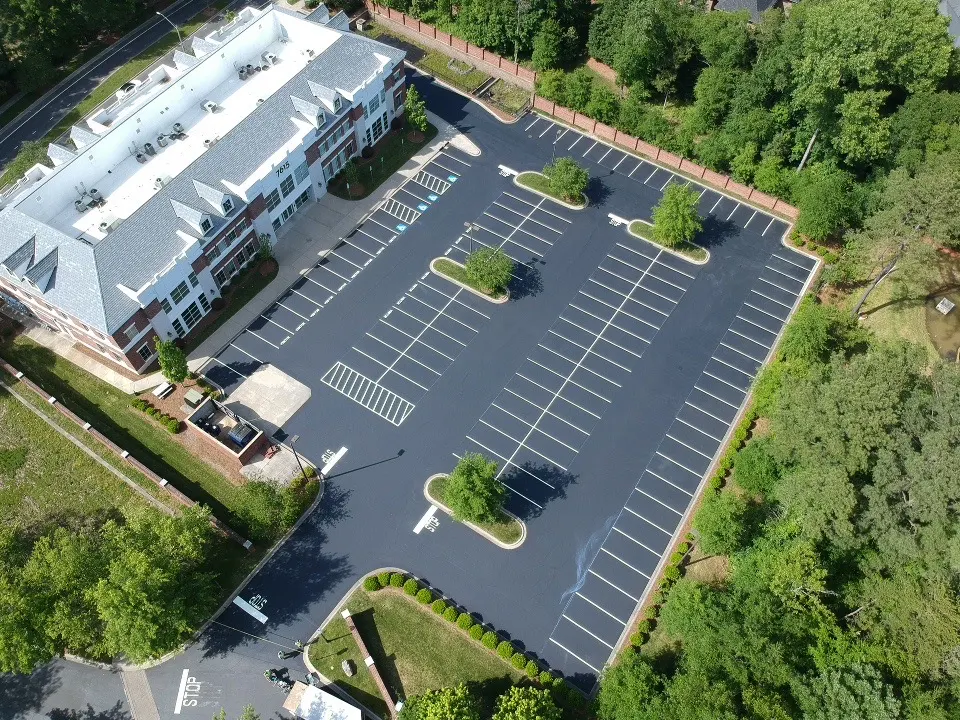
- Full-Property Marking Coverage: High-build acrylic paint application for stall lines, ADA accessibility hatches, curb markings, fire lanes, crosswalks, and directional arrows.
Frequently Asked Questions
What is the usual cost of having a professional company carry out apartment parking lot striping, and why is the price so different?
The prices charged for striping work depend on several actual cost factors, not merely on the contractor’s markup; these include the total area to be covered, the number and kind of markings required (for example, standard stalls as compared to accessible-route markings, arrows, and signage), the type of material used (such as water-based paint or thermoplastic), and the amount of surface preparation the site actually needs before painting can start. When a quotation appears significantly lower than the others, it is usually because one of these cost factors has been omitted. Most often surface preparation or the grade of material, rather than because the contractor is more efficient. Therefore, when property teams compare bids, they should ask each contractor to specify the material type and the prep work involved, since a per-stall figure alone can hide very different kinds of work.
How long after striping does it need to cure before the residents can park on it once more?
The time needed for curing is largely determined by the type of material and the weather conditions; standard traffic paint is usually touch-dry in about 30 minutes to an hour when the weather is good but may take a lot longer to fully cure in humid or cooler weather, a situation that is typical along the Carolina coast and during the shoulder seasons. Thermoplastic, on the other hand, cools and hardens more quickly in some respects but still needs the surface to be at a particular temperature to bond properly. Both the transportation departments of North Carolina and South Carolina have published material specifications for pavement markings that include guidance on curing and application temperatures, and a professional contractor should be able to give you the exact expected closure period for the specific product they are using, not just a general one.
Should apartment complexes repaint their stripes either on a fixed schedule or only when the lines become clearly faded?
Waiting for the lines to become visibly unclear suggests the parking area has likely been using faulty traffic control for months, which is why most pavement maintenance recommendations suggest a proactive maintenance schedule based on traffic volume and the type of material used, rather than waiting until a visible failure occurs. For parking areas with high traffic and water-based paint, maintenance should occur closer to the one- to two-year mark, whereas those with lower traffic or striped with a more durable material can wait longer. The recommended approach is to do a visual inspection every year, along with a maintenance schedule based on that site’s specific wear patterns, rather than applying a one-size-fits-all calendar rule to all parking areas.
Do apartment communities have to inform their residents about a striping project, and if so, is there a standard period during which they must do so?
No single legal requirement specifies a notice period for routine striping, as it does for, for example, entering a unit. Still, according to property management best practices, outlined in advice from groups such as the National Apartment Association, it is strongly advisable to give advance written notice since the work directly affects residents’ daily access to parking. In many Carolina communities, notices are posted anywhere from a few days to a week in advance, and on the day before work starts, signs are often placed in the affected parking spaces. In some communities governed by a homeowners’ association, the governing documents set the notice requirements, so it’s important to check those documents rather than assume a general time frame applies.
Can striping be done in cooler or rainy weather, or does it have to wait for a dry season?
Most striping materials require both a minimum surface temperature and a dry forecast window to bond and cure correctly, which is part of why professional contractors watch weather closely rather than working off a fixed calendar. Rain on freshly applied paint before it cures can wash out the line entirely, requiring the section to be redone, and cold surface temperatures can prevent proper adhesion even without active rain. In the Carolinas, this generally means avoiding both the height of hurricane season’s heaviest rain stretches and, less intuitively, damp, humid mornings even outside of storm season, since ambient moisture alone can interfere with cure time.
What’s the difference between hiring a general paving contractor and a dedicated striping specialist for an apartment community?
General paving contractors often focus primarily on asphalt repair, sealcoating, and larger paving projects, treating striping as a secondary add-on service rather than a specialty. A dedicated striping specialist typically brings more precise equipment for consistent line width, deeper knowledge of current accessibility and code requirements, and more experience coordinating around occupied, live communities rather than vacant commercial sites. For a standalone striping refresh, especially one involving accessible-route markings, a specialist is generally better positioned to get the layout and compliance details right the first time.
Does professional striping come with any warranty or guarantee?
Reputable striping contractors typically offer some form of written warranty covering premature fading, peeling, or material failure within a defined window, though the exact terms, what’s covered, for how long, and under what conditions—vary meaningfully by contractor. Organizations like the Associated General Contractors of America generally recommend putting warranty terms in writing before work begins rather than relying on verbal assurances, since disputes are far easier to resolve with documented terms. Property teams should ask specifically whether the warranty covers material defects, workmanship, or both, since some contractors limit coverage to one or the other.
See also: Why Professional Line Striping Is Essential for Multi-Family Apartment Communities, The Best Time of Year to Schedule Line Striping for Apartment Communities