The minimum retroreflectivity standards for pavement markings on public roads are established by the Federal Highway Administration’s Manual on Uniform Traffic Control Devices, and most private paving contractors use those same standard figures as their reference when it comes to the visibility of parking lot markings at night, even though the law doesn’t always require private parking lots to comply with them (MUTCD). This is important because painted lines do not all lose their reflectivity at the same time; instead, they gradually decrease in reflectivity due to exposure to ultraviolet light and from tire wear until on a given night the driver can no longer see the stall line, the fire lane edge, or the ADA access aisle and it is too late to react.
In the Carolinas the decline occurs more quickly than the average property manager anticipates, and not for the reasons that are most commonly cited in articles. This guide goes beyond the standard recommendation of repainting once a year and looks at the particular standards, the specific weather conditions in the Carolinas that are adverse to your paint, and the particular maintenance schedule that actually ensures that the markings remain legible throughout every season, not just the month following the restriping cost.
What “Clear” Actually Means: Retroreflectivity, Not Just Fresh-Looking Paint
A parking lot line may appear perfectly white in daylight yet be almost invisible to a driver at night, since visibility in the dark is due to retroreflectivity and not to color. This effect is produced by incorporating small glass beads into the wet paint when it is being applied. When the headlights strike these beads, the light is reflected back towards the driver’s eyes rather than being scattered, and it is precisely this process that makes a painted line visible in the dark.
The reflectivity is measured in millicandelas per square meter per lux (mcd/m²/lx) and decreases gradually as the beads wear away and the paint film thins out due to exposure to traffic and weather. Rather than making an estimate based on a visual check, a contractor can measure it directly using a handheld retroreflectometer, turning a statement such as “the lines look rather faded” into a figure that can be monitored over time and compared with the standard that is used by the local Department of Transportation on public roads (NCDOT, SCDOT).
Why Carolina’s Climate Hits Your Markings Harder Than You’d Think
All areas have their own weather, and the Carolinas involve a number of particular stressors that cause marking wear to occur more quickly than in many places that have a milder or drier climate, since most maintenance schedules do not take these stressors into consideration individually.
| Season | Carolina-Specific Stressor | Effect on Markings | Recommended Action |
| Late Winter/Early Spring | Pine and oak pollen coating | A film of pollen prevents new paint from bonding to the surface and hides existing line condition under yellow dust | Pressure wash before any inspection or repaint, never stripe over a pollen film |
| Spring/Summer | High UV index and long daylight hours | UV breaks down the paint binder faster than in northern climates, fading color and reducing bead reflectivity | Inspect reflectivity by early summer, before the worst UV months hit |
| June-November | Atlantic hurricane season, heavy rain and wind-driven debris | Standing water and wind-blown grit erode fresh paint and wash out uncured lines | Avoid scheduling restriping in the 48 hours around a named storm forecast (National Hurricane Center) |
| Summer | High humidity and dew point | Slows paint curing time and can cause paint to lift or blister if crews apply it to a damp surface | Confirm dew point and surface dryness before painting, not just air temperature |
| Occasional Winter Events | Ice storms and de-icing treatments in Piedmont and mountain areas | Ice scraping and treatment chemicals can strip thin or already-worn paint film | Inspect high-traffic lines after any ice event before spring |
Choosing the Right Paint for the Job
You shouldn’t use the same material for all the markings on your property, since making an incorrect choice for the wrong area ends up wasting money in two ways.
| Material | Typical Lifespan | Application Temp | Best Use Case |
| Water-based traffic paint | 1-2 years in high-traffic areas | 50°F+ and rising | Standard stall lines, directional arrows, general lot markings |
| Solvent-based/epoxy paint | 2-4 years | 50°F+ and rising | Loading zones, drive lanes with heavier tire scuffing |
| Thermoplastic | 4-7 years | Applied hot, ambient temp above 50°F for proper bonding | Crosswalks, stop bars, high-traffic entrances, fire lane edges |
We assess each material zone in the same way as we assess the condition of the pavement zone by zone, since the entry drive, which sees 500 turning movements each day, requires a different kind of material from that needed by a seldom-used overflow row.
The Markings That Can’t Wait: ADA and Fire Lane Priority
Certain markings are merely cosmetic; two of the categories, however, are not and must therefore be included at the top of each inspection no matter what the budget cycle is.
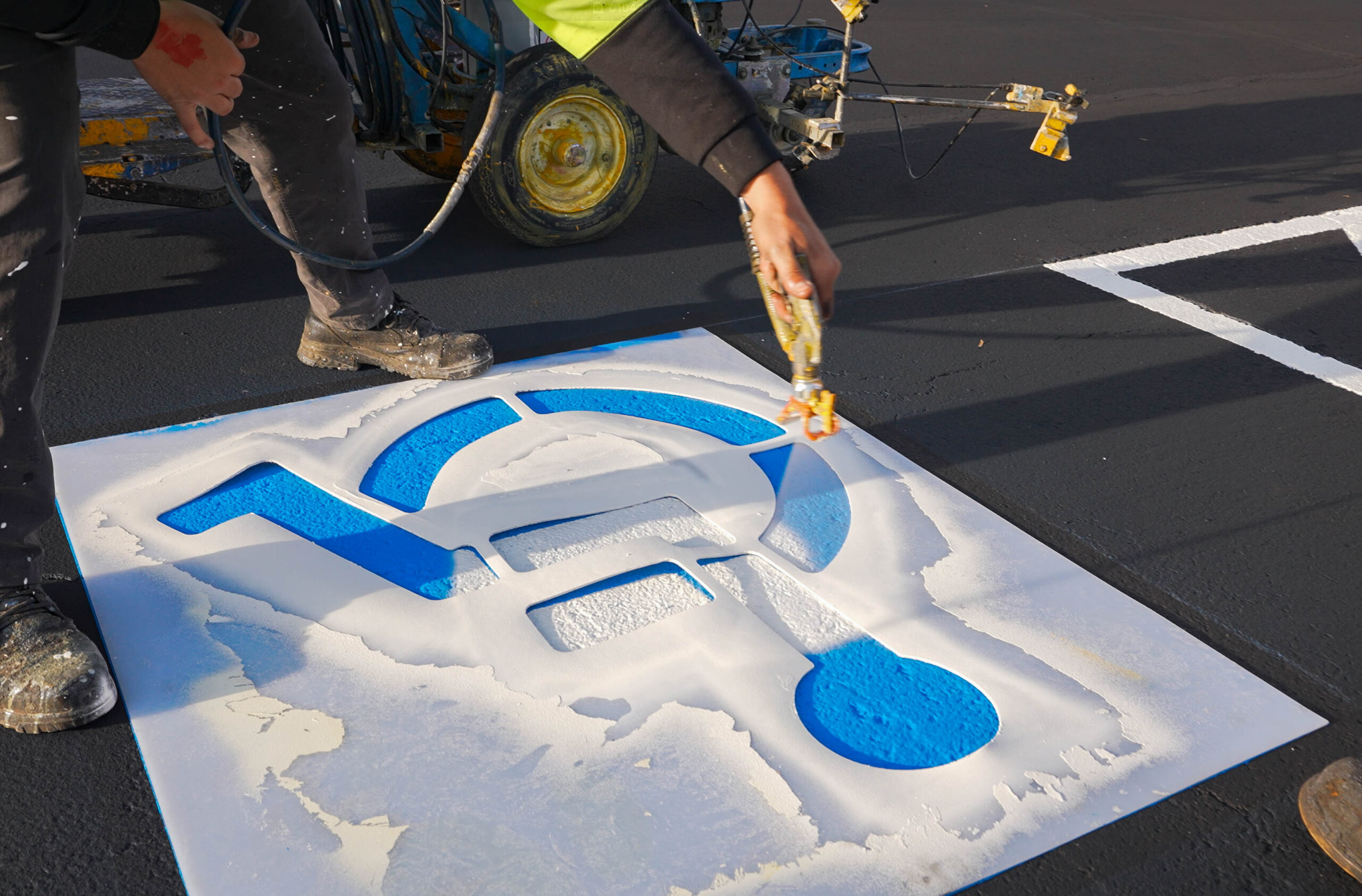
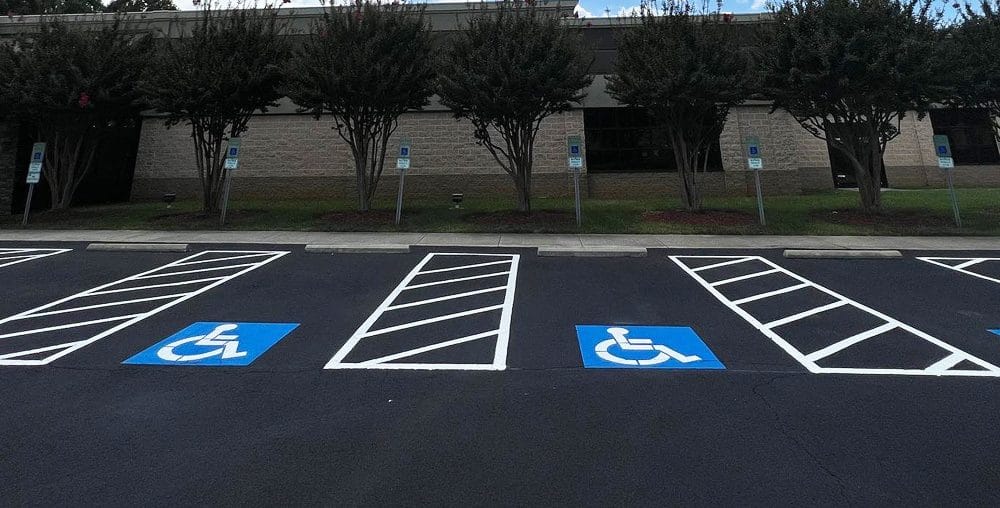
- The Americans with Disabilities Act specifies certain requirements regarding stall width, access aisle width, and the international symbol of accessibility, and a faded accessible stall constitutes a compliance issue, not merely a matter of curb appeal (ADA.gov).
- Your local fire marshal usually mandates that red paint be applied to the curb or that lane markings be put in place, together with clearly visible lettering that says “Fire Lane, No Parking,” and a faded fire lane may delay emergency access or result in a code violation at a regular inspection.
The same applies to both of these categories since failure to inspect them would result in increased liability and a breach of the code, not merely a matter of appearance.
A Carolina-Specific Maintenance Calendar
| Timing | Task |
| February-March | Full property walk after the last freeze; note any ice or de-icing damage on high-traffic lines |
| April-May | Pressure wash after peak pollen, then run a reflectivity check before summer UV ramps up |
| June | Touch up any lines that tested below your reflectivity benchmark before hurricane season starts |
| July-August | Monitor high-traffic zones for UV fading, schedule any thermoplastic work in this stable-weather window |
| September-November | Post-storm inspection after any named tropical system, repaint anything washed out or eroded |
| December-January | Inspect ADA stalls and fire lanes specifically, since these get the least traffic-based wear but the most liability exposure if missed |
How We Decide When to Restripe vs. Touch Up
We never go through the process of restriping an entire lot simply because a walkthrough has been requested. Here is the real way in which we proceed:
- Instead of relying on a visual walk, we check each reflectivity zone one at a time using a retroreflectometer.
- We compare the reading from each zone with the benchmark that is used by your local DOT on public roads.
- We always flag ADA stalls and fire lanes for immediate correction no matter what their reflectivity score is, since these cases have compliance deadlines, not just wear deadlines.
- Touch-up should only be carried out in areas that are still above the benchmark, and full restriping should only be done in those areas that have fallen below it.
- We carry out the work in accordance with the Carolina climate calendar shown above, not just whenever you call.
The Bottom Line
In the Carolinas, clearing parking spaces isn’t something you have to do only once a year; it’s a routine that accounts for pollen season, UV exposure, hurricane season, and the specific standards the local DOT applies to public roads. A property that follows this schedule spends less money over time than one that waits until the lines have vanished and then has to pay for a complete emergency restripe each spring.
Get in touch with ProLine Parking Lot Maintenance to compare your property’s reflectivity with the actual benchmark and to have a maintenance schedule prepared specifically for your location in the Carolinas, not one that is based on a general national schedule.
Are Faded Parking Stalls Compromising Safety and ADA Compliance?
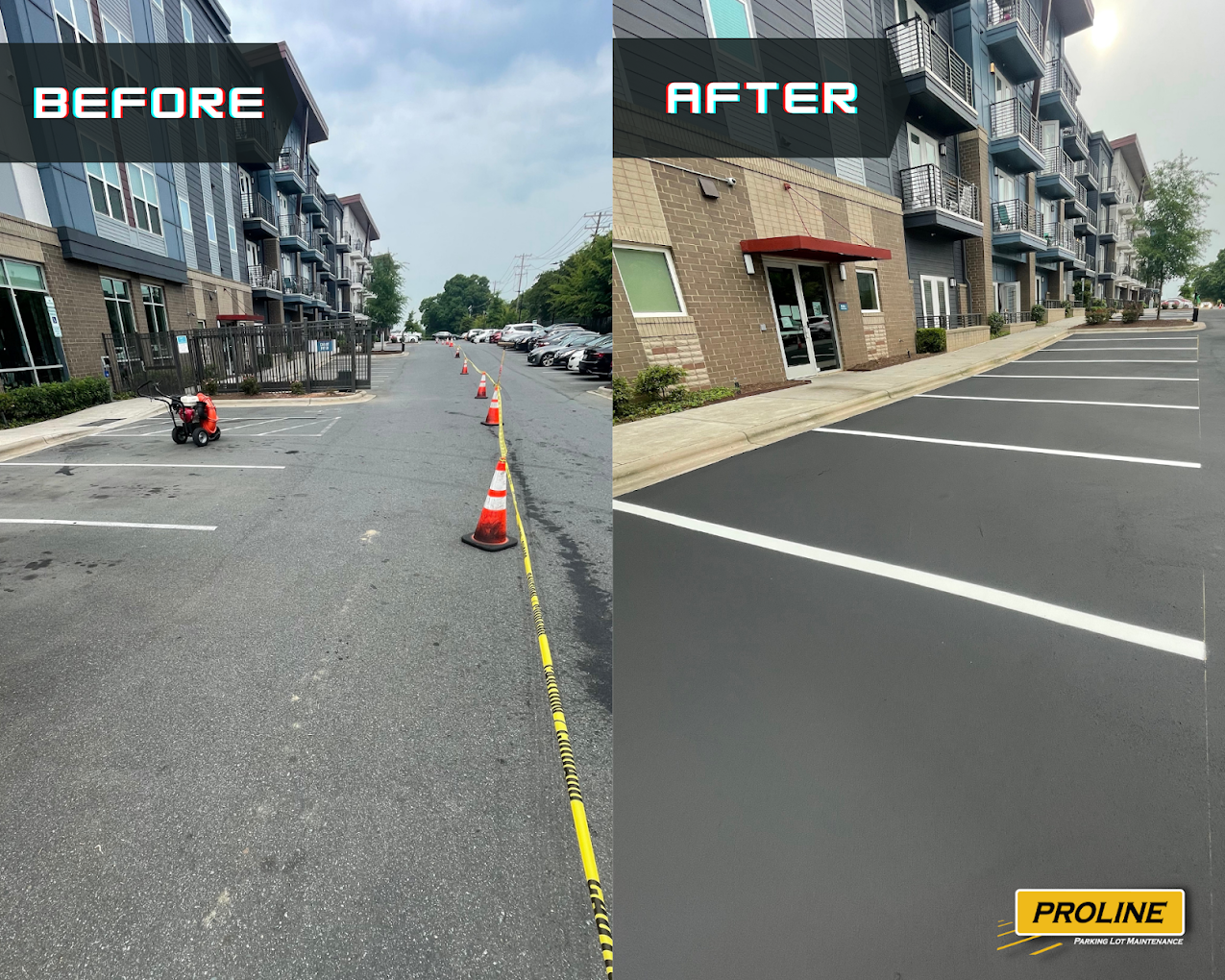
Faded directional arrows, worn stalls, and unreadable fire lane markings increase liability risks and diminish curb appeal across commercial properties. Maintaining crisp, high-visibility layout lines year-round requires commercial-grade traffic paints, proper surface preparation, and tactical maintenance scheduling designed to withstand heavy traffic and seasonal weathering. ProLine Parking Lot Maintenance delivers precision layout engineering and durable re-striping tailored to keep your facility safe, compliant, and pristine. Contact our layout specialists today to request a custom maintenance plan.
Frequently Asked Questions
For how long does striping paint have to cure before the area can be opened up to traffic once more?
Water-based traffic paint usually requires 30 minutes to 1 hour to dry before it can handle foot traffic and about 2 to 4 hours before vehicles can use it. However, the high humidity typical of Carolina summers can make this drying period much longer. Thermoplastic, on the other hand, cures much faster because workers apply it while it is hot and it hardens as it cools, which usually means traffic can be allowed back within 10 to 15 minutes under good conditions. In any case, always check with your contractor about the cure time for the day, taking into account temperature and humidity, since reopening the road too soon could cause severe tire tracks or smear the fresh line to the point that it has to be redone.
Can you put down a new stripe directly on top of old, faded ones, or do you need to remove them first?
In most cases, you can apply a new coat of paint directly onto the existing lines, provided the surface is clean, dry, and free of loose or flaking paint. This is the usual approach for routine annual touch-ups. However, if the old lines have accumulated several layers over several years, this layering can create a slight ridge that a driver or pedestrian may not notice, but that affects how evenly the new paint adheres and cures. When the property is also changing its layout. For example, adding ADA stalls in a new position or reconfiguring drive lanes, the existing lines usually have to be ground down or blasted off first. Hence, the new arrangement is clearly visible without ghost lines showing through.
Does either high humidity or a forecast of rain affect whether striping can take place that day?
Certainly, and in the Carolinas, the situation is even more serious than the temperature during the summer months. Most traffic paints require the pavement surface to be completely dry and call for a minimum period. Usually several hours. without any rain following application so that the paint has time to set before it is exposed to water; for this reason, a contractor has to look at both the present weather and the forecast, not merely whether it is raining at the exact moment of painting. Even on a technically dry day, high humidity combined with a low dew point spread will slow curing, which is why a contractor might postpone a striping day that looks satisfactory on the surface but has inadequate drying conditions beneath.
How much does a simple restripe differ from a full remark after resurfacing?
A simple restripe, this involves a contractor repainting the existing lines in their present positions on the pavement, provided that the pavement is still structurally sound. It costs a great deal less than a full remark since it does not require any new layout work, no new measurements, and only involves a small amount of preparation apart from cleaning the surface. In the case of a full remark carried out after resurfacing or a mill and overlay, the process starts from a completely blank surface. Hence, the contractor has to resurvey the property, lay out each stall, ADA space, fire lane, and directional arrow from scratch, and frequently update the layout to meet current code, all of which results in extra labor costs apart from the paint itself. If your property will need resurfacing soon, ask your contractor whether it makes sense to postpone the full restriping until after that project, rather than paying for the markings twice in the same year.
Who among the property owner and the management company is legally responsible for the ADA-compliant markings?
The property owner is legally responsible for ensuring ADA compliance because the obligations under the ADA are tied to the property itself. However, a management company can take on the practical and even contractual responsibility if the management agreement assigns it the duty of carrying out maintenance and compliance. Given this overlap, it is advisable to specify in the management agreement who is responsible for scheduling and paying for ADA-related repairs, such as re-marking accessible stall markings. Since organisations like the Building Owners and Managers Association provide general advice on the allocation of maintenance responsibilities and this advice is often referred to in management agreements, it makes sense to use that as a starting point if your present agreement is unclear on this issue.
Can old parking lot markings lead to legal liability for a property owner?
Certainly, in two different ways. If the accessible stall markings have faded, someone can file a complaint with the Department of Justice or bring a private lawsuit under the Americans with Disabilities Act, which treats an unmarked or indistinct accessible stall as equivalent to one that is missing. Furthermore, a driver or pedestrian who has been injured in an area where the directional arrows are worn out, the stop bars have faded, or the pedestrian crossing is not clear can claim that the property has not maintained reasonably safe conditions, which is a typical line of argument in general liability and premises liability cases. Actual maintenance records and a history of reflectivity testing give the property concrete documentation to refer to if either kind of claim arises.
What is the method used to measure retroreflectivity, and is it possible for a property manager to check this without having special equipment?
A handheld retroreflectometer measures retroreflectivity. This instrument directs a light source of known intensity at the marking. It then measures the amount of light that reflects to a sensor, giving a figure in millicandelas per square meter per lux that can be compared directly with a standard. If a property manager does not have access to such equipment, they can carry out a rough approximate check by driving through the site at night with the headlights set low, on a dry night, and observing which lines are difficult to see from a typical approach distance; however, this method is subjective and will fail to detect a gradual decrease in retroreflectivity that a numerical reading picks up earlier. When the decision in question involves compliance. For example, whether an ADA stall requires repainting, a retroreflectometer reading from a contractor provides a defensible figure rather than a visual estimate someone could later challenge.
See also: The Role of Directional Arrows and Pavement Markings in Multi-Family Parking Lots, How to Identify Worn Parking Markings Before They Become a Safety Problem