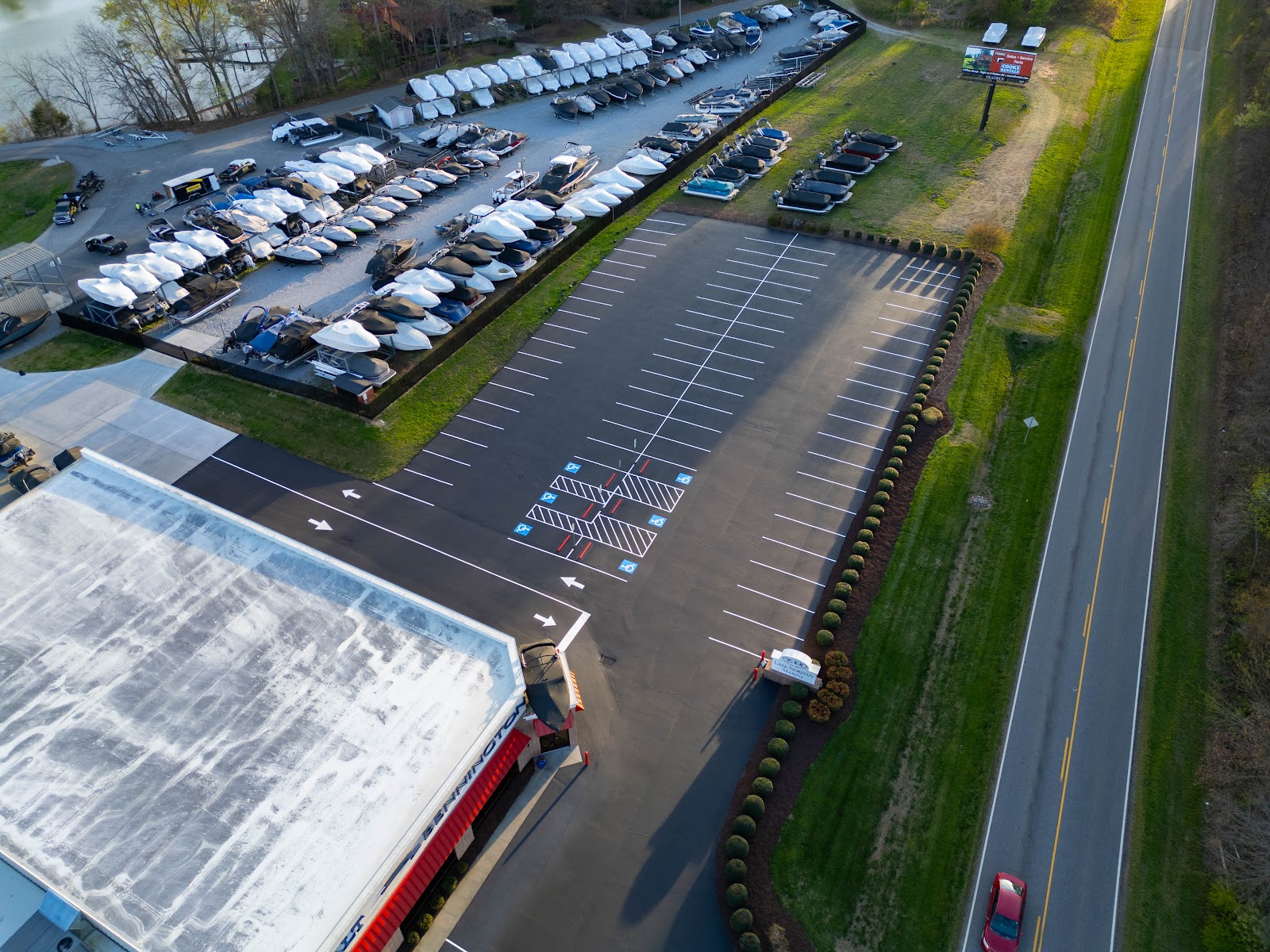
Across the country, physical and architectural barriers—such as inaccessible parking that is missing, faded, or incorrectly labeled—continue to be one of the most commonly mentioned categories in lawsuits relating to ADA Title III facility access, as shown in the annual litigation reports published by firms like Seyfarth Shaw’s ADA Title III Blog. With regard to multi-family housing, the U.S. The Department of Housing and Urban Development mandates that an accessible route must be provided to connect parking, building entrances, and common-use areas at all properties that are built for the first time after March 13, 1991, pursuant to the Fair Housing Act Design Manual. However, most compliance checklists overlook the fact that an accessible route is not a single design decision—it is a painted surface and therefore wears out.
At ProLine Parking Lot Maintenance, we carry out the task of striping and re-striping parking areas all over the Piedmont, the Sandhills, the Lowcountry, and the Upstate—including Charlotte, Raleigh, Durham, Columbia, Charleston, Greenville, and Myrtle Beach. Constantly, we observe that properties get their accessible parking and route markings correct on the day they are installed, only for the compliance to be gradually lost in the years that follow as the effects of the sun, storms, and ordinary tire wear gradually erase the lines that the law relies upon. The purpose of this article is not to provide another explanation of “How many accessible spaces do I need? “It is concerned with the aspect that almost no one else discusses—that of keeping the route itself—not just the spaces—clearly visible, unbroken, and legally defensible over time.
The Real Risk Isn’t the Original Design — It’s What’s Visible Today
Multi-family properties are actually subject to two overlapping sets of rules, and conflating them is where a lot of properties get tripped up:
| ADA Title III | Fair Housing Act (FHA) | |
| Applies to | Areas open to the public (leasing office, clubhouse, rental amenities) | “Covered” multifamily dwellings built for first occupancy after March 13, 1991 |
| What it requires | Accessible route and parking at public-facing areas | Accessible route connecting parking, building entrances, and public/common-use areas for residents |
| Enforced by | U.S. Department of Justice, private lawsuits | HUD, DOJ, private complaints |
| Where to check current standards | ADA.gov 2010 Standards | HUD FHA Design Manual |
A property may appear to meet the requirements of both frameworks in theory and yet still be functionally non-compliant in practice as soon as the striping is no longer legible. In the end both frameworks are assessed according to what a resident, visitor, or inspector can actually see and use.
What “Accessible Route” Actually Means in Striping Terms
The accessible route is not merely the blue and white area close to the door; it is a complete and connected system, and striping determines almost every part of that system.
- The markings for accessible parking spaces are sized and placed in accordance with the present standards.
- Next to the stall there is an access aisle, which remains clear for the use of wheelchair lifts and transfers.
- The aisle strips that are accessible from the van are wider than a standard accessible aisle.
- The International Symbol of Accessibility is painted on the stall.
- Striping in the form of a path of travel should connect the space with the building entrance—best if it is arranged so as not to cross any unmarked drive lanes.
- According to the U.S. According to the Access Board’s PROWAG guidance, curb ramps should have detectable warning surfaces at the points where the route goes from the property to the sidewalk.
- At each point where the accessible route crosses a vehicular path, continuity markings should be provided.
If one of the links in that chain disappears or is covered over without anyone noticing, then the ‘route’ is broken, even if the parking space still appears in good condition.
Why Accessible Route Striping Fades First in the Carolinas
What maintenance teams notice but what is never included in the design plans is that accessible route markings suffer more wear than almost any other type of striping on the premises because two factors combine—they are positioned closest to the building (exposing them to the highest level of foot and tire traffic), and Carolina’s climate is particularly severe on paint.
- In the Piedmont and Upstate areas, exposure to ultraviolet radiation causes pigments to break down more quickly due to the long and intense summer periods.
- The rainfall that occurs during the hurricane season, which is concentrated from June to November, speeds up the washout of standard water-based paint.
- In the Lowcountry and Grand Strand area, the coastal humidity and salt air cause lower-grade paint to deteriorate more quickly than it does in areas inland.
- The paint on accessible spaces — usually those nearest to the entrance — is worn away mechanically due to the high volume of traffic, not merely from exposure to the sun and rain.
| Striping Material | Typical Lifespan | Best Use |
| Water-based traffic paint | 1–2 years | Budget lots, low-traffic areas |
| Solvent-based paint | 2–3 years | Standard stalls, moderate traffic |
| Thermoplastic | 4–8 years | Accessible routes, high-traffic zones, crosswalks |
| Preformed tape | 5–10 years | Symbols, ISA markings, high-precision areas |
With regard to accessible routes, we usually recommend that Carolina properties use thermoplastic or preformed tape for the ISA symbol and for the hatching of the access aisle, even if the rest of the site is painted with standard paint, since the difference in cost is small compared to the compliance risk posed by a faded route.
Local Compliance Across the Carolinas
Both North Carolina and South Carolina have adopted accessibility standards based on ICC A117.1, with each state’s building code office responsible for administering them locally. The following regional considerations are taken into account:
- In Charlotte-Mecklenburg, Raleigh, and Durham, site-plan and code-enforcement reviews are carried out independently, which means a striping update that is normal in one county may need to be documented in another.
- In recent years, both the building departments of Columbia and Charleston have increased their efforts to enforce the code for existing multifamily properties, not just new construction.
- Properties in Greenville (Upstate) and Myrtle Beach experience more rapid paint deterioration because of their elevation and UV exposure and salt-air exposure, respectively; therefore, the fact that a property was compliant last year does not mean that it is compliant now.
How ProLine Approaches Accessible Route Striping
- For the route audit, we walk the entire route from each accessible stall to each building entrance and amenity, not just the parking space.
- We compare the current layout with the ADA and FHA requirements that apply to the property type and age.
- We select materials so sections subject to heavy wear match a striping material rated for real traffic and climate exposure.
- We take photographs and record the completed route, giving property teams a compliance record with a date.
- The frequency with which routes are inspected is based on the lifespan of the materials rather than waiting for someone to notice.
Signs Your Accessible Route Striping Needs Attention
- The ISA symbol has faded so much that it is difficult to identify from a moving vehicle.
- In some areas, the access aisle hatching is either worn thin or missing.
- Tire marks run straight through the designated accessible path.
- The route passes through a drive lane that has no crossing markings.
- Curb ramps show worn or missing detectable warning surfaces. The van-accessible spaces and standard accessible spaces are not clearly differentiated from each other.
What Well-Maintained Accessible Striping Protects You From
- Reduced ADA and Fair Housing complaint exposure, since the most common trigger is a visibly non-compliant route. Inspections related to the certificate of occupancy and code enforcement can be smoother, particularly in cities that are increasing their reviews of existing properties. The risk of liability in cases involving vehicles or pedestrians decreases when accessible routes cross drive lanes. property knew and when.
- True usability for residents, guests, and staff who actually depend on the route functioning as intended.
Let’s Walk Your Route
Properties usually don’t fail to meet accessible-route requirements because of one poor decision; instead, they gradually lose compliance as the paint fades faster than the records show. Should it have been more than a couple of years since someone had actually inspected your accessible route (not just counted the stalls), ProLine can accompany you on a walk down it and show you precisely the point at which the difference between ‘technically compliant’ and ‘visibly compliant’ begins to become unclear.
Ensure Full ADA Compliance and Safe Accessible Routes Across Your Property
Maintaining clear, compliant accessible routes is essential for resident safety, inclusivity, and protecting your multi-family property from costly ADA non-compliance penalties. Faded markings, improper van-accessible aisle dimensions, or unmapped routes from parking stalls to main building entrances create serious mobility barriers and liability risks.
ProLine Parking Lot Maintenance provides precise, code-compliant ADA line striping, crosswalk markings, and custom stencil applications designed to define safe, unobstructed accessible routes across your entire lot.
- Strict ADA Code Adherence: Exact layout and measurement execution for handicap stalls, van loading zones, slopes, and continuous crosswalk pathways.
- High-Visibility Markings: Heavy-duty, slip-resistant coatings and bright traffic paints that stand out clearly day or night to enhance pedestrian navigation.
Frequently Asked Questions
What number of accessible parking spaces, including those accessible to vans, does a multi-family property really need?
The federal minimum depends on the total number of parking spaces: it is usually one accessible space for every 25 spaces, up to a total of 100, and the ratio falls as the size of the lot increases, with the requirement that at least one in every six accessible spaces must be van-accessible, according to Table 208.2 of the 2010 ADA Standards. For multi-family developments, this should be a starting point rather than an upper limit, since FHA “covered” properties may have additional accessibility requirements for units that are more stringent than the ADA minimum. Because the exact figure varies with total parking provision, the mix of units, and the date of construction, it is best to have a professional confirm the precise number rather than assuming last year’s figure still applies after any lot changes.
Who is legally liable for compliance with the accessible route requirements — the property owner, the HOA, or the management company?
Liability generally comes with control—that is, the person who has authority over the physical parking area and the funds needed to maintain it is usually responsible. In practice, this is usually the property owner or the management company acting for the owner. In communities governed by a homeowners’ association or a condo association, responsibility usually depends on how the governing documents assign the task of maintaining the common areas, so it’s important to review those documents in detail rather than assume. Although it may be necessary to determine who actually has the obligation, neither HUD nor the DOJ requires a complainant to do so first—the ADA National Network points out that complaints are generally directed at the person who is publicly responsible for the property, with the issue of internal responsibility being dealt with afterwards.
Do older multi-family buildings have to update their striping to meet the current accessible-route requirements, or are they exempt because of their age?
It all comes down to which of the laws is in effect and when the property was constructed: properties that were first occupied after March 13, 1991, are usually required to meet the FHA accessible-route requirements even if they are old, whereas the ADA Title III provision applies a ‘readily achievable barrier removal’ standard to existing public areas, implying that changes are only expected where it is easy and affordable to carry them out. In reality, very few multi-family properties are completely ‘grandfathered’ out of their accessible-route duties—the standard changes from having to comply with full new-construction rules to one that calls for reasonable and continuous improvements. Re-striping a faded accessible route is almost always seen as readily achievable, which is why it is among the first things inspectors and plaintiffs’ attorneys examine.
Does the severe weather, which is common in the Carolinas—such as storms and pollen as well as fallen leaves—affect compliance with accessible routes, and who is then responsible for keeping them clear?
Right — a route can be completely and properly striped and yet still be non-compliant if it is physically blocked by standing water, storm debris, or a heavy accumulation of pollen, since the accessibility requirements relate to usability and not just to the markings. The person responsible for keeping the route clear is generally the one who handles everyday property maintenance, so regularly clearing debris after a storm and seasonally becomes a compliance obligation, not merely a matter of maintaining a good appearance. This is especially important during hurricane season and the spring pollen season in the Carolinas, since routes can go from clear to blocked within a week.
Who among residents, visitors, or government inspectors typically files an ADA or Fair Housing complaint regarding a property’s accessible route?
Complaints come from all three, but a significant share of ADA Title III litigation nationally is filed by private individuals (sometimes referred to as “testers”) who visit or review a property specifically to document accessibility barriers, a pattern tracked in the annual lawsuit data published by Seyfarth Shaw. Fair Housing complaints, by contrast, are often filed by residents or prospective residents directly with HUD or through a private attorney. Government code-enforcement inspectors can also flag issues during routine or complaint-driven inspections, a separate track from either type of lawsuit that can trigger its own remediation deadline.
Does the color of striping paint matter for accessibility compliance — does the accessible symbol have to be blue?
Federal ADA standards specify the shape and proportions of the International Symbol of Accessibility but don’t themselves mandate a specific paint color; the widespread blue-background, white-symbol convention comes primarily from state DOT standards and the Manual on Uniform Traffic Control Devices (MUTCD), which most jurisdictions follow for consistency. Because North Carolina and South Carolina both largely align with MUTCD conventions, using anything other than the standard blue can create confusion during an inspection even if it isn’t a strict federal violation. Sticking with the conventional color scheme is the simplest way to avoid that ambiguity entirely.
Does ProLine coordinate striping schedules around city inspections or certificate-of-occupancy renewals?
Yes — when a property lets us know an inspection or CO renewal is coming up, we prioritize the accessible route and any other code-critical markings ahead of routine work elsewhere in the lot. We also keep dated photo documentation from each striping visit, which property teams have found useful to have on hand if an inspector asks when a route was last verified or refreshed. For properties on a recurring inspection cycle, we can build the striping maintenance schedule directly around that calendar, so the route is never in a “just faded” state when an inspector shows up.
See also: How to Plan a Line Striping Project for a Busy Apartment Community, The ROI of Investing in Professional Multi-Family Line Striping Services