

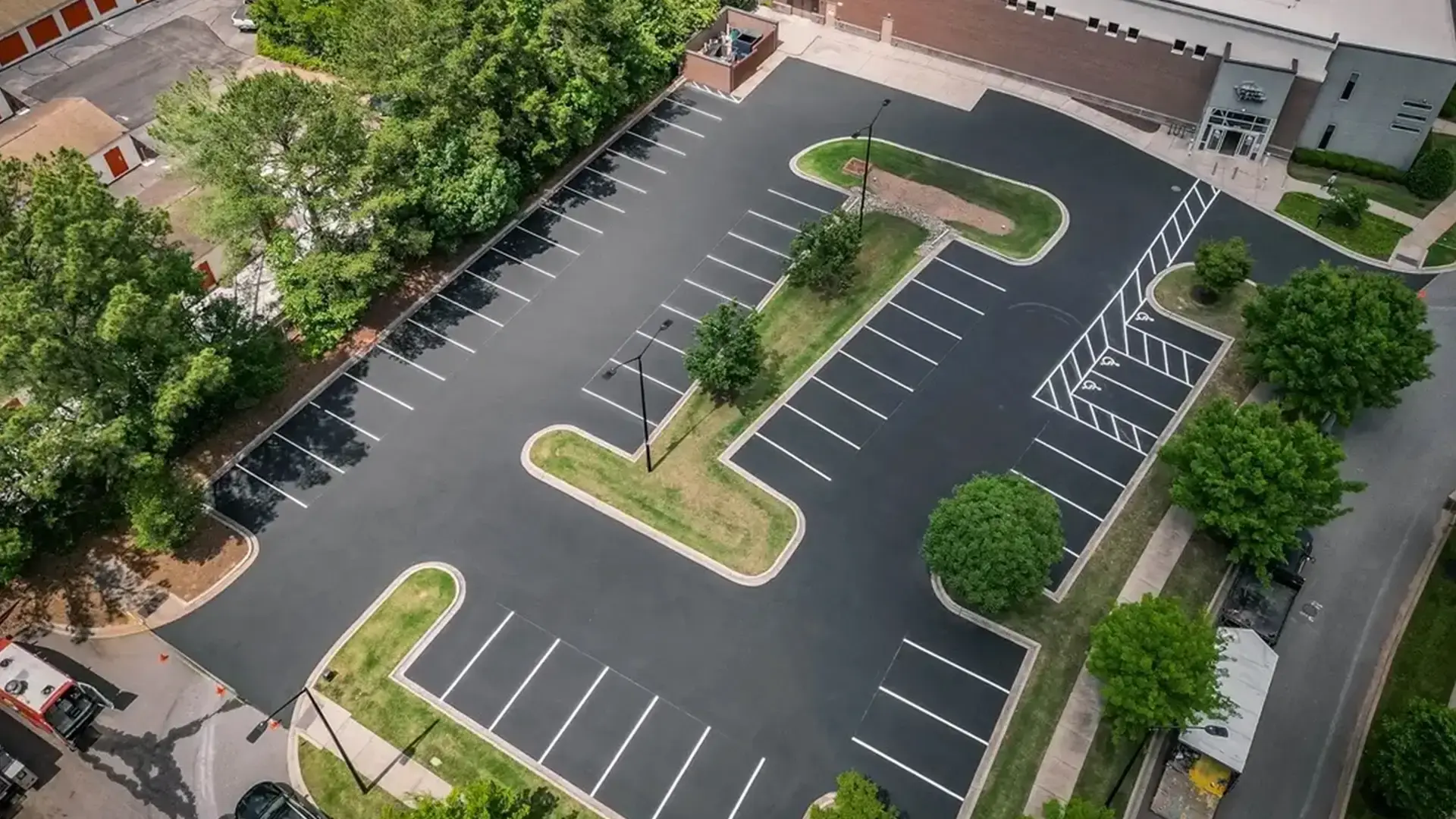
A standard longitudinal pavement marking is generally 4 to 6 inches wide, according to the Federal Highway Administration’s Manual on Uniform Traffic Control Devices (MUTCD). That small amount of paint plays a surprisingly important role in communicating how drivers should move through a parking area.
For a busy apartment community, however, line striping is more than repainting faded parking spaces.
A multifamily property may have hundreds of residents, assigned spaces, visitor parking, delivery vehicles, emergency access lanes, ADA spaces, dumpsters, pedestrians, and vehicles moving through the property at virtually every hour.
That creates a unique challenge for property managers:
How do you refresh the parking lot markings without turning a routine maintenance project into a resident-relations problem?
The answer is careful planning.
Treat a successful apartment parking lot line striping project as a traffic-management project with a paint component, not simply a painting job. The goal is to improve organization and visibility while keeping residents, visitors, vendors, and emergency personnel moving safely throughout the process.
Start With a Parking Lot Walkthrough
Before scheduling a striping crew, walk the property as if you were a resident arriving home after work.
Look at the parking lot from several perspectives:
- Where do vehicles enter and exit?
- Which spaces are assigned to residents?
- Where do visitors typically park?
- Are there areas where drivers frequently travel in the wrong direction?
- Are fire lanes clearly identifiable?
- Are ADA spaces and access aisles clearly marked?
- Where do pedestrians cross vehicle lanes?
- Are dumpsters or loading areas interfering with traffic?
- Which areas experience the heaviest vehicle activity?
- Are pavement markings faded, confusing, or inconsistent?
This walkthrough can reveal problems that aren’t obvious from a parking-space count alone. For example, an apartment community may have perfectly sized parking spaces but still experience traffic congestion because directional arrows are faded or an entrance lane is poorly defined.
The FHWA explains that the MUTCD establishes national standards and guidance for traffic control devices, including pavement markings, to promote safety and efficiency. For private roads open to public travel, property owners may also have responsibilities, while state or local agencies can impose additional requirements depending on the jurisdiction.
That makes the initial site assessment an important part of the project.
Build a Striping Plan Around How Residents Actually Use the Property
A common mistake is to create a striping plan based solely on the physical layout. Apartment communities should also consider behavior patterns.
For instance, residents may use one entrance more heavily during morning commutes, while another becomes busier in the evening. A visitor lot may fill up on weekends, while delivery vehicles may create additional activity during business hours.
Your striping plan should account for these patterns.
Identify the property’s critical zones
| Zone | What to Review |
| Resident parking | Assigned spaces, numbering, accessibility |
| Visitor parking | Space visibility and traffic circulation |
| Entrances | Directional markings and lane organization |
| Fire lanes | Visibility and prohibited parking areas |
| ADA parking | Accessible spaces, access aisles, signs |
| Pedestrian areas | Crosswalks and pedestrian movement |
| Loading zones | Delivery and service-vehicle access |
| Dumpster areas | Collection truck movement |
| High-traffic areas | Wear, fading, congestion points |
| Secondary lots | Whether markings match the primary lot |
It lets property managers ask whether the current layout still works for how the community operates today.
Choose the Right Time to Stripe
Timing is one of the most important decisions in an apartment line-striping project. The best date isn’t necessarily the day the contractor has an opening.
It should be the date that creates the least operational disruption.
Consider:
- Resident schedules
- Leasing-office activity
- Weekend traffic
- Trash collection
- Landscaping schedules
- Maintenance work
- Community events
- Deliveries
- Weather conditions
- Emergency access requirements
For communities in Charlotte, Denver, Winston-Salem, and surrounding North Carolina markets, property managers should also consider local weather patterns when choosing an appropriate application window.
A line striping project needs suitable pavement and weather conditions for proper application and curing. Your contractor should confirm the product requirements and anticipated conditions before finalizing the schedule.
Use Phased Striping Instead of Closing Everything at Once
For a large apartment complex, closing the entire parking lot can create unnecessary chaos. A better strategy is often phased line striping.
Instead of treating the property as one giant work zone, divide it into manageable sections.
Example of a phased approach
Phase 1: Back-of-property parking
Phase 2: Side-lot resident parking
Phase 3: Visitor parking
Phase 4: Main entrance and high-traffic areas
Phase 5: Fire lanes, directional markings, and specialty markings
This lets residents keep using parts of the property while crews work elsewhere.
The exact sequence should be customized to the property’s layout.
A community with one primary entrance may require a completely different strategy from a property with multiple access points.
Give Residents More Notice Than You Think You Need
A line striping project can be completed efficiently and still receive complaints if residents feel surprised by parking restrictions.
Start communicating before the crew arrives.
A useful resident notification should clearly explain:
- The project dates
- Which parking areas will be closed
- When vehicles must be moved
- Where residents can temporarily park
- How long each section is expected to remain closed
- Whether visitor parking will be affected
- What happens if a vehicle is left in a restricted area
- Who residents should contact with questions
Avoid vague messages such as:
“Parking lot work will occur next week.”
Residents need actionable information. A better message identifies the affected section and gives residents a specific deadline for moving vehicles.
Create a Temporary Parking Map
For a large apartment community, a temporary parking map can be one of the most useful project-management tools.
The map can identify:
- Closed areas
- Temporary resident parking
- Visitor parking
- Accessible parking
- Fire lanes
- Contractor work zones
- Pedestrian routes
- Alternative entrances
Post the map digitally and physically.
Consider placing signs at entrances several days before the project begins so residents encounter the information before reaching the closed area.
Don’t Forget Emergency Access
Fire lanes and emergency routes require special attention. A line striping project should never create uncertainty about where emergency vehicles can travel.
Before work begins, property managers should verify that:
- Emergency access remains available.
- Fire lanes are clearly identified.
- Temporary barricades do not obstruct emergency routes.
- Contractor vehicles are positioned appropriately.
- Residents understand temporary restrictions.
- Local requirements are followed.
The MUTCD contains standards and guidance for pavement markings and traffic-control devices, but private-property requirements can also depend on state and local rules.
For that reason, property managers should confirm applicable requirements with the appropriate local authority rather than assuming that one striping layout applies everywhere.
Review ADA Parking Before the Crew Starts
Treat accessible parking as a planning issue, not something to address after the striping is finished.
The ADA Standards for Accessible Design establish requirements for accessible parking spaces and access aisles at covered facilities.
Before the project begins, review:
- Accessible parking spaces
- Access aisles
- Required signage
- Accessible routes
- Van-accessible spaces where applicable
- Surface condition
- Marking visibility
Use the U.S. Department of Justice’s ADA guidance alongside applicable state and local requirements when evaluating accessible parking.
A fresh coat of paint does not automatically make an existing parking arrangement compliant. If the layout itself has an issue, repainting the same configuration preserves the problem.
Decide What Should Be Re-Striped
Not every marking needs the same treatment. During the site assessment, divide the markings into categories.
Standard markings
These may include:
- Parking stalls
- Directional arrows
- Stop lines
- Crosswalks
- Center lines
Regulatory or restricted areas
These may include:
- Fire lanes
- No-parking zones
- Loading areas
- Curb markings
Specialty markings
These may include:
- ADA symbols
- Reserved parking
- Visitor parking
- Numbered spaces
- Pickup areas
- EV spaces
This makes it easier to build an accurate scope of work.
It also prevents a common problem: discovering halfway through the project that the property needs substantially more marking work than originally estimated.
Coordinate With Other Property Maintenance
One of the smartest ways to reduce disruption is to coordinate line striping with other maintenance work.
For example, if the apartment community also needs asphalt repairs, crack filling, sealcoating, or parking lot cleaning, completing compatible work in the correct sequence can reduce repeated closures.
A typical maintenance sequence might involve:
- Inspecting the pavement
- Completing necessary asphalt repairs
- Cleaning the surface
- Completing sealcoating if appropriate
- Allowing the surface to cure
- Applying new pavement markings
- Conducting a final inspection
The actual sequence depends on the services being performed and the materials used.
The key is to avoid restriping an area and then immediately closing it again for another maintenance operation.
Account for Resident Parking Assignments
Apartment parking creates a challenge that commercial lots often don’t have: residents may believe a particular space belongs to them.
If parking spaces are assigned by lease, building, unit, permit, or numbered stall, the striping project should preserve that system or clearly communicate any changes.
Before restriping, verify:
- Space numbers
- Assigned parking
- Reserved spaces
- Guest spaces
- Accessible spaces
- Employee or management parking
- EV spaces
- Loading spaces
If the property wants to change the parking arrangement, make that decision before the crew arrives. Otherwise, freshly painted lines may reproduce an outdated parking system.
Consider Parking Space Numbers and Wayfinding
Line striping can also become an opportunity to improve wayfinding. If residents routinely struggle to find specific buildings or parking areas, consider whether the pavement can provide additional visual guidance.
Depending on the property and applicable requirements, improvements might include:
- Building-area identifiers
- Parking-zone numbers
- Directional arrows
- Visitor parking markings
- Clearly defined loading areas
- Improved pedestrian crossings
The goal isn’t to cover the pavement with paint. The goal is to make the parking environment easier to understand.
Schedule a Final Inspection
Don’t consider the project finished when the crew leaves. Conduct a walkthrough after the markings are complete.
Check:
- Parking stall alignment
- Line visibility
- Directional arrows
- Crosswalks
- Fire lanes
- ADA spaces
- Access aisles
- Curb markings
- Reserved spaces
- Visitor parking
- Signs
- Cleanup
Take photographs for the property’s maintenance records. These records can be useful when planning future restriping projects and comparing pavement-marking deterioration over time.
A Practical Planning Timeline
For a busy apartment community, consider this general planning framework:
| Time Before Project | Recommended Action |
| 4–6 weeks | Inspect pavement and identify striping needs |
| 3–4 weeks | Request proposals and compare scopes |
| 2–3 weeks | Select contractor and finalize phasing |
| 1–2 weeks | Create temporary parking plan |
| 1 week | Notify residents and staff |
| 2–3 days | Install advance notices and confirm logistics |
| Project day | Close designated zones and begin work |
| After completion | Inspect markings and reopen areas as appropriate |
| Following weeks | Monitor wear, complaints, and traffic flow |
The timeline can be shorter or longer depending on the size and complexity of the property.
For particularly large communities, early planning gives management more flexibility if weather or operational issues require a schedule change.
What Makes a Successful Apartment Line Striping Project?
A successful project should accomplish more than producing bright lines.
It should:
- Improve parking organization.
- Make traffic patterns easier to understand.
- Maintain appropriate emergency access.
- Preserve accessible parking.
- Minimize resident disruption.
- Coordinate with other pavement maintenance.
- Give residents clear instructions.
- Account for the property’s actual traffic patterns.
- Leave management with useful project records.
That is why planning should begin before the striping contractor arrives.
For property managers, the best line striping project is often the one residents barely notice—except that the parking lot suddenly feels easier to navigate.
Plan Your Apartment Line Striping Project Without the Tenant Headaches
Executing a line striping project in a high-occupancy apartment community requires precise logistics, strategic parking sectioning, and proactive tenant communication. Improper planning leads to vehicle towing conflicts, blocked emergency lanes, and costly project delays that frustrate residents and disrupt daily routines.
ProLine Parking Lot Maintenance provides comprehensive project management and fast-curing pavement marking solutions designed to keep your property accessible and compliant with zero unnecessary downtime.
- Phased Execution Plans: Custom sectioning and rapid-dry traffic paints allow residents to park safely while work progresses seamlessly in stages.
- Complete Safety & Code Alignment: Strategic re-marking of fire zones, ADA accessible spaces, and visitor stalls to eliminate property liability.
Frequently Asked Questions
How far in advance should an apartment community schedule line striping?
The ideal lead time depends on the property’s size, season, and contractor availability. Larger communities should begin planning several weeks in advance because resident communication, parking relocation, and coordination with other maintenance activities can take time. Starting early also gives management more flexibility if weather or unexpected pavement repairs affect the schedule.
What should an apartment property manager look for when comparing striping contractors?
Compare the contractor’s proposed scope, including preparation, specialty markings, accessible parking, fire lanes, cleanup, traffic control, and any necessary pavement repairs. Verify insurance, relevant experience, references, and the approach to working around occupied properties.
How can apartment managers handle residents who refuse to move their vehicles?
The property should establish its vehicle-movement policy before the project begins and communicate it clearly to residents. Management should provide advance notices, temporary parking instructions, and clearly marked closure areas so residents have a reasonable opportunity to move their vehicles. If enforcement or towing may be necessary, managers should follow the property’s established policies and applicable local requirements rather than improvising during the project.
Should an apartment community restripe parking spaces at the same time every year?
Not necessarily, because pavement-marking wear depends on traffic, weather, pavement condition, maintenance activities, and the quality of the previous application; a busy entrance may need attention sooner than lightly used spaces elsewhere on the property. Instead of automatically following an annual calendar, managers should inspect the markings periodically and schedule restriping when visibility and organization begin to decline.
Can line striping change how much parking an apartment community has?
Yes, changing stall dimensions, layouts, drive aisles, or restricted areas can affect the number of usable spaces. However, property managers should not reduce accessible parking, emergency access, or other required areas to create additional stalls. Review any proposed layout change against applicable building, fire, zoning, accessibility, and local requirements before painting.
What happens if it rains shortly after an apartment parking lot is striped?
Rain can interfere with pavement-marking application and curing, depending on the product and conditions. A reputable contractor should monitor the forecast and follow the manufacturer’s requirements for surface conditions and drying time rather than proceeding simply because the calendar says the project is scheduled. If unexpected weather occurs, the contractor may need to delay application or adjust the work plan to protect the finished result.
How can property managers document a completed striping project?
Take photographs of the completed parking areas, specialty markings, fire lanes, accessible spaces, and any areas where the layout changed. Keep the contractor’s scope, product information, project date, site plan, and invoices with the property’s maintenance records. This documentation can make future maintenance planning easier and give management a useful reference for how quickly markings deteriorate.
See also: How Weather and Heavy Traffic Affect Line Striping at Apartment Complexes, The Operational Benefits of Professional Multi-Family Line Striping Services


