

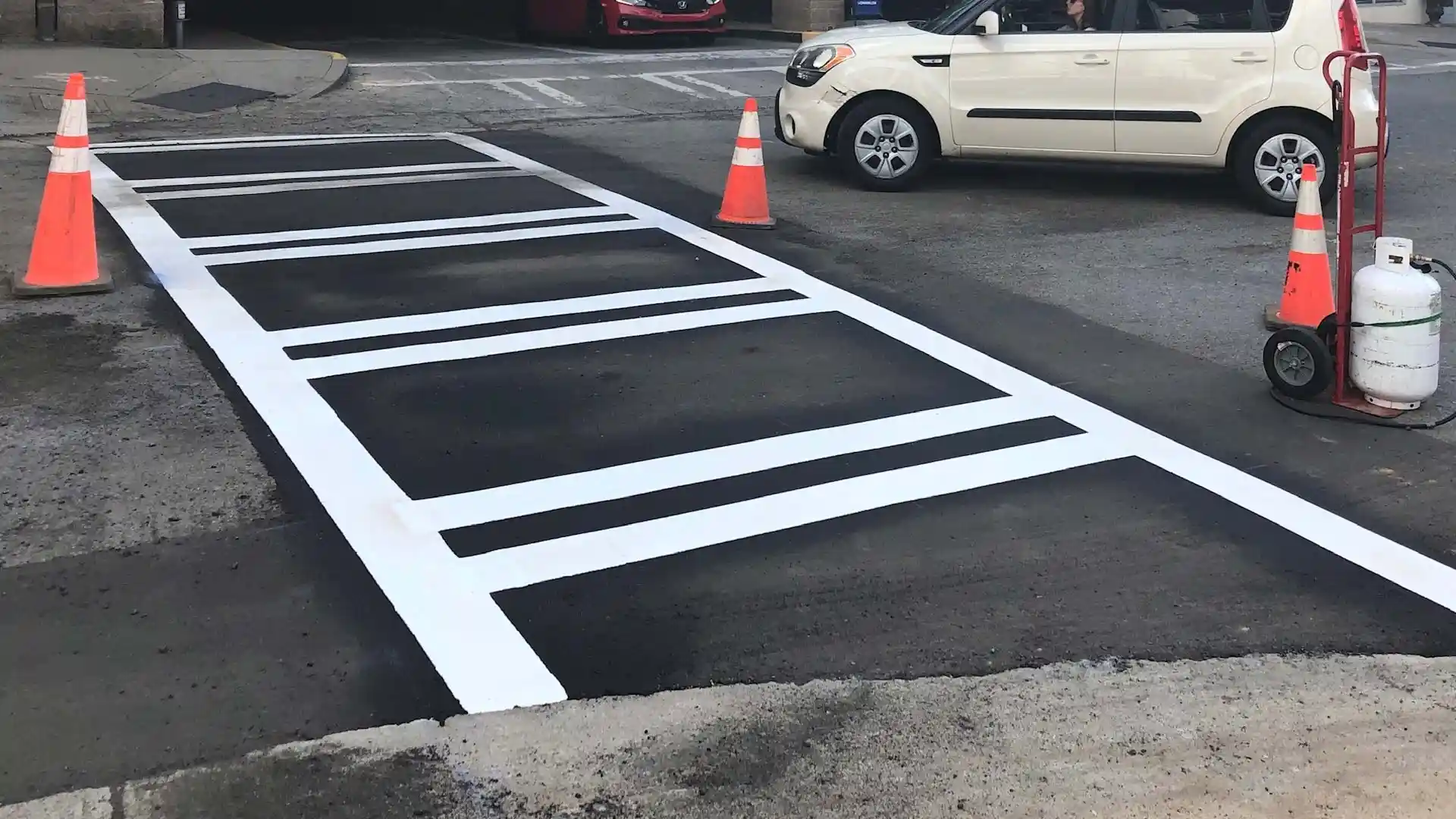
Clear parking markings help drivers find stalls, follow circulation patterns, and recognize pedestrian crossings. At an apartment community, that guidance matters throughout the day and after dark. Evaluate markings together with lighting, sightlines, walking routes, and emergency access.
Quick answers:
- Striping functions as a safety system for a parking lot, the same basic role signage and lane markings play on a public road, not as a purely cosmetic feature.
- Professional layout design accounts for sightlines, turning radii, and traffic conflict points, factors a bargain repaint of the existing pattern doesn’t reconsider.
- According to the Federal Highway Administration, reflective pavement markings are specifically designed to remain visible under headlights at night, a performance factor that varies significantly between marking materials.
- Accessible parking and fire-access markings should be reviewed against the requirements that apply to the property and its approved layout.
- Poorly executed or bargain striping can create a safety risk of its own, not just an appearance problem, if lines are misapplied, poorly placed, or use materials that don’t hold up.
Striping Is a Safety System, Not Just Paint
It’s easy to think of striping as an aesthetic finishing touch, the thing that makes a freshly sealcoated lot look complete. Functionally, it’s closer to a traffic control system: it tells drivers where to go, where not to go, where pedestrians might be, and where emergency access needs to stay clear. Treating it as decoration rather than a safety system is exactly how a property ends up with a lot that looks fine in photos but functions poorly for the people actually driving and walking through it every day.
Professional Layout Design Accounts for Sightlines and Traffic Conflicts
A professional striping crew doesn’t just repaint whatever pattern already exists. Part of the job is evaluating whether that existing layout actually manages sightlines well at blind corners, whether turning radii work for the vehicles that actually use the lot, and where pedestrian paths cross vehicle traffic in ways that deserve a marked crossing rather than an assumed one. A bargain repaint that restores the old lines skips this evaluation entirely, which means any layout problem that existed before gets preserved rather than caught.
Reflective Materials Matter More at Night Than Most People Realize
Reflective additives can improve marking visibility under headlights when the selected product and application support them. Choose materials for the pavement surface and site conditions, and inspect their visibility after dark. Public-road marking standards do not automatically establish requirements for every private parking lot.
Compliance Markings Exist for Real Safety Reasons, Not Just Regulatory Box-Checking
Accessible parking and fire-access routes serve different needs and may involve different requirements. Confirm the applicable standards, signs, dimensions, slopes, and routes with the responsible professional or authority before painting.
Pedestrian Safety: Crosswalks, Play Areas, and Walkway Delineation
Apartment communities have a pedestrian safety consideration that many commercial lots don’t: residents, including children and elderly residents, regularly walk through parking areas to reach mailboxes, pools, playgrounds, and their own units. Marked crosswalks at common walking paths, clear delineation between vehicle lanes and pedestrian walkways, and visible markings near playgrounds or pool entrances all reduce the chance that a driver and a pedestrian end up in the same space without either expecting it. This is an area a generic repaint job, focused only on restoring parking stalls, frequently overlooks entirely.
Consistent, Professional Work Reduces the Chance of an Incident in the First Place
Clear, well-maintained, properly placed markings reduce driver confusion, and less confusion generally means fewer close calls and fewer minor collisions in a lot’s tightest, most conflict-prone areas. According to the Insurance Information Institute, the conditions present at the time of an incident often factor into how a resulting claim gets evaluated, which makes clear, professional striping a meaningful piece of a property’s broader risk management, not just a safety nicety with no practical stakes attached.
Want a safety-focused walk-through of your property’s current striping, not just a quote for a repaint? ProLine Parking Lot Maintenance can identify where layout, visibility, or compliance gaps are actually creating risk before deciding what to fix.
Review Markings Alongside Other Site Conditions
Visible markings help guide drivers and identify pedestrian routes. They support site safety but cannot prevent every collision or eliminate liability. Review striping alongside lighting, pavement condition, signs, and the way people use the property.
ProLine Parking Lot Maintenance applies commercial-grade, reflective striping solutions designed to maximize safety, visibility, and traffic flow in high-density residential areas.
- Traffic & Pedestrian Flow: Precision placement of crosswalks, speed bump markings, stop bars, and directional arrows to protect residents.
- Emergency Access: Review required routes and markings against the approved site plan and local authority guidance.
Frequently Asked Questions
Does professional striping actually reduce accidents in a parking lot, or is that hard to measure?
Isolating striping as the single cause of a change in incident rates is genuinely difficult, since traffic volume, lighting, weather, and driver behavior all play a role at the same time. What’s more measurable is the underlying mechanism: clearer, more visible, better-placed markings reduce driver uncertainty in the specific spots where confusion tends to cause a collision, like blind corners or unmarked pedestrian crossings. Properties that address a specific problem area with better striping often see that particular location’s incident pattern improve, even without a formal before-and-after study to prove it.
Are pedestrian crosswalks required in an apartment parking lot or just recommended?
Crossing-marking requirements depend on the site, its approved plan, and applicable rules. Review pedestrian routes with the responsible design professional; do not assume paint alone creates an accessible or protected crossing.
What is retroreflectivity, and why does it matter for nighttime safety?
Retroreflectivity refers to a marking material’s ability to reflect a vehicle’s headlight beams back toward the driver, rather than simply appearing as a colored line under ambient light. According to the Federal Highway Administration, this property is built into public-road marking standards specifically because visibility at night depends on more than paint color; it depends on how well that paint reflects light to the person who needs to see it. Materials with glass beads or similar reflective additives perform meaningfully better after dark than standard paint without them, even if both look similar during a daytime inspection.
Should speed bumps or speed humps be marked with striping?
Speed bumps and humps should be visible to approaching drivers. Review their markings and warning signs against the approved design and applicable local requirements. Inspect lighting and visibility after dark as well as during daylight.
Can poorly executed DIY or bargain striping actually create a safety risk, rather than just looking bad?
Yes, and this is one of the more overlooked risks of cutting corners on this kind of project. Lines placed inconsistently, painted over debris or moisture, or using material that doesn’t cure or bond properly can create markings that peel, smear, or mislead drivers about where a stall or lane actually is, which is arguably worse than faded old paint that at least reflected an intentional layout. A poorly executed repaint can introduce new confusion rather than simply failing to fix old confusion.
Does professional striping account for how emergency vehicles need to navigate the property, not just everyday traffic?
Review emergency vehicle access against the approved site plan and local fire authority requirements. Turning areas, clearances, obstructions, and signs may require attention beyond the striping scope.
How does a professional striping company decide where lines actually go versus just repainting what was already there?
A proper evaluation typically starts with walking the property to identify traffic patterns, blind spots, pedestrian routes, and any areas with a history of complaints or near-misses, rather than assuming the existing layout was correct to begin with. That assessment gets combined with applicable standards for accessible stalls, fire lane clearance, and general traffic flow to produce a layout that’s been deliberately checked against safety criteria, not simply copied from whatever was painted there last time. This is a meaningfully different process than a bargain repaint that treats the existing pattern as the default.
Should apartment communities involve their insurance company when planning a new striping project?
For a substantial layout change, consult the responsible design professional and confirm applicable requirements. The insurer can answer coverage questions, but insurance input does not replace the required design or authority review.
See also: How Often Should Multi-Family Parking Lots Be Restriped?, How Parking Lot Striping Improves Traffic Flow in Multi-Family Communities


