

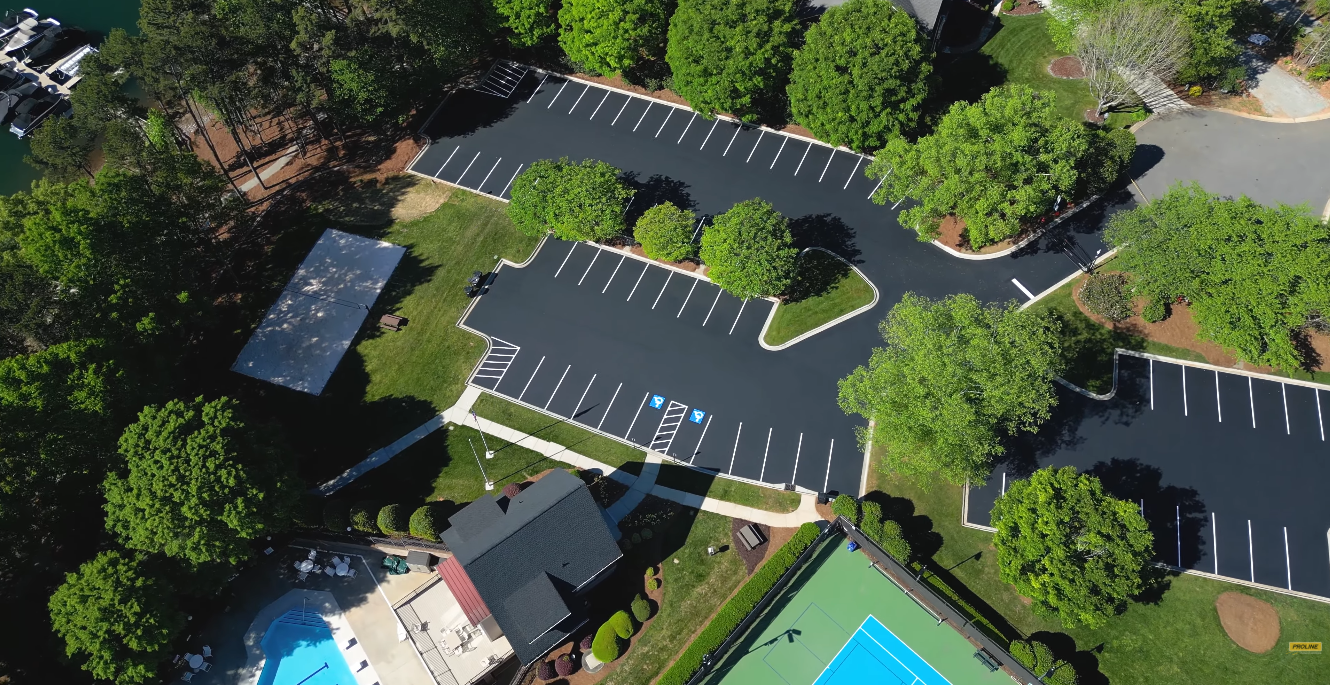
The parking arrangements in apartment pool areas are different from those in the rest of a multifamily building. When residents arrive, they bring with them their children, pool equipment, coolers, towels, and other such items, thus increasing the number of people who move between their parked cars and the entrance to the facility. Moreover, the 2010 ADA Standards mandate that accessible parking spaces must be connected to an accessible route that serves the entrance to the facility.
What this implies is that striping around an apartment pool should not only give parking spaces a neat appearance but also aid the residents in knowing where they can park, where pedestrians should walk, and which areas should stay clear near the pool gates, the clubhouse entrances, the sidewalks, and other amenities.
We study these projects by examining the way the amenity area functions during busy times; a pool parking area, which is adequate on a quiet weekday morning, can become crowded on a Saturday afternoon, particularly in apartment complexes in Charlotte, Huntersville, Mooresville, Greensboro, Winston-Salem, Greenville, Columbia, or in other busy Carolina markets.
Why Pool and Amenity Areas Need Different Striping
Apartment car parks generally have a number of things going on at the same time, such as residents parking their cars, pedestrians walking between the buildings, guests searching for a space, delivery drivers going around the premises, and maintenance crews needing access. The fact that the pool and amenity areas involve an extra element is that residents usually remain in their vehicles while they are getting their possessions out or while they are waiting for other people.
For example, a resident may stop beside a pool entrance to unload:
- Children and personal belongings
- Pool chairs or umbrellas
- Coolers and food
- Strollers
- Sports equipment
- Personal mobility equipment
Where the pavement markings fail to clearly outline the parking spaces and the areas for circulation, drivers might use the open pavement as temporary parking, which can soon reduce the usable width of the drive aisles or obstruct the movement of pedestrians. The aim is not to apply more paint to the pavement; it is to use markings in those situations where they deal with a particular circulation problem.
What We Check Before Striping
| Area | What We Look For | Striping Consideration |
| Pool entrance | Pedestrian concentration | Keep vehicle parking away from the entrance |
| Accessible spaces | Route to the amenity | Preserve the required access aisle and route |
| Drive aisles | Vehicle circulation | Keep stall lines aligned with the existing traffic pattern |
| Sidewalk crossings | Pedestrian movement | Use appropriate crossing markings where applicable |
| Guest parking | Short-term turnover | Clearly separate parking from no-parking areas |
| Clubhouse frontage | Drop-off activity | Prevent vehicles from stopping in circulation areas |
| Amenity buildings | Multiple pedestrian destinations | Avoid creating confusing vehicle paths |
| Pool gate area | Frequent foot traffic | Keep the entrance approach unobstructed |
This method provides the property manager with a layout that is according to the way residents actually use the area, not just by repainting the earlier configuration.
Keep Pool Entrances Clear With Purposeful Markings
Having a visible layout of parking spaces is not enough for a pool entrance. People should be able to recognize the entrance area without needing to go around parked vehicles or those which have been temporarily stopped in front of the gate.
Depending on the existing site design and local requirements, a property may need clearly defined no-parking areas near:
- Pool gates
- Pedestrian crossings
- Fire access areas
- Sidewalk connections
- Accessible routes
- Clubhouse entrances
- Emergency access points
You should not introduce random yellow lines merely on the grounds that a section seems to be crowded. Every line has to serve a particular purpose and must be in accordance with the property’s traffic-control plan. The MUTCD lays down standards and guidance regarding pavement markings, which are used to guide, warn, and regulate traffic. What this means for an apartment complex is that the striping should coordinate with the signs and other traffic control measures rather than give out contradictory messages.
Plan for Pool-Day Parking Demand
The availability of parking in the pool area tends to change during the day. Even though a community has a lot of open space in the morning, it can see a great deal of parking demand in the afternoon. Also, families might take longer than in other parts of the property when they are unloading near the pool. When assessing the striping, we take into account the most busy practical application of the area.
For example:
Normal weekday:
The residents come in slowly, and most of the spaces are still available.
Weekend afternoon:
A greater number of residents and visitors reach here in a shorter amount of time.
Holiday weekend:
Demand for parking goes up at the same time as pedestrian activity around the pool increases.
The striping plan must still make sense when demand is high.
It could involve establishing a more distinct separation between regular parking, guest parking, pedestrian crossings, and the areas that have to stay open.
Do Not Let Guest Parking Take Over the Amenity Area
Guest parking can be a problem if visitors are unable to at first work out where they are supposed to park. A visitor might see an area by the pool that is open and take it to mean that it is available. At the same time, another driver might stop by the edge of the parking lot since the designated spaces are full. Well-defined stall lines and the use of suitable pavement markings aid in showing the intended parking layout. Yet the markings should support the parking policy of the property,, not try to replace it. When special identification is needed for guest parking, property managers can arrange for pavement markings to be accompanied by signs and the community parking rules.
Coordinate Striping With Pedestrian Crossings
In pool areas it is common for pedestrians to cross over vehicle lanes. This is particularly the case when the sidewalk from the apartment blocks runs straight up to the pool entrance. A marked crossing can be used to show where pedestrians move when the site design and the relevant traffic-control requirements indicate that this is necessary. The MUTCD includes guidelines regarding the placement and design of crosswalks, covering coordination with curb ramps and other pedestrian features.
We look at:
- Where pedestrians naturally cross.
- Where vehicles approach the crossing.
- Whether visibility is adequate.
- Whether parked vehicles could block the crossing.
- Whether the crossing connects to an existing sidewalk or accessible route.
- Whether signs or other traffic-control devices need to coordinate with the pavement markings.
The goal is to make the crossing part of the overall traffic pattern rather than painting a crosswalk in a location that residents do not naturally use.
Protect Accessible Parking Near Amenity Areas
Special attention should be given to accessible parking in the vicinity of apartment pools and clubhouses. The ADA Standards stipulate that accessible parking spaces must be situated on the shortest accessible route to the accessible entrance that they serve, provided that the applicable requirements and exceptions apply.
For a pool or a clubhouse, the location of the accessible space is just as important asnt as the symbol painted inside that space, whether:
- The parking space remains clearly identifiable.
- The access aisle stays unobstructed.
- The route toward the amenity remains usable.
- Nearby parking does not interfere with the access aisle.
- Vehicle overhang does not block the pedestrian route.
- Pavement markings remain visible.
Restriping is also a good opportunity to identify layout problems before applying new paint. If the existing configuration places accessible spaces too far from the entrance or creates conflicts with pedestrian movement, simply repainting the same layout may not solve the underlying issue.
A Practical Pool-Area Striping Checklist
Before we begin a project, property managers can use this checklist:
| Question | Why It Matters |
| Where do residents naturally walk from parking to the pool? | Helps identify pedestrian routes |
| Which spaces serve the pool or clubhouse? | Helps organize amenity-related parking |
| Are accessible spaces positioned correctly? | Supports required accessible routes |
| Can vehicles overhang into sidewalks? | Helps protect pedestrian clearance |
| Where do residents tend to stop temporarily? | Identifies potential circulation conflicts |
| Are guest spaces clearly identifiable? | Reduces confusion for visitors |
| Has the amenity layout changed? | Determines whether the old striping still works |
| Are existing markings still visible? | Shows whether restriping is needed |
| Does the pavement need repair first? | Prevents premature striping |
| Do markings coordinate with signs? | Keeps the traffic-control system consistent |
Why Property Managers Should Review Pool Striping Before Peak Season
Since the pool areas are used a lot during the warmer months, it makes sense to carry out a check of the pavement markings in the spring. Search for stall lines that have faded, accessible symbols that are worn, crossings that are unclear, and places where drivers have begun to use informal parking spaces.
If people currently park outside the designated areas during the busy times, then just repainting in the same pattern won’t be sufficient. We can look at the present arrangement and assist in deciding if the property requires simple restriping or a more intentional change to its layout. In apartment complexes located in Carolina areas such as Charlotte, Greensboro, Winston-Salem, Greenville, and Columbia, the use of seasonal amenities can cause these minor pavement features to become much more noticeable.
We Stripe for How the Amenity Area Actually Works
The striping in the parking lot around an apartment complex pool should match the actual behaviour of the residents. We aren’t treating the project as if it were merely about repainting the existing lines; instead we consider the relationship between the parking spaces, the drive aisles, the sidewalks, the accessible routes, the pool entrances, the clubhouse areas, and the pedestrian crossings.
This provides property managers with a more clear idea of the parking layout and enables the pavement markings to have a practical function. We can assist you in drawing up a striping plan regardless of whether you are looking after an apartment community that is already in place or one that has just been renovated.
Frequently Asked Questions
Can apartment pool parking spaces be numbered?
Certainly. Where the community’s parking system requires it, property managers may use the pavement numbers to identify the parking spaces that have been assigned. Such numbering helps residents to find their assigned spaces and also makes it easier to enforce parking rules if a written parking map is used. The numbers must stay in line with the property’s records so that residents do not get inconsistent information from the pavement markings, the signs, or the leasing documents.
Should pool parking spaces be wider than regular apartment spaces?
It is not automatic; the dimensions needed will vary according to the parking layout, the relevant codes, the flow of vehicles, accessibility requirements, and the design of the property. Just increasing the width of every space next to a pool will fail to deal with the real circulation problem and may in fact reduce the number of spaces that can be used. We suggest that you assess the particular parking row, the adjacent sidewalks, the turning movements, and the types of vehicles before altering the width of the stalls.
Can a property use pavement markings to reserve pool parking for residents?
Pavement markings may be used by a property as part of its parking management system, but they must correspond with the community’s real parking policy. For instance, the property could make use of space numbers, guest-space markings, or other approved means of identification. It is also necessary for the property to ensure that its signs, the lease rules, the enforcement procedures and the pavement markings all convey the same parking restrictions.
How often should apartment pool parking numbers be repainted?
There isn’t a one-size-fits-all timetable that applies to all types of property. The amount of traffic, the state of the pavement, the effects of the weather, the type of paint used, the maintenance procedures, and the level of vehicle activity all influence how long the markings stay visible. Rather than repainting merely according to a calendar, property managers should examine the markings and plan restriping when the lines or symbols no longer make it clear what they are identifying.
What should a property manager do if residents keep parking outside the marked pool spaces?
Begin by recording the place and time when the behaviour takes place. In the case where vehicles keep on stopping in the same unmarked area, the problem may be due to the property having a flawed layout or a communication issue rather than just a lack of resident compliance. Before deciding whether extra markings, signs, or a new parking layout would solve the problem, review parking demand, the signs, the stall configuration, pedestrian routes, and available spaces.
Can pool-area striping be changed without repaving the parking lot?
In numerous instances, yes. It is often possible for a property to restripe an existing asphalt surface without having to completely repave it, provided that the pavement offers an appropriate base for the new markings. Yet, if there is serious cracking, potholes, raveling, failed repairs, or other pavement issues, this can have an impact on the outcome. Before any decision is made, we carry out an inspection of the surface so that the property won’t end up spending money on new markings while failing to address pavement problems that might need repairing in the near future.
Does pool furniture affect parking lot striping?
It is possible for permanent or frequently used furniture to affect the way residents move from their vehicles to the pool entrance, especially in cases where the furniture is placed close to sidewalks, gates, or pedestrian crossings. Wconfirminghat before restriping, you take into account the final position of any fixedn’tnity features so that the new parking arrangement doesn’t conflict with them.
Can a parking lot be restriped after a pool renovation?
Certainly, and since a pool renovation provides a suitable opportunity to check the parking striping, alterations to the fencing, gates, sidewalks, landscaping, entrances, or amenity areas can affect how pedestrians and vehicles move. Instead of simply reproducing the earlier layout, we suggest reviewing the finished renovation and deciding whether the parking markings still match how residents will use the area.


