Parking is frequently among the most common complaints recorded by community associations, and the Community Associations Institute has for a long time identified disputes over parking as one of the most frequent causes of tension between residents and their HOA or apartment management. The Carolinas have seen a large number of new apartment and HOA communities established over the last ten years as the population in the region has continued to increase, and each of these communities eventually ends up facing the same issue: parking rules for residents, guests, and visitors that seem clear on paper but fail when someone tries to enforce them at the curb.
We receive calls all over the Carolinas—at places such as the Piedmont neighborhoods and the coastal areas of the Lowcountry—to deal with parking problems that generally come down to one underlying issue: the striping on the ground doesn’t match the parking rules stated on paper. This guide outlines how proper striping actually eliminates that discrepancy, not just how to draw straight lines.
Why Parking Categories Break Down Even When the Rules Are Clear
Most communities aren’t having problems because their residents can’t read the rules; instead, they have problems since the physical striping and stenciling on the pavement go out of step with the actual situation over time. When a resident moves out and a new tenant moves in, the numbered space on the ground still displays the previous resident’s allocation for months because no one arranges a touch-up. After a year or two of exposure to sun and rain, the faded guest lines blend in with the general parking, so residents can no longer tell which spaces are which. Once the paint no longer matches the policy, enforcement then becomes a matter of judgment rather than a clear fact, and it is at this point that parking complaints begin to accumulate on the property manager’s desk.
Reserved Parking: The Stencil Is the Enforcement Document
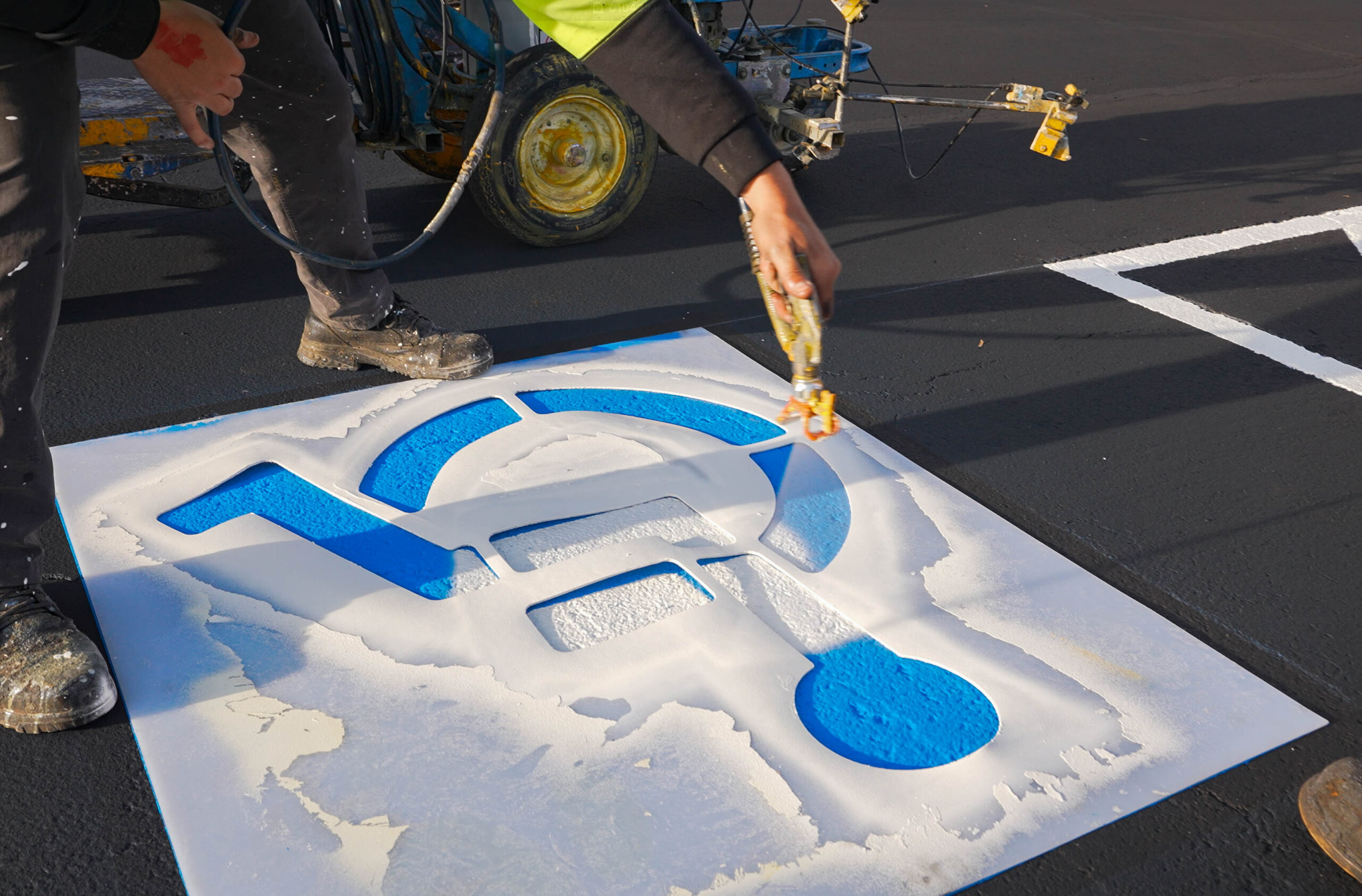
A reserved space stencil serves no decorative purpose; it is the physical evidence that either supports or contradicts the lease or HOA records at the time a dispute arises. By numbering reserved spaces to correspond with a resident’s actual lease or deed record rather than using a unit number whose meaning changes as people move in and out, communities prevent a frequent source of confusion during turnover. Since the same set of tires keeps stopping and starting in the same place week after week, the paint on the reserved space undergoes much more concentrated wear than that on a general traffic line, which is why the material used for the numbered stencils is more important than most property managers realize.
| Application | Typical Material | Why It Matters for Reserved Spaces |
| General parking lines | Water-based traffic paint, single or double coat | Cost-effective for large areas with lighter, more evenly distributed wear |
| Reserved space numbers and letters | Heavier-mil paint or thermoplastic stencils | Withstands repeated braking and turning wear concentrated in one small area far better than standard line paint |
| High-traffic entry lanes and crosswalks | Thermoplastic or epoxy-based marking | Holds up to constant tire contact and, in thermoplastic’s case, cures faster in humid conditions |
Guest Parking: The Legal Line Between Annoying and Actually Towable
This aspect is completely omitted by most articles on parking, yet it is the one that becomes most important when a community actually attempts to enforce its guest parking rules. Laws in both North Carolina and South Carolina govern towing on private property, and one of the most frequent reasons for a tow to later be successfully challenged is improperly marked or signed guest parking. Consumer protections regarding towing on private property are covered by resources from both the North Carolina Department of Justice and the South Carolina Department of Consumer Affairs, and the practical conclusion for property managers is the same in both states: striping and signage must be used together, not separately, if a guest parking policy is to be enforceable.
- Guest spaces must have a label that is clearly stenciled, for example, “GUEST,” so that a towing company or a responding officer will be able to visually verify that the vehicle was parked outside of its assigned category without having to rely on the resident’s word.
- The signs placed near the parking area for guests must clearly state the restriction, specifying any time limit, and should be visible from a vehicle before it parks, not hidden behind some landscaping or another sign.
- Since the exact requirements regarding sign placement, size, and the necessary contact information differ from state to state and may change, we advise that you check the current requirements with your community’s legal advisor or property manager before relying on the new striping and signage for enforcement.
- The mere presence of striping does not give someone the legal right to tow; it only provides the physical evidence that backs up a policy that your community has already properly recorded and displayed.
Resident Parking: Where Color Coding Actually Reduces Confusion
There are two types of pavement marking legally mandatory colors, and all the rest are optional recommendations that a contractor can make to reduce confusion. Blue markings featuring the international accessibility symbol are required by the ADA design standards for all accessible areas, and a red curb or striping to indicate a fire lane is required according to fire codes such as NFPA 1. After these two requirements, communities have genuine flexibility, but it is still important to be consistent, since many contractors deliberately adopt the general color logic found in the federal Manual on Uniform Traffic Control Devices so that drivers visiting a site and emergency responders can recognize the markings at a glance rather than having to learn a new system at each property.
| Parking Category | Typical Marking | Required by Law? |
| ADA accessible | Blue lines with the international symbol of accessibility | Yes |
| Fire lane | Red curb or striping, stenciled “NO PARKING FIRE LANE” | Yes |
| Reserved or assigned resident | A distinct color, commonly yellow, plus a stenciled space or unit number | No, but strongly recommended for clear enforcement |
| Guest parking | White lines with a stenciled “GUEST” label and posted time limit | No, though required signage elements come from state towing law |
| General or unassigned resident | Standard white lines, no special stencil | No |
Scheduling Restriping Around Carolina Weather
Carrying out a restriping project in line with the area’s weather patterns guards the investment, as paint will fail prematurely if applied under incorrect conditions regardless of how well the layout plan has been prepared. In the Carolinas, the high humidity during summer greatly slows down the curing of the paint when compared to a drier climate, and the frequent summer thunderstorms in the region may wash away newly applied paint if the crew miscalculates the forecast by just a few hours. Communities in coastal and Lowcountry areas have the extra problem of hurricane season, which lasts approximately from June to November, so the more reliable times for carrying out outdoor paving and striping work along the coast are early summer or fall. Meanwhile, the Piedmont and Upstate areas face the reverse seasonal problem in winter, since cold and wet conditions can stop the paint from curing properly, causing most contractors to adopt a schedule that runs from spring through to fall over nearly the whole region.
A Quick Checklist Before You Approve a Restriping Project
- Before any numbering is reduced, check the current list of residents or those assigned to leases, as retouching an outdated list will simply cause the same confusion once again in the fresh paint.
- Make sure that the number of accessible spaces you have still satisfies the required ratio for the total number of spaces, since that ratio is determined by the size of the lot and may change if the community has added or removed spaces since the most recent count.
- Make sure that the markings for the fire lane remain completely visible and clear, since local fire marshals generally require these to be well maintained at each inspection and not merely after a complaint has been made.
- Check that the posted towing signage complies with the current state requirements before treating either a new guest’s signage or reserved striping as enforceable, since the paint and the signage must match if enforcement is to be valid.
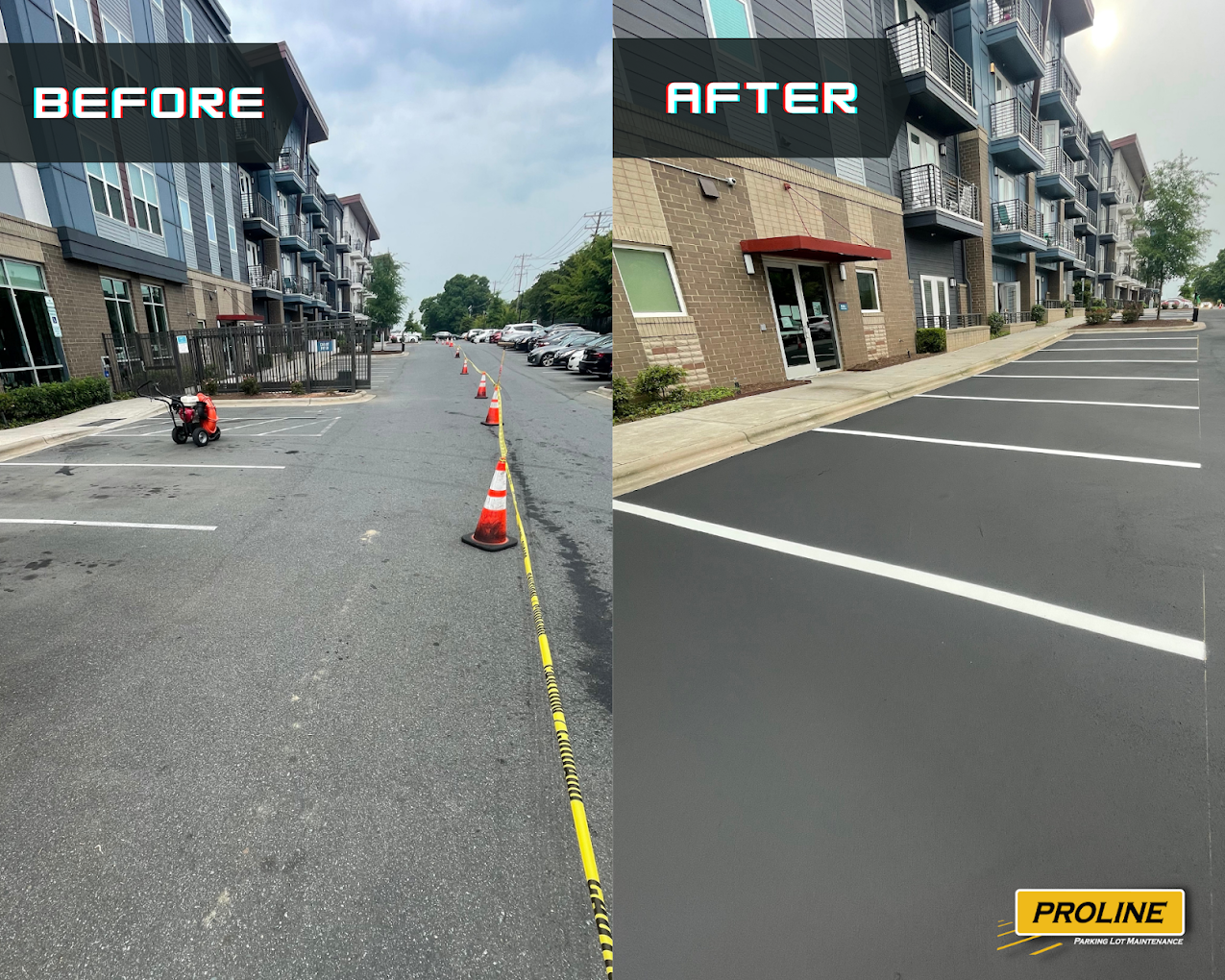
- Ask your contractor for before-and-after photos when dealing with your HOA board or for inclusion in your ownership records, as having a documented condition of the property helps to settle disputes and aids in future budget planning.
The “reserved, guest, and resident parking only” rule only functions as a system when the paint on the ground agrees with the policy stated on paper, and that agreement requires more than simply applying a fresh coat of white lines. ProLine Parking Lot Maintenance collaborates with HOA boards and property managers throughout the Carolinas in developing a striping plan that supports your real parking policy and can stand up to enforcement, not one that just looks neat on move-in day. If you get in touch with us, we’ll carry out a site visit and show you precisely where the current striping differs from your current policy.
Frequently Asked Questions
How frequently should reserved and guest parking spaces be repainted in order to remain legible?
Most reserved and guest parking lines should be repainted every one to three years, although the precise timeframe largely depends on the amount of traffic, the climate, and the type of paint that was originally used. Reserved spaces and other areas that see a high volume of use tend to fade more quickly than ordinary parking lines since the same tires go over the same stencil repeatedly, and as a result, these usually require repainting towards the shorter side of that time period. Communities located in the hotter, sunnier coastal regions of the Carolinas also tend to experience faster UV fading than those in more shaded areas in the inland regions, meaning that the practical interval between repaints can be shortened by a year or so. The most dependable method is to carry out a simple annual visual inspection rather than depending on a fixed calendar date, since the rate at which fading occurs differs so much from one property to another that a set schedule on its own may fail to identify a parking line that needs touch-up at an early stage.
Can a property manager reassign or renumber the reserved spaces without having to repaint at once?
Certainly, but only as a temporary solution, and it must never be turned into a long-term replacement for proper restriping. A great many property managers make use of a printed placard, a laminated sign secured to a post with zip-ties, or a temporary vinyl decal to indicate a new assignment while they arrange for a full restriping job. To depend on an out-of-date painted number for a long time does result in actual liability, as a towing company or a new resident has no means of knowing that the paint no longer shows the current assignment. By setting a definite internal deadline—for example, updating the physical stencil within 30 to 60 days of a reassignment—one prevents temporary remedies from slowly becoming permanent gaps in your records.
What is the usual size of a parking space, and is it different for reserved spaces and guest spaces?
In most of the Carolinas, local regulations require a standard parking space to be about 9 feet wide and 18 feet long. However, exact minimum sizes differ by municipality and by whether the space is for compact or standard vehicles. Reserved and guest parking generally use the same dimensions as regular resident parking because space size is determined by the need to clear the vehicle, not the type of parking. Accessible spaces are the only exception, as ADA design standards set minimum widths for both the area allocated to the vehicle and the access aisle, and van spaces need to be wider than standard accessible spaces. Since the specific figures can be amended and enforcement differs from jurisdiction to jurisdiction, we advise checking current local code requirements before finalizing a striping layout, rather than assuming a single national standard applies in all cases.
Does a community need a permit to restripe a parking lot in North Carolina or South Carolina?
In both states, routine restriping that stays within the present layout generally does not need a permit because it is considered normal maintenance rather than new construction. However, a permit would be required if the project includes new spaces, moves a fire lane, alters traffic flow patterns, or changes the number or position of accessible spaces, since any of these changes could trigger review by the local fire marshal or planning department. Also, HOA and condo communities should check their governing documents, as some require board approval or sign-off from an architectural review committee for changes to shared parking areas, even if no government permit is needed. Check with your local municipality and your community’s governing documents before starting the project to prevent delays after the work crew has already been scheduled.
How long must a resident or visitor stay off freshly painted lines before driving over them?
Standard water-based traffic paint typically becomes dry to the touch within one to two hours in good weather. Still, full cure, meaning the paint can handle regular tire traffic without damage, usually takes closer to 24 to 72 hours depending on temperature and humidity. Thermoplastic markings cure much faster, often within minutes, since the material is heat-applied and bonds as it cools rather than drying through evaporation like paint. Humid conditions common across the Carolinas can extend standard paint cure times noticeably compared to a drier climate, which is one more reason contractors build extra buffer time into a project schedule here. Posting temporary signage or cones over freshly painted areas for the recommended cure window prevents smudged or damaged lines that would otherwise need touch-up work almost immediately.
What happens if a resident parks in another resident’s reserved space? Does striping alone resolve it?
Striping and a clear stenciled number give a community the evidence needed to identify a violation, but striping alone does not create the authority to tow or fine a fellow resident. That authority typically comes from the community’s governing documents, such as HOA covenants or the apartment lease agreement, which must spell out the consequences for parking in another resident’s assigned space. Property managers generally need to follow a documented notice or warning process before escalating to towing, even when the striping clearly shows the violation, since skipping that process can undermine enforcement if a resident disputes it. Clear striping makes the violation easy to prove, but a documented policy and consistent enforcement are what make that proof enforceable.