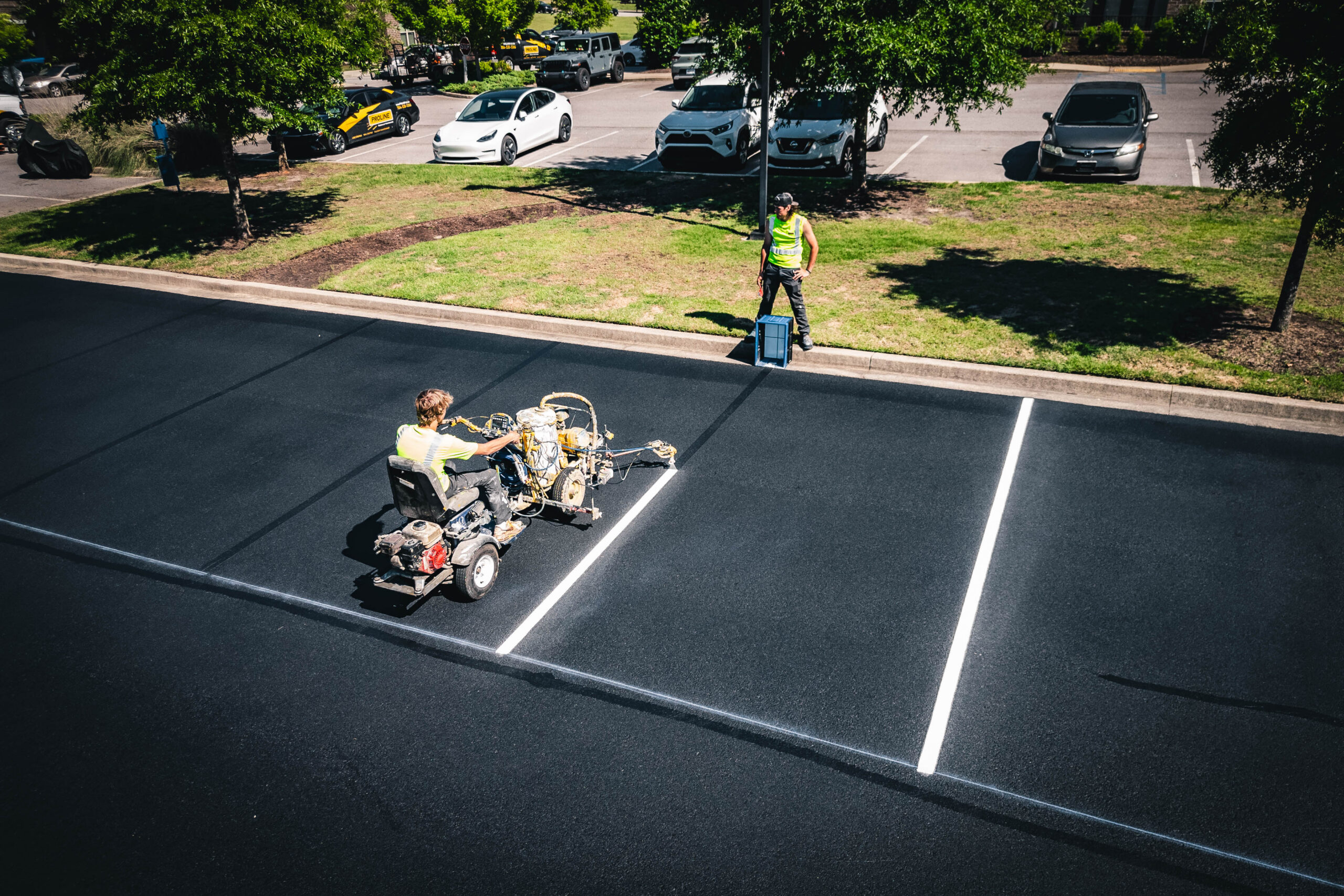

Data from a survey by the National Apartment Association indicates that the average apartment turnover rate in a single year is 46.8 percent. In a community of 300 units in Charlotte, Raleigh, or Greenville, that’s about 140 households moving in each year, with no idea how your parking area is arranged. These new residents won’t know that the far row is reserved for guests, that the red curb next to Building C designates a fire lane, or that the spaces near the leasing office are intended for tours. Since your leasing staff can’t explain all of this to every driver, the pavement itself has to provide the information. Effective parking lot striping in apartment buildings with high resident turnover turns the asphalt into a clear, quiet guide and reduces complaints, tow requests, and the general disorder that happens when that guide is missing.
Striping Works as the Onboarding Guide for Every New Resident
Long-term residents get used to the markings. New residents have to rely on the paint to learn them. Each line, number, arrow, and stencil provides an answer to a question that the driver would otherwise have to ask your office or would have answered incorrectly. Once the markings fade, the answers disappear, and drivers have to guess to fill in the gaps. This is what we observe at places with high resident turnover: cars parked in two separate stalls, trucks blocking the drive aisles on move-in day, and visitors parking in spaces meant for residents because no one tells them where to go.
Number and Assign Stalls So New Drivers Never Guess
Assigned parking only works if each space has a number that matches your lease agreement. We etch the number at a size a driver can read from their seat and place it in the same spot on every space so it’s easy to spot. Most apartment parks we stripe have spaces about 9 feet wide and 18 feet long, although exact dimensions are determined by your site plan and local regulations. When a unit is sold, your team updates the number in the lease file, and the painted number stays accurate without further work. We also recommend painting a clear visitor label on each guest space, since a general ‘guest parking’ sign at the entrance doesn’t help a driver circling the parking area at night.
Separate Move-In Traffic From Daily Parking
The heaviest and most unusual traffic on the estate occurs on the move-in and move-out days. Box trucks stop in the drive aisles, residents move furniture through the fire lanes, and tight bends rub the paint off the pavement. To address this, we paint a clearly defined loading area near each building entrance, complete with hatched markings, a stencil indicating the time limit, and a sign. This loading area gives movers a legally permitted spot to stop briefly and keeps the main aisle clear for emergency vehicles. We also mark a number of short-term parking spaces near the leasing office for prospective residents on tours, so their first impression doesn’t have to involve looking for parking.
Protect Accessible Spaces and Fire Lanes First
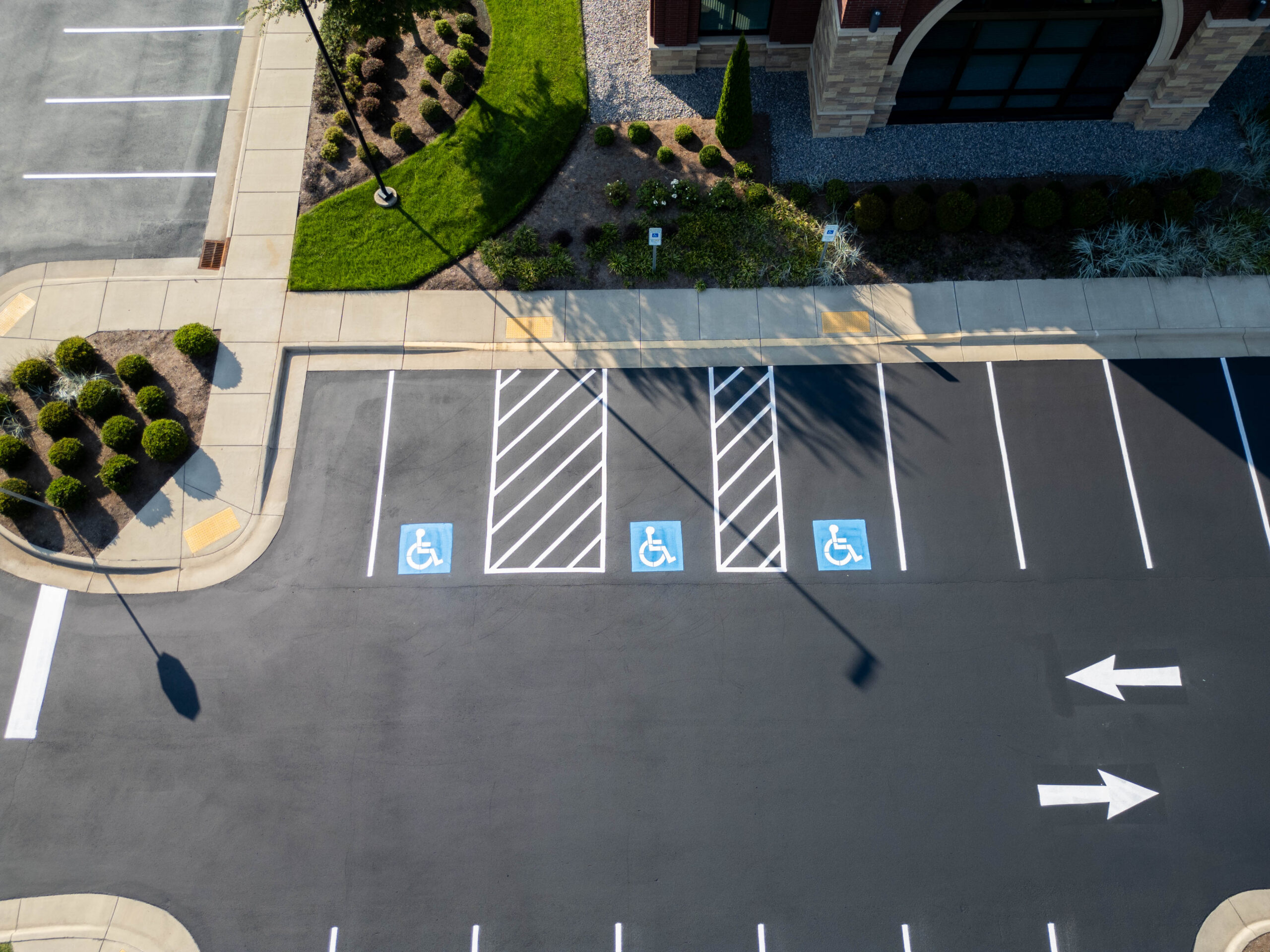
These markings have legal significance and should therefore figure first in your budget. According to its brief on the ADA restriping issue, the U.S. The Department of Justice says that a business that repaints a parking area must provide accessible spaces as required by the 2010 ADA Standards. In reality, a simple repaint can lead to an inspection to check for compliance. A car space must be 96 inches wide and have a 60-inch access aisle, while a van space must be 132 inches wide with a 60-inch access aisle or 96 inches wide with a 96-inch access aisle. At least one in every six accessible spaces must be van accessible, and the sign must include the words “van accessible.”
Fire lanes follow different rules. According to the International Fire Code, markings must be placed where the fire code official requires them, but each local authority determines the specifics of paint color, lettering, and spacing. The Lubbock fire marshal’s rules show how detailed a local office can be, specifying both lettering intervals and sign spacing. Before we paint any red curb, we always check with your local fire marshal in the Carolinas or in any state where we provide our services.
The Marking Plan We Build for High-Turnover Communities
The table lists the core markings we include, along with the standard associated with each one.
| Marking | What it tells a new resident | Specification We follow |
| Numbered assigned stalls | Which space belongs to which unit | Stencil number in the same position on every stall, matched to your lease records |
| Visitor and guest stalls | Where to park without a permit | “Visitor” stencil, placed nearest building entries and the leasing office |
| Move-in and move-out zone | Where a truck may stop briefly | Hatched area, time limit stencil, and sign, positioned outside the main drive aisle |
| Accessible stalls and aisles | Where accessible parking begins and ends | 96-inch car stall, 132-inch van stall with 60-inch aisle, or 96-inch van stall with 96-inch aisle |
| Fire lane | Where parking never occurs | Red marking and lettering as the local fire code official requires |
| Arrows and stop bars | Which way traffic flows and where to stop | Placed at entrances, corners, and building crossings to cut wrong-way driving |
Plan Striping Around the Carolina Calendar
Timing matters as much as layout; the leasing season peaks in late spring and summer, when students and job seekers move into areas around Clemson, UNC Charlotte, NC State, and the University of South Carolina. To ensure new residents have clear, well-defined markings from day one, we plan to complete the striping before this peak arrives.
Weather in the Carolinas affects our schedule. Because the air is humid in the morning, the curing process slows down, and one manufacturer’s data sheet for waterborne traffic paint states that the paint should be applied when the temperature is above 50 degrees Fahrenheit and cautions that if the relative humidity is above 80 percent, then a longer curing time will be needed before the paint can carry traffic. The same data sheet shows a tack-free time of under 5 minutes at 70 degrees and 50 percent humidity, meaning that a dry afternoon allows for a lot faster turnaround than a damp dawn. Spring pollen also settles on roads across North Carolina and in upstate South Carolina, and we sweep and blow it off so the paint can bond to the surface. During hurricane season, from June to November, we monitor the forecast and keep a flexible timeframe so a storm doesn’t wash out a newly laid surface.
Keep a Layout Map So Every Restripe Matches the Last
High resident turnover has a twin problem: high staff turnover. The National Apartment Association reports that on-site maintenance technicians had an annual turnover rate of 39.2 percent, so the person who remembers where the old stall lines sat often leaves before the next restripe. We solve that by saving a dimensioned layout map for every community, with stall counts, number ranges, accessible space locations, fire lane limits, and loading zones. When we return, we match the map, and when your team changes a rule, we update the map and log the change.
You get a great deal from this method because it eliminates parking disagreements, lightens your leasing staff’s workload, and shows residents and inspectors that you’re keeping the parking area safe. ProLine Parking Lot Maintenance serves apartment communities across the country and sees each layout as more than a coat of paint; it’s a safety and communication tool. If you’d like, call us to arrange a walk-through of your parking area, and we’ll measure your parking spaces, check your accessible areas, and provide a written striping plan that matches your turnover schedule. To help you budget and plan ahead, we offer complimentary estimates based on factors like total parking area, number of spaces, specified materials, and any unique site requirements. After our visit, you’ll receive a detailed quote outlining the scope and pricing, so you understand everything before work begins.
Keep High-Turnover Apartment Parking Lots Clearly Marked
Frequent resident move-ins and move-outs can make apartment parking layouts harder to manage and quickly wear down pavement markings. We can help keep parking spaces, fire lanes, accessible spaces, and traffic markings clear and organized as your community changes.
Contact UsFrequently Asked Questions
How often should an apartment community restripe its parking lot?
The lots we look after generally need refreshing every 1 to 3 years, depending on traffic levels and the type of paint used. The highest-traffic areas wear out first, which is why the entrance, visitor stalls, and move-in zones usually need attention before the farther rows. We recommend an annual inspection in which you compare each marking with the stored layout map and assess its visibility. This inspection lets you address faded areas first and prevents you from repainting the whole area before it actually needs it.
What stripping material is best suited to apartment complexes?
Waterborne traffic paint suits most apartment parking stalls because it dries quickly, is cheaper, and covers large areas efficiently. Although thermoplastic and epoxy markings cost more upfront, they perform better in high-wear areas such as entry stop bars and crosswalks, where tires rub against the surface all day. We generally advise using paint for the main part of the stalls and employing a more durable material for the small sections that suffer the most abuse. The final decision depends on your budget, the type of traffic you have, and the condition of your pavement, and we go into detail about each trade-off before you agree to the scope.
What is the procedure for looking after the residents’ cars when striping?
We carry out cooperation with your office to send out a notice several days in advance, including a map that indicates which section will be painted each day. We stripe in stages, typically involving no more than half a lot at a time, so residents never lose all their parking at once. Cars in the stalls to be painted must be moved for a few hours, and we suggest providing temporary parking in a section that has already been completed or is currently empty. Additionally, we leave cones around freshly painted areas until the paint is no longer tacky to protect both the markings and your residents’ tires.
Do we need approval to change the stall layout or count?
Certainly, in numerous instances you will. Local zoning regulations usually specify a minimum number of parking spaces per unit, and your approved site plan will determine the layout. Altering stall or aisle widths may also affect fire access and the number of accessible spaces, so a simple layout change can quickly become a code issue. On each project,, we begin by comparing your current markings with your site plan and identifying any modifications that require approval from the city, the county, or your fire marshal.
Should we stripe before or after sealcoating and pavement repairs?
You must complete the repairs first, in this order: patching and crack repair, then sealcoating, then a curing period, and finally striping. The sealcoat generally takes 24 to 48 hours to cure; the exact time depends on the temperature and humidity, and if the new stripes are applied too early, they will smear or peel. Before sealcoating starts, we mark reference points on the pavement so that, after the surface has cured,, the stalls can be restored to match the original pattern.
See also: How to Stripe Apartment Parking Lots for Better Nighttime Visibility, Why Is Asphalt Breaking Apart Around Apartment Dumpster Areas?