
The Federal Highway Administration states that about half of all traffic fatalities occur at night, even though only about one-quarter of travel occurs after dark, and it considers retroreflective pavement markings, signs, and road lighting important tools for improving nighttime visibility. In an apartment parking lot, the problem takes on a different shape: residents might enter after work, return late from travel, walk from their cars to their buildings, or navigate unfamiliar areas as guests. A parking line that looks acceptable in the afternoon can become hard to see when the only substantial light comes from vehicle headlights.
We don’t just repaint the faded lines when carrying out nighttime striping; instead, we consider how the markings are seen from the driver’s point of view, the areas where the headlights strike the road, the places where drivers have to make decisions, and which markings should still be easy to identify in the dark.
What Makes a Parking Lot Marking Visible at Night?
The important term is retroreflectivity. Retroreflection is different from ordinary reflection in that it sends the incoming light back towards its source. When the headlights of a vehicle strike a retroreflective pavement marking, part of the light goes back towards the driver, which makes the marking look brighter. The FHWA points out that the retroreflectivity of pavement markings decreases with time, so property managers have to keep an eye on them and reapply the markings when needed.
Several factors affect how a marking performs at night:
| Factor | Effect on Nighttime Visibility |
| Retroreflective material | Determines how much headlight illumination returns toward the driver |
| Marking condition | Worn or missing material reduces visual definition |
| Pavement condition | Cracks and rough surfaces can interrupt the appearance of lines |
| Dirt and debris | Can reduce contrast between the marking and pavement |
| Wet pavement | Can change how reflective markings perform |
| Lot lighting | Changes the overall visual environment |
| Marking placement | Determines how early drivers can recognize the intended path |
| Color contrast | Helps drivers distinguish different pavement messages |
That is the reason why we do not regard every faded line as being the same maintenance problem.
Use High-Visibility Markings Where Drivers Need Them Most
It is not a necessity to make every square foot of pavement highly marked. Rather, our emphasis is on the areas in which drivers need clear visual information. For instance, imagine a situation in which a driver enters an apartment complex along the main drive at night; if the lane lines, the directional arrows, and the markings indicating the pedestrian crossings have faded, the driver will have fewer visual clues to guide him.
We can prioritize markings around:
Parking Lot Entrances
When entrance markings are present, they provide the first visual reference point for a driver as he or she enters the premises. Directional signs clearly displayed can assist drivers to understand where each route leads when the entrance links to multiple parking areas.
Internal Intersections
Certain internal intersections need special attention because drivers must choose a direction while also watching for other vehicles and pedestrians. Pavement markings that are clear can be used to identify travel routes and decision points.
Pedestrian Crossings
It is particularly important to have crosswalk markings in places where people regularly go from parking areas to apartment buildings. The design and position must adhere to the relevant traffic-control requirements and to the site conditions of the property; the MUTCD offers national standards and guidance regarding pavement markings and traffic-control devices.
Accessible Parking Areas
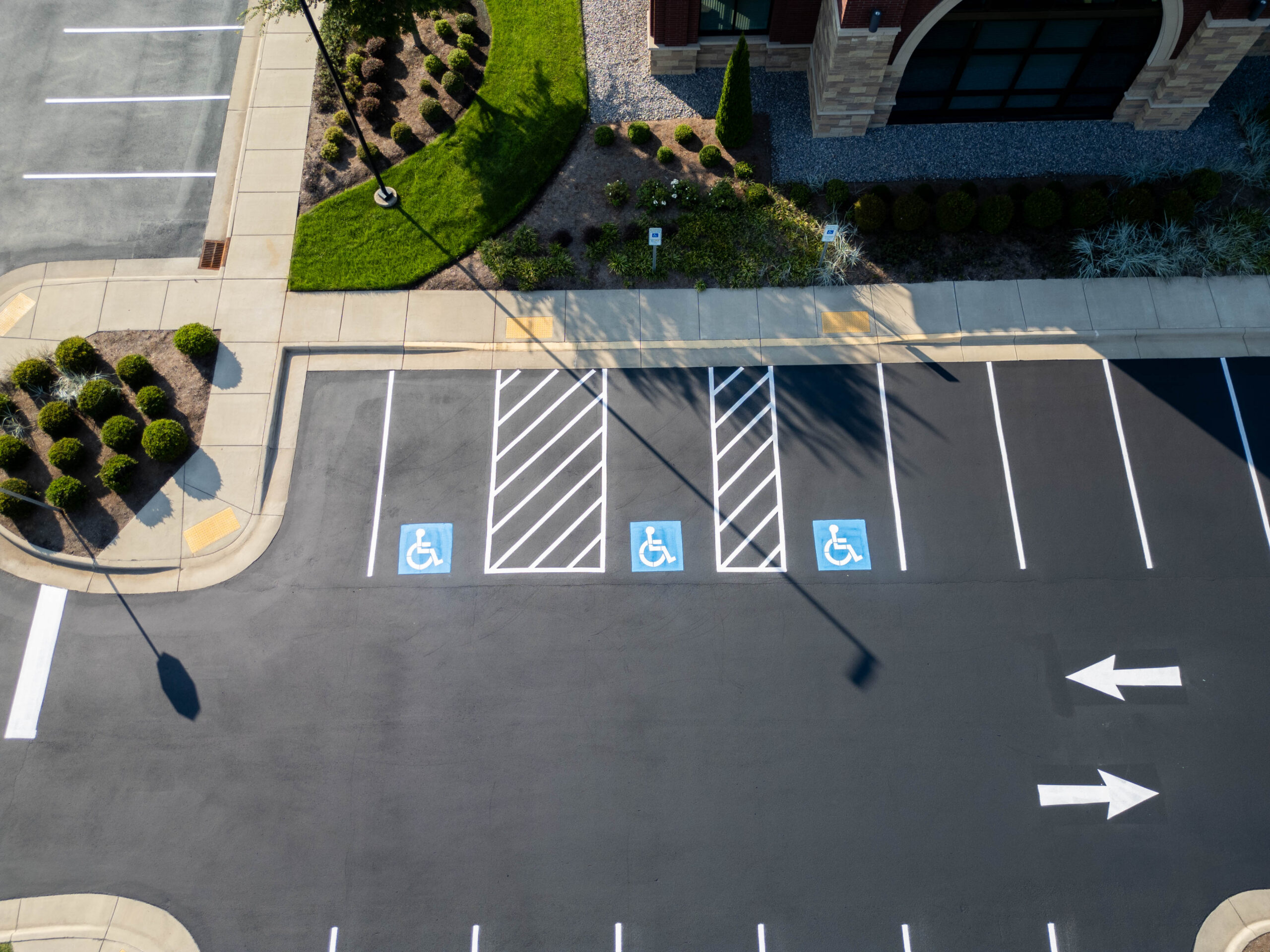
Just because a parking space is visible doesn’t mean that accessible parking spaces have more than that. The pavement markings must still be identifiable when it is dark, including the accessible symbol and the access aisle markings where they are required. The presence of clear markings also helps drivers to tell the designated accessible parking spaces apart from the regular ones.
Stripe the Lines So Headlights Can Pick Them Up
The angle from which the driver is viewing it is important. A perfectly straight marking can still offer only limited guidance during the night if the general arrangement does not give the driver sufficient visual information before having to make a turn or reach a decision point. Instead of just looking down from above, we consider the situation from the point of view of the driver.
For instance, when a driver is coming up to a row of parking spaces, we need to decide if the stall lines become visible early enough to indicate the direction of the row, and we should also check whether directional arrows or other markings are in suitable positions rather than putting them where vehicles will only see them after they have already made up their minds. That is one of the reasons why we suggest assessing the entire striping arrangement before merely repainting the existing lines.
White and Yellow Markings Serve Different Visual Purposes
White is the usual color for parking space lines, whereas yellow is employed for certain traffic control or separation purposes according to the specific application and governing requirements. If identical areas are designated with different colors without having a clear reason, drivers might find it difficult to understand the meaning of each marking.
The NCDOT keeps its pavement marking and traffic-control facilities coordinated so that the pavement markings match the signs and other traffic-control devices. We therefore advise property managers not to select a colour merely because it appears brighter. The color used for marking should indicate a particular function and should be in keeping with the property’s traffic-control plan.
Consider the Pavement Before Applying New Striping
The way the pavement looks is influenced by the new markings. Where the asphalt shows severe cracking, raveling, patches, or surface deterioration, fresh painting will not give the clean visual contrast that the property requires.
Before carrying out the stripping, we check the surface.
| Pavement Condition | Striping Consideration |
| Smooth, sound asphalt | Suitable surface for planned striping |
| Minor surface wear | May require cleaning and preparation |
| Extensive cracking | Evaluate whether repairs should come first |
| Heavy patching | Check whether the existing layout still makes sense |
| Significant raveling | Determine whether surface repairs are needed |
| Fresh asphalt | Allow appropriate curing and preparation before striping |
| Existing conflicting lines | Remove or address old markings before final layout |
The guidance on construction issued by NCDOT also stresses the importance of surface preparation, the conditions under which the coating is applied, the curing process, and retroreflectivity when fitting pavement markings. Although apartment car parks do not always adhere to the precise specifications employed in public road projects, the basic principle is still valuable in that the surface and the method of application have an effect on the marking performance.
How We Approach Nighttime Visibility Striping
We offer parking lot striping, pavement markings, signage, wheel stop installation, and other forms of pavement maintenance all over North and South Carolina. The areas we serve include Charlotte, Mooresville, Huntersville, Greensboro, Winston-Salem, Greenville, Columbia, Myrtle Beach, and Mount Pleasant.
While assessing an apartment car park, we take into account more than just whether the lines appear fresh during the day.
We consider:
1. Layout
We determine the places where drivers need clear visual guidance.
2. Marking condition
We examine whether the existing lines and symbols have faded or worn away.
3. Pavement condition
We check if the surface can support the markings that have been planned.
4. Material and application
We look at the system that should apply to the use and the conditions of the property.
5. Nighttime appearance
We want to examine how the markings will perform when drivers depend a great deal on their headlights and on the lighting available in the parking area.
6. Maintenance needs
On the basis of real wear, we assist property managers to decide upon the time at which future restriping should take place rather than continuing to wait until the markings are no longer recognizable.
A Practical Nighttime Striping Inspection Table
Property managers can use this quick inspection before requesting a restriping project:
| Check | What to Look For at Night |
| Parking stalls | Can drivers distinguish individual spaces? |
| Drive aisles | Can drivers recognize the intended travel path? |
| Arrows | Can approaching drivers identify the direction? |
| Crosswalks | Do pedestrian crossings remain visually distinct? |
| Accessible spaces | Are the symbols and access aisles easy to identify? |
| Yellow markings | Do restricted areas remain visually distinct? |
| Intersections | Can drivers recognize where they need to turn or yield? |
| Old markings | Do previous lines create conflicting visual information? |
| Pavement | Does surface wear reduce contrast? |
| Lighting | Are markings visible under existing lot lighting and headlights? |
Nighttime Visibility Should Be Part of the Striping Plan
A parking area ought not to rely completely on overhead lights in order to show its layout. Clearly marked pavement lines offer an additional amount of visual information, in particular when the headlights of vehicles shine onto the pavement. The FHWA in particular considers properly maintained retroreflective pavement markings to be an important element of nighttime highway visibility.
With respect to apartment buildings, we apply that principle in the car park by concentrating on the spots where drivers have to make decisions, where pedestrians cross the paths of vehicles, and where the parking rows become difficult to tell apart after dark. We don’t just repaint all the lines that already exist; instead, we assess whether the present layout, the condition of the pavement, the visibility of the markings, and the traffic pattern are still coordinated.
Improve Parking Lot Visibility After Dark
Clearly defined parking spaces, traffic lanes, pedestrian areas, and other pavement markings can make an apartment parking lot easier to navigate at night. ProLine Parking Lot Maintenance can help property managers plan and maintain clear, durable striping that remains visible and supports organized traffic flow throughout the community.
Plan Your Parking Lot Striping ProjectFrequently Asked Questions
Does sealcoating make parking lot lines more visible at night?
Sealcoating may enhance the visual contrast between a dark asphalt surface and the newly applied pavement markings, but it does not in itself make the markings retroreflective. The performance of the markings at night depends on the marking material, how it is applied, the state of the surface, and the amount of wear. If a property intends to both sealcoat and restripe, we suggest that the two services be coordinated so that the final pavement surface and the marking layout complement one another.
Can LED parking lot lights replace reflective pavement markings?
Lighting and pavement markings have different functions: lighting illuminates the parking area, whereas retroreflective markings reflect the light from the headlights back to the driver and assist in defining the pavement features from the driver’s point of view. The FHWA considers roadway lighting and retroreflective markings to be separate elements which, when used together, can improve nighttime visibility.
Should apartment parking lot striping be inspected after dark?
A nighttime inspection is able to detect issues that a daytime inspection might fail to identify. In daylight, property managers are generally able to see faded lines since the sunlight spreads evenly over the pavement; at night, on the other hand, drivers have to rely more on their headlights and the existing lighting. Therefore, if visibility is a particular concern, we suggest a nighttime drive-through, especially when a property has reported trouble identifying parking rows, arrows, crossings, or other markings.
Does rain make faded parking lines harder to see at night?
It can. Research carried out by the FHWA shows that dry retroreflectivity does not directly indicate how well the markings will perform at night when it is wet, and performance of the pavement markings in wet conditions is largely determined by the type of marking material and its optical properties. If residents say that the markings become difficult to see on rainy nights, then we suggest that the markings should be assessed under the real conditions rather than merely evaluating them during a dry afternoon.
Can old parking lines reduce nighttime visibility even after new lines are painted?
Certainly. If old markings are still visible alongside a new parking arrangement, they can give rise to conflicting visual impressions. The situation is particularly confusing at night since drivers have fewer visual references and may, for a short time, see both the old and the new lines in the beam of their headlights. Therefore, we suggest that the obsolete markings be removed or otherwise properly dealt with when the parking layout is altered so that the final surface conveys a single, clear configuration.
Does parking lot size affect how much striping is needed for nighttime visibility?
Lot size alone does not determine the striping plan. A smaller lot with several intersections, pedestrian crossings, or complicated circulation can need more deliberate pavement markings than a larger lot with a simple layout. We evaluate the actual movement pattern, decision points, parking configuration, and visibility conditions rather than applying the same marking plan to every apartment property.
How does pavement color affect nighttime line visibility?
Contrast between the pavement and the marking can influence how easily drivers recognize a line. Fresh, darker pavement can provide a stronger visual background for white or yellow markings, while heavily weathered, oxidized, patched, or dirty pavement can reduce visual separation. This is one reason we inspect pavement condition before restriping, rather than treating the marking material as the only factor affecting visibility.
Can parking lot striping improve visibility without adding more parking lot lights?
It can improve the pavement-based visual information available to drivers, but it cannot substitute for adequate lighting where lighting is required or where the property has poorly illuminated areas. High-quality, properly maintained markings can make parking stalls, travel paths, and other pavement features easier to recognize when headlights illuminate them. If an area remains very dark, however, the property manager should address the lighting condition separately rather than expecting striping alone to solve it.