The North Carolina Fire Code mandates that fire apparatus access roads must be at least 20 feet wide, but the Charlotte Fire Department advises property owners to mark their private fire lanes in white, while fire districts in California paint the curb red. For the same lane, different colors, different heights for the letters, and different signs may be required depending on which inspector is looking at your property. This variation surprises multifamily property owners since a vendor who stripes a lane correctly in one city will fail the inspection in the next.
To help property managers stay compliant, the main steps are to consult the fire official’s marking requirements for your jurisdiction, review and follow the approved plans, coordinate any repairs and sealcoating before marking, use the specified materials and colors, and keep all markings and signs maintained according to local rules.
Key Overview
- Your fire code officer determines where markings are needed, which is why we start with the approved plan rather than a paint can.
- The model’s code wording includes the words “NO PARKING-FIRE LANE,” and the local regulations determine the color, the size, and the spacing.
- The color of the pavement markings differs, since Charlotte uses white reflective material, and many of the districts in California have red curb paint.
- We stripe after repairs and sealcoating so the markings stay visible.
- Since the property owners are responsible for maintenance, things like faded paint and damaged signs will be considered your violations.
- When dealing with multifamily lots, special care should be taken at the building corners, at the hydrants, at the dumpster enclosures, and at the gates.
Start With the Fire Official’s Specification
All marking jobs start with the authority responsible for enforcing your fire code. According to the model language employed in North Carolina, approved signs or markings that state ‘NO PARKING—FIRE LANE’ must be placed where the fire code official requires them, and the owner is then obliged to keep the markings clean and legible and to replace or repair them if necessary. The code also says the size of the signs, the mini, with dimensions being 12 inches wide by 18 inches high with the letters in red on a white reflective background. Before giving out our quotation, we read the North Carolina Fire Code and then checked with the fire marshal’s office to confirm each local amendment.
Local departments frequently impose their own standards in addition to those set out in the state code. According to the specifications of the Charlotte Fire Department, any marking of fire lanes and the associated signage must first be approved by the fire official, the markings themselves must be white, and the crews have to use reflective highway marking material when installing them. The same document makes the property owner liable for keeping the markings and signs in good condition. This responsibility is included in all our proposals, since an owner who is aware of the standard can make provision in their budget for maintenance rather than having to respond to a notice.
How Marking Rules Differ Across Jurisdictions
The figure below illustrates the extent to which the details differ from one source to another, and we include these examples to demonstrate the range involved, without considering any one city’s standard as being universal.
| Authority | Pavement or curb marking | Signs and spacing | What it means for your lot |
| Charlotte Fire Department | White lane and word markings in reflectorized highway marking material | Signs follow the department’s approved specification | Do not paint curbs red without approval |
| North Carolina Fire Code | Words NO PARKING-FIRE LANE where the fire official requires them | Signs at least 12 by 18 inches, red letters on white reflective background | Confirm the exact legend with your inspector |
| Santa Clara County | Red curb top with white stenciled FIRE LANE – NO PARKING at intervals of 30 feet or less | Signs no more than 50 feet apart | Stencil spacing drives labor and material |
| North County Fire Authority | Red curb with white lettering at least 3 inches tall every 25 feet; 6-inch red stripe where no curb exists | Posting depends on road width | Curbless lots need a painted stripe |
It is for this reason that we request the fire official’s written specifications before placing our order; if there is a discrepancy in color or spacing, we are forced to take down and redo the work, and no one wants to have to pay for that.
Width Decides Where We Mark
The width of the road determines how much of the lane has to be marked. In the North County district, any road that is 32 feet wide or more does not need to have any markings, whereas roads that are wider than 26 feet and narrower than 32 feet require marking on one side only. A drive aisle serving a clubhouse or a three-story building may therefore have to be treated differently from a narrow loop road situated between buildings in a garden style. We measure each aisle between the curbs or the lines indicating where parked cars are placed and then mark the plan with the width of each section before drawing a single line.
Our Layout and Marking Process
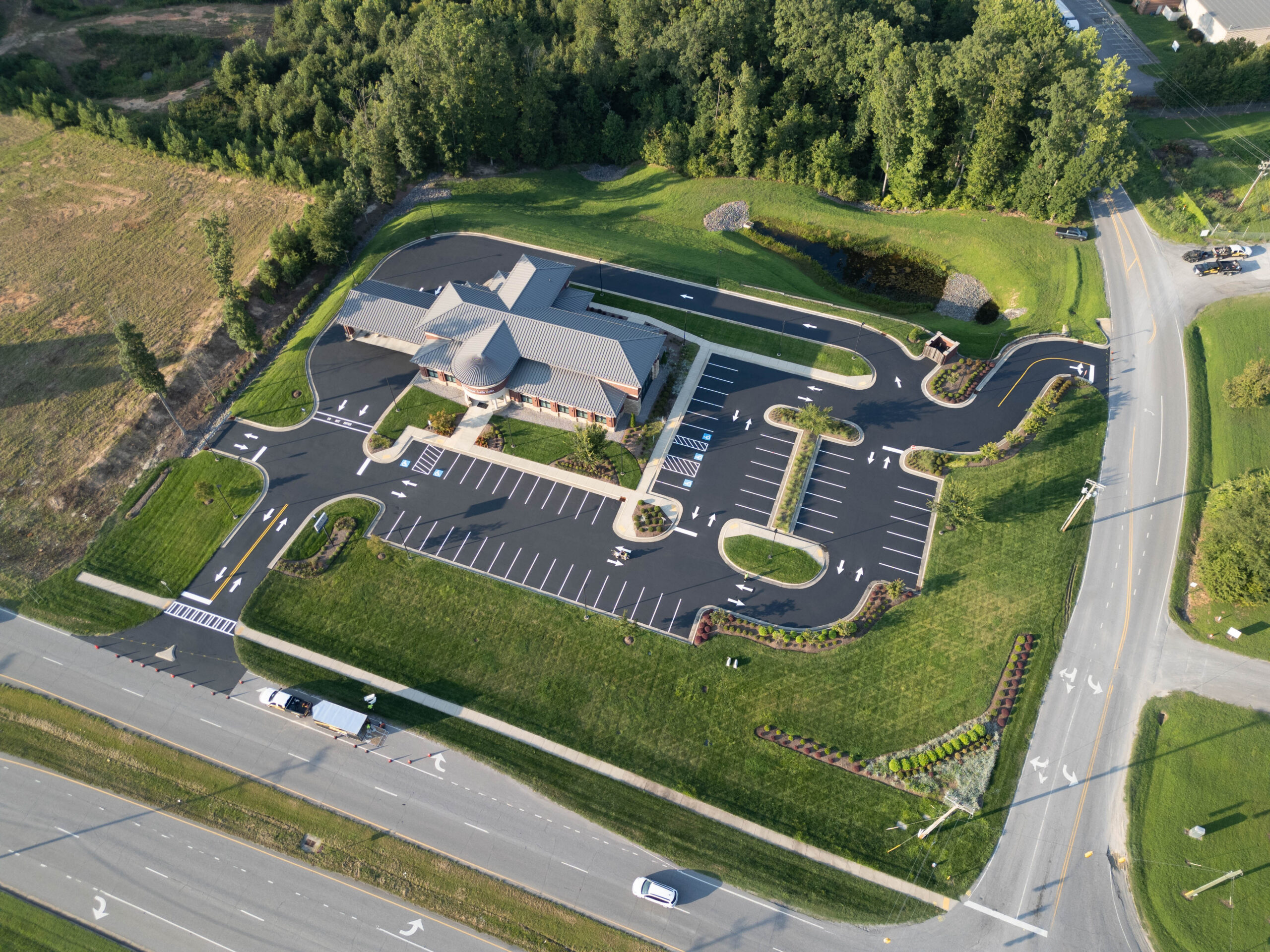
The process begins with the approved fire plan and an inspection of the site; we establish the position that the fire official has decided for the lane, record the locations of the hydrants, the building corners, the dumpster enclosures, and the gates, and take photographs of any existing markings and signs. If crack sealing, pothole repair, or sealcoating is required on the property, we arrange for that work to be done first since new asphalt treatments will cover the old paint.
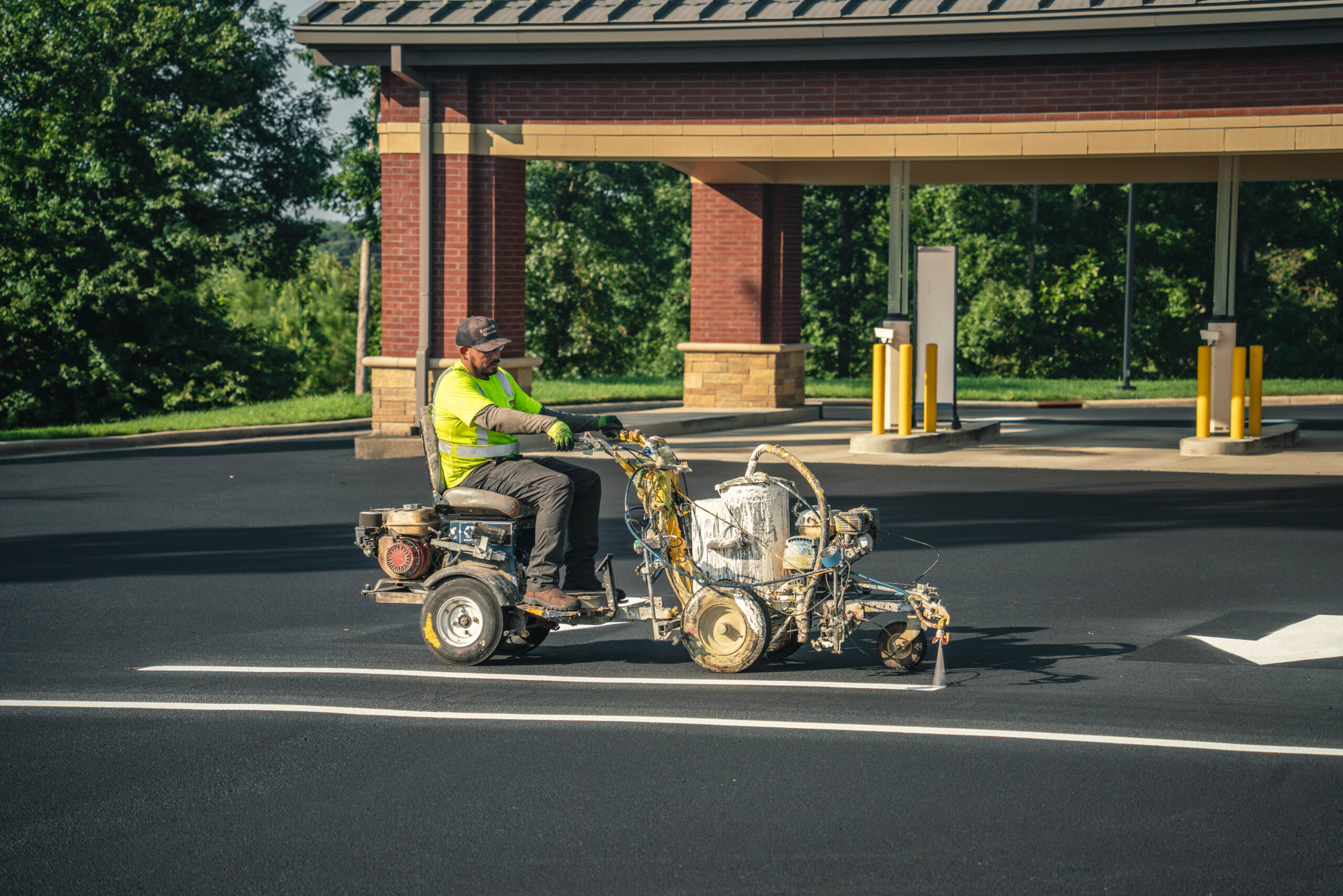
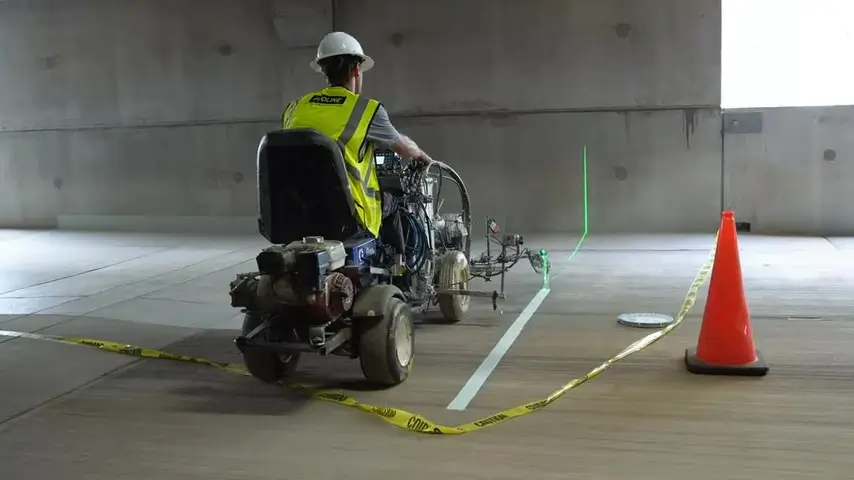
The order in which we carry out the work is important. Since sealcoating alters the look of the existing markings, we carry out the restriping after the sealing is complete, and we apply the stencils and pavement markings only after the sealer has dried fully. We then mark out each lane using string lines and chalk, position the stencils according to the dimensions that the fire official approved, and apply the required material. In cases where the local standard specifies the use of reflectorized material, such as in Charlotte, we use the reflective product rather than the standard paint.
We carry out the installation of the signs last; the posts are placed at the spacing and height that the fire official has approved, with the signs facing the traffic coming towards them, and the posts are ensured to be outside the clear width of the lane. Upon leaving, we will send you a photo log together with a marked-up site plan so that your property manager can hand the fire inspector evidence of exactly what we have installed.
Multifamily Details That Trip Up Inspections
Apartment complexes present marking problems that retail centers seldom do. Since dumpster enclosures are usually located right next to the access road, a rubbish truck reversing out can end up blocking the lane. The areas beside the pool and the clubhouse are used for temporary parking, which leads residents to park their car in the lane for a few minutes. Additionally, the corners of the building and the sharp turns should have extra signs because a driver going around a corner might not be able to see the lettering, which is placed further down the aisle.
Gates should also be examined carefully since a keypad or swing gate that reduces the opening below the minimum required clear width may fail the inspection even if the paint appears flawless. To determine the clear width, we open the gate completely, take the measurement, and then mark any issues for the fire marshal before the inspection date.
Get Your Fire Lanes Marked Right
If your fire lane paint has faded, your signs have gone missing, or your last inspection report listed a marking deficiency, contact ProLine Parking Lot Maintenance for a site review. We will compare your lot against your local fire official’s specification and give you a clear scope for repairs, sealcoating, striping, and signs. We serve multifamily communities nationwide, and we schedule the work in phases so residents keep their parking.
Keep Fire Department Access Areas Clearly Marked
Clearly marked fire department access areas help keep emergency routes open and reduce the risk of vehicles blocking critical access points. In multifamily communities, proper pavement markings can make restricted areas easier for residents, guests, and emergency personnel to recognize.
ProLine Parking Lot Maintenance can help property managers plan and maintain clear pavement markings for fire lanes, access areas, and other designated no-parking zones. Contact our team to discuss your apartment community’s parking lot striping needs.
Contact UsFrequently Asked Questions
Can we remove or relocate a fire lane marking if we change our site layout?
It is wrong to regard fire lane markings as being any different from ordinary parking lines since the fire department has control over their placement. In Charlotte, anyone who wishes to remove fire lane signs or markings must first obtain approval from the Charlotte Fire Department. Similar rules apply in other areas, with a number of them requiring a revsubmitting plan before agreeing to a new lane position. We advise you to send your suggested layout to the fire marshal first and then wait until you have received written approval before anyone paints over the existing lane. After you have received approval, we will remove the old markings, mark the new lane according to the approved specifications, and provide you with photos for your records.
Who can ticket or tow vehicles that block a fire lane in a multifamily community?
The enforcement authority varies according to the jurisdiction, and the rules usually go beyond the responsibility of the fire department. In Charlotte, offenses for parking in designated fire lanes can be dealt with by a Charlotte Fire Department officer, a Charlotte-Mecklenburg Police officer, or a fire inspector, and police officers are empowered to tow vehicles that are parked illegally in fire lanes. The lease and the community rules should mention these penalties so that residents understand that the lane is not intended for guest parking. We recommend that you check the local enforcement procedures with both your fire marshal and your towing contractor, and we put up the signs required by the local code so that the lane can withstand a challenge.
How soon after sealcoating can you stripe the fire lane, and when can residents drive on it?
We don’t apply any marking until the sealer has cured, since if the sealer is still wet or tacky it could smear the lettering and damage the bond. The curing time varies according to the temperature, humidity, the amount of sunlight and the thickness of the sealer applied, which is why we establish the schedule on the job site. As a rule, the crews are allowed to walk on the surface on the same day and residents are asked to avoid the area for a day or so before vehicles are permitted to go back on it, and our team informs your manager of the exact time when the area will reopen before work begins. The site is carried out in sections so that the fire lane can reopen quickly while the rest of the community continues to have parking.
Should we use traffic paint or thermoplastic for fire lane lettering?
Both products are effective, and the correct one to choose will depend on the fire official’s specifications, the amount of traffic you have, and your budget. Although traffic paint is cheaper and dries more quickly, it wears out more quickly in areas where the vehicle paths turn and at entrances. On the other hand, thermoplastic is more expensive initially, but it creates a thicker and longer-lasting marking that is better suited to high-wear areas such as the lane close to a main entrance. Certain fire departments, for example Charlotte, insist on using reflectorized marking material, thus limiting the range of options available. We start by checking the local specifications and then suggest the product that satisfies them and is suitable for your maintenance schedule.
What marking is required for temporary fire access during a renovation or new building phase?
When in the construction phase, a separate set of requirements is established for your permanent fire lane. According to Charlotte’s construction site guidelines, a fire access road must be provided as soon as vertical construction starts and must be kept in good condition until the permanent access roads are opened. The entrance should have a robust sign stating “Fire Department Access”, containing the site address, being at least 3 feet by 3 feet in size, having a red background, and being mounted so that its bottom edge is at least 6 feet above the ground level. We advise that you check the temporary access plan with the fire plans examiner before your contractor arrives on site, and we will be able to install the sign and markings to correspond.
How do fire lanes and accessible parking stalls fit together on the same lot?
Fire lanes and accessible stalls serve different purposes, and we lay them out so they do not compete for the same pavement. Fire lanes must stay clear at all times, so we keep stalls, access aisles, and curb ramps out of their clear width. We also keep fire lane signs and posts off the accessible route so they do not narrow a path or block a ramp. If your site design forces an overlap, we recommend you talk to the fire marshal and an accessibility specialist before we restripe anything. We can prepare a scaled drawing that shows both layouts together, which makes those conversations faster.