

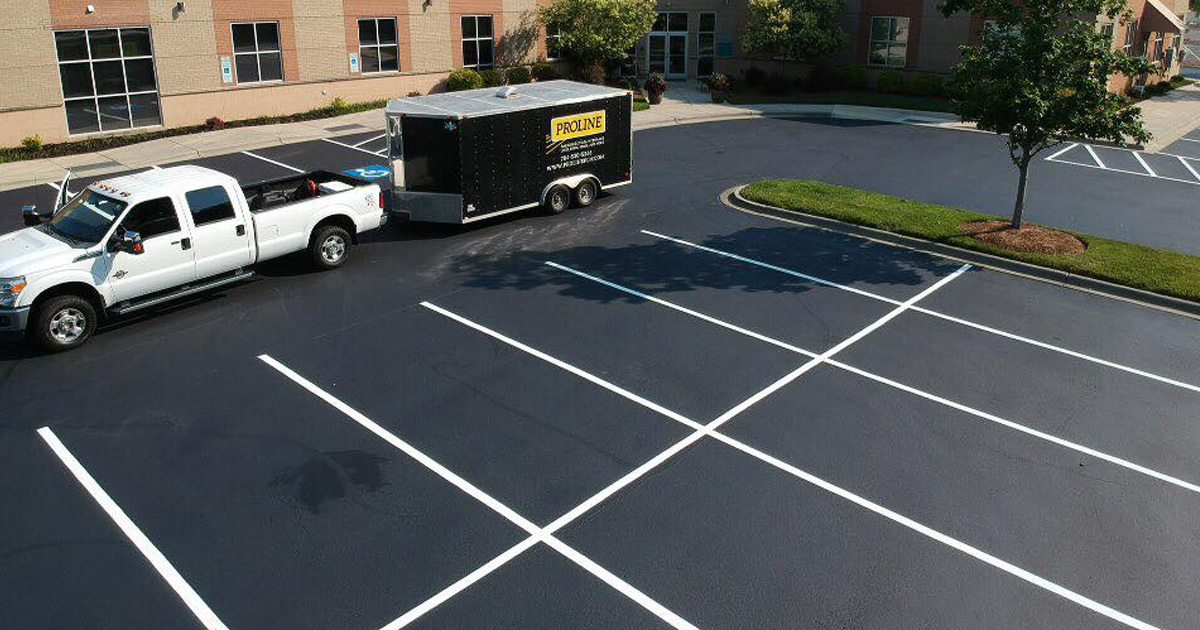
A parking lot can deteriorate gradually without becoming an obvious problem overnight. The same applies to pavement markings. Lines may remain visible while becoming increasingly difficult to distinguish, particularly after repeated vehicle traffic, weather exposure, pavement maintenance, and routine wear.
For multifamily communities, that gradual deterioration can create problems that extend beyond appearance. Faded parking stalls can contribute to inconsistent parking, unclear accessible spaces, guest parking confusion, and an increasingly unorganized appearance across the property.
The Federal Highway Administration (FHWA) explains that pavement markings are among the traffic-control devices used to promote safety and efficiency. Its Manual on Uniform Traffic Control Devices (MUTCD) also recognizes parking-space markings as a way to encourage more orderly and efficient use of parking areas.
That makes regular striping an important component of multifamily property maintenance. However, annual line striping should not automatically mean repainting every line every 12 months, regardless of condition. Instead, property managers can use an annual evaluation to determine whether markings need full restriping, targeted touch-ups, layout adjustments, or no immediate work.
For communities in Charlotte, Denver, Mooresville, Huntersville, and surrounding North Carolina markets, a scheduled review allows property managers to address pavement markings before they become a recurring resident complaint.
Annual Striping Creates a Predictable Maintenance Schedule
One of the biggest advantages of scheduling an annual striping assessment is predictability. Property managers already have recurring responsibilities for landscaping, exterior inspections, HVAC servicing, roofing, pest control, and other property systems. Parking lot markings should be approached with the same preventive mindset.
Instead of waiting for residents to report faded lines, management teams can establish a recurring date for evaluating the parking lot. For example, consider a 150-unit apartment community in Charlotte. During the property’s annual exterior inspection, the manager notices that approximately 30% of the parking stall lines are difficult to distinguish. Directional arrows are also beginning to fade near the secondary entrance.
Rather than waiting until residents begin parking inconsistently, management can schedule restriping during the property’s planned maintenance window. The result is a proactive maintenance decision instead of a reactive response to complaints.
ProLine’s apartment parking maintenance guidance similarly recommends routine inspections and identifies restriping as a recurring maintenance task rather than something property owners should address only after serious deterioration occurs.
Faded Lines Can Create Parking Confusion
Apartment parking lots often serve residents who park in the same spaces every day. When markings become difficult to see, residents may gradually begin positioning vehicles differently. One vehicle may sit slightly over the line, another may leave additional space, and eventually the usable width of the aisle can change.
This can become particularly frustrating in high-occupancy communities where parking availability is already limited. The FHWA specifically notes that parking-space markings encourage orderly and efficient use of parking spaces and help discourage encroachment into restricted areas.
Example: A crowded apartment community
Imagine a 200-unit property where several parking stalls have faded almost completely. A resident parks slightly across the boundary because the line is difficult to see. The neighboring resident then has to park farther toward the opposite side. Within several spaces, vehicles are no longer positioned consistently.
No single driver necessarily caused the problem. The underlying issue is that the parking layout has become difficult to interpret. Annual restriping can restore those visual boundaries before the problem becomes widespread.
Annual Striping Helps Property Managers Address Accessibility Markings
Accessible parking spaces require particular attention. A parking lot maintenance review should include accessible parking spaces, access aisles, symbols, and related signage. The U.S. Access Board’s accessibility standards address accessible parking spaces and access aisles, including requirements concerning their configuration and identification.
Annual striping provides a convenient opportunity for property managers to inspect these areas rather than treating accessible markings as an afterthought.
Example: A community with faded accessible markings
Consider an apartment community in Denver, North Carolina, where the accessible parking spaces remain physically usable, but the painted symbols and boundary lines have faded. The spaces may still be present, but their markings are no longer as clear as they were when originally installed.
During an annual striping review, the property manager can identify the issue and coordinate the appropriate maintenance before the markings become significantly deteriorated. Property managers should still verify applicable federal, state, and local accessibility requirements rather than assuming that repainting alone establishes compliance.
Annual Reviews Can Reveal Layout Problems
Restriping does not have to mean copying the existing parking layout exactly. An annual review allows property managers to ask whether the current layout still works for the property.
A multifamily community may have changed substantially since the original striping was installed. New buildings may have been added. Resident demographics may have changed. Visitor parking demand may have increased. A previously underused area may now experience heavy traffic.
Example: A community that changed over time
A 20-year-old apartment community originally had relatively low vehicle traffic near its clubhouse. After renovating the clubhouse and adding a package-delivery area, vehicle activity increases significantly.
During the annual parking review, management notices that the existing markings no longer provide a practical arrangement around the new activity. Rather than simply repainting the old configuration, management can have the layout assessed and determine whether revised markings would better accommodate the property’s current use.
This is one reason annual evaluations can be more valuable than simply putting “repaint lines” on a maintenance calendar.
Annual Striping Can Be Coordinated With Other Pavement Work
Parking lot maintenance tasks are often more efficient when planned together. If an apartment community is already scheduling sealcoating or asphalt repairs, property managers can coordinate striping after the pavement work has been completed and is ready for new markings.
This avoids the unnecessary situation of applying fresh markings and then disrupting them with subsequent pavement maintenance. ProLine’s published project portfolio includes multifamily and HOA work combining pavement protection and restriping. One documented project at Sailview HOA in Denver, North Carolina, involved a 36,448-square-foot sealcoating and restriping project.
Example: Combining maintenance projects
Suppose an apartment property plans sealcoating for September. Instead of scheduling line striping several months earlier, management can coordinate the project sequence so that pavement preparation and preservation occur first, followed by the appropriate striping work.
This can create a more efficient maintenance schedule and minimize repeated disruptions to residents.
Annual Inspections Support Maintenance Planning
Inspect markings regularly and record areas that need attention. Plan repainting according to observed wear and the product’s performance rather than assuming every area needs repainting each year.
An annual inspection provides better visibility into upcoming maintenance requirements. For example, a property manager may determine that the lot does not require complete restriping this year but will likely need it during the next maintenance cycle.
That information can be incorporated into future budgeting rather than becoming an unexpected expense. ProLine’s apartment parking maintenance guidance emphasizes planned maintenance as a way to identify issues before they develop into more expensive problems.
Annual Striping Can Improve the Property’s Exterior Appearance
Residents and prospective renters see the parking lot before they reach many of the property’s amenities. Fresh, consistent pavement markings can contribute to a more orderly exterior appearance. Faded lines, inconsistent parking stalls, and deteriorated pavement can create the opposite impression.
At properties in Charlotte, Huntersville, Mooresville, and Denver, NC, include resident and visitor feedback when reviewing marking condition and parking assignments.
Example: Preparing for leasing season
A property manager preparing a 300-unit community for peak leasing season notices that parking stall lines have become difficult to distinguish.
The buildings have recently been renovated, landscaping is maintained, and common areas look presentable. However, the parking lot looks noticeably older because the markings have faded.
Restriping becomes a relatively straightforward exterior improvement that helps bring the parking area into line with the rest of the property’s appearance.
Annual Striping Can Help Identify Other Maintenance Problems
A professional striping project requires attention to the pavement surface. Before new markings are installed, contractors may identify issues that property managers had not noticed during ordinary inspections.
These can include cracks, potholes, deteriorated pavement, drainage concerns, damaged wheel stops, or other surface problems. That does not mean striping contractors automatically diagnose every pavement defect. It does mean that scheduling recurring pavement evaluations can give property managers another opportunity to identify conditions that deserve attention.
ProLine’s apartment parking checklist recommends regular inspections of pavement, drainage, lighting, wheel stops, and markings as part of a broader maintenance program.
Annual Striping Should Be an Assessment, Not an Automatic Repaint
It is important to distinguish between annual inspection and mandatory annual repainting. Not every parking lot needs to be completely restriped every year.
Traffic volume, pavement condition, weather, marking materials, maintenance practices, and the visibility of existing lines can all affect how frequently restriping is necessary. ProLine’s own maintenance guidance states that striping typically needs repainting every one to two years, or sooner when lines become difficult to see from a vehicle.
An annual assessment therefore gives property managers information.
After inspection, the appropriate recommendation might be:
- Full restriping
- Selective restriping
- Accessible-space marking refresh
- Directional-arrow replacement
- Fire-lane marking refresh
- Parking-space touch-ups
- Layout review
- No immediate striping work
That approach is more practical than treating every property identically.
Consistent Striping Supports a Professional Maintenance Standard
Multifamily properties benefit from consistent maintenance standards. When parking stalls, directional markings, accessible spaces, loading areas, and restricted zones are maintained according to a planned schedule, the parking lot becomes easier for property managers to monitor.
The FHWA explains that the MUTCD establishes national standards and guidance for traffic-control devices, including pavement markings, to promote safety and efficiency. For private roads open to public travel, the property owner is generally responsible for traffic-control devices, although state or local approval requirements may apply in some jurisdictions.
Apartment communities should therefore consider their specific property requirements and applicable local regulations when planning pavement markings.
Annual Line Striping Is a Small Task With a Larger Maintenance Role
For multifamily communities, parking lot striping is easy to overlook because it does not involve a major structural repair. Yet markings influence how residents use parking spaces, how visitors navigate the property, how accessible spaces are identified, and how the exterior environment appears.
A planned annual review allows property managers to identify worn markings, coordinate pavement work, address changing site conditions, and plan future expenses. The goal is not necessarily to repaint every line every year.
The goal is never to let the condition of the markings become an unexpected problem.
For apartment communities in the Charlotte region and surrounding North Carolina markets, ProLine Parking Lot Maintenance can assess existing pavement markings and help property managers determine whether their community needs restriping, targeted repairs, or a broader parking lot maintenance plan.
Protect Property Safety and Value with Annual Line Striping Maintenance
Constant vehicle traffic, UV exposure, and harsh weather conditions cause parking lot markings to degrade quickly throughout the year. Waiting too long to refresh faded lines leads to illegal parking, ADA compliance risks, and heightened liability for property owners. Establishing a routine annual striping schedule ensures your apartment community remains clean, compliant, and easy to navigate 365 days a year.
Contact ProLine Parking Lot Maintenance to discuss worn markings and the striping work your multifamily property needs.
- Accessible Parking and Safety Markings: Keep markings legible and routes clear; verify the complete layout against applicable requirements.
- Regular inspections: Check marking condition throughout the year and arrange touch-ups when wear or damage requires attention.
Frequently Asked Questions
Is annual line striping required for every apartment parking lot?
No, there is not a universal rule requiring every apartment community to repaint all parking lines every year. The appropriate frequency depends on factors such as traffic, weather, pavement condition, marking visibility, and the marking material used. However, an annual inspection can help property managers determine whether restriping or targeted maintenance is necessary before faded markings create operational problems.
What time of year is best for annual apartment parking lot striping?
The ideal timing depends on local weather and pavement conditions rather than a single nationwide calendar date. Pavement-marking materials generally require appropriate surface and weather conditions for proper application and curing, so property managers should coordinate with their contractor before selecting a project date. ProLine’s guidance notes that spring and fall can provide favorable striping windows in many areas, although regional conditions can change the appropriate schedule.
Should apartment managers restripe after sealcoating?
Generally, new striping should be scheduled after sealcoating is complete and the surface is ready for pavement markings. Applying lines before a preservation treatment can result in the markings being covered or disrupted by subsequent work. Coordinating the two services allows the property manager to establish a logical project sequence and avoid paying for striping that has to be redone.
How can annual striping help with resident parking complaints?
Clearly defined markings can make parking boundaries easier to identify, which may reduce disputes caused by residents unintentionally occupying portions of adjacent spaces. However, striping cannot resolve every parking complaint because assigned-space policies, guest rules, towing procedures, and enforcement also influence resident disputes. Property managers should treat pavement markings as one part of a broader parking-management strategy.
Should property managers photograph the parking lot before and after restriping?
Photographs can be useful for documenting the condition of the property and the work performed. Before-and-after images can help management compare the condition of markings over time and maintain a record of completed maintenance. A consistent photographic record may also help property managers communicate maintenance work to ownership, residents, or asset-management teams.
Can annual striping help identify ADA parking problems?
An annual striping review can help identify markings, symbols, access aisles, and signage that appear worn or inconsistent with the property’s intended accessible-parking arrangement. However, repainting a faded space does not automatically establish compliance with the Americans with Disabilities Act or applicable state and local requirements. Property owners should have accessibility questions reviewed against the current requirements that apply to their specific property.
What should an apartment community include in an annual striping inspection?
The inspection should consider parking-stall lines, accessible parking markings, directional arrows, stop markings, crosswalks, fire-lane markings, loading areas, curb markings, and other pavement symbols used on the property. Managers should also inspect the pavement beneath those markings because cracks, potholes, drainage issues, or surface deterioration may need attention before striping is performed. A written inspection record can then be used to prioritize immediate work and future maintenance.
Is restriping worthwhile if the asphalt is already aging?
It can be, but the pavement condition should be evaluated before investing in extensive new markings. Fresh paint cannot correct structural pavement failure, major cracking, drainage problems, or extensive deterioration. If the pavement remains serviceable but the markings are faded, restriping may still be a practical maintenance improvement; if substantial pavement rehabilitation is imminent, management may benefit from coordinating the work instead.
How should property managers handle resident vehicles during restriping?
Management should establish a temporary parking and access plan before the contractor arrives. Residents should receive clear notice about dates, affected areas, vehicle relocation requirements, and alternative parking arrangements. For large communities, completing the work in sections can sometimes reduce disruption while preserving access to unaffected areas.
What is the benefit of hiring a professional line-striping contractor instead of repainting the lines in-house?
Professional contractors bring specialized equipment, pavement-marking experience, layout knowledge, and the ability to complete larger parking areas efficiently. They can also identify issues that may not be obvious to someone simply repainting existing lines, such as inconsistent layouts, deteriorated pavement, or markings that no longer reflect how the property operates. For multifamily communities, professional evaluation can be particularly useful when the parking lot contains accessible spaces, fire lanes, directional markings, multiple buildings, or complex circulation patterns.
See also: Choosing Durable Traffic Paint for Multi-Family Line Striping Projects, How Fresh Line Striping Enhances Curb Appeal for Multi-Family Properties


