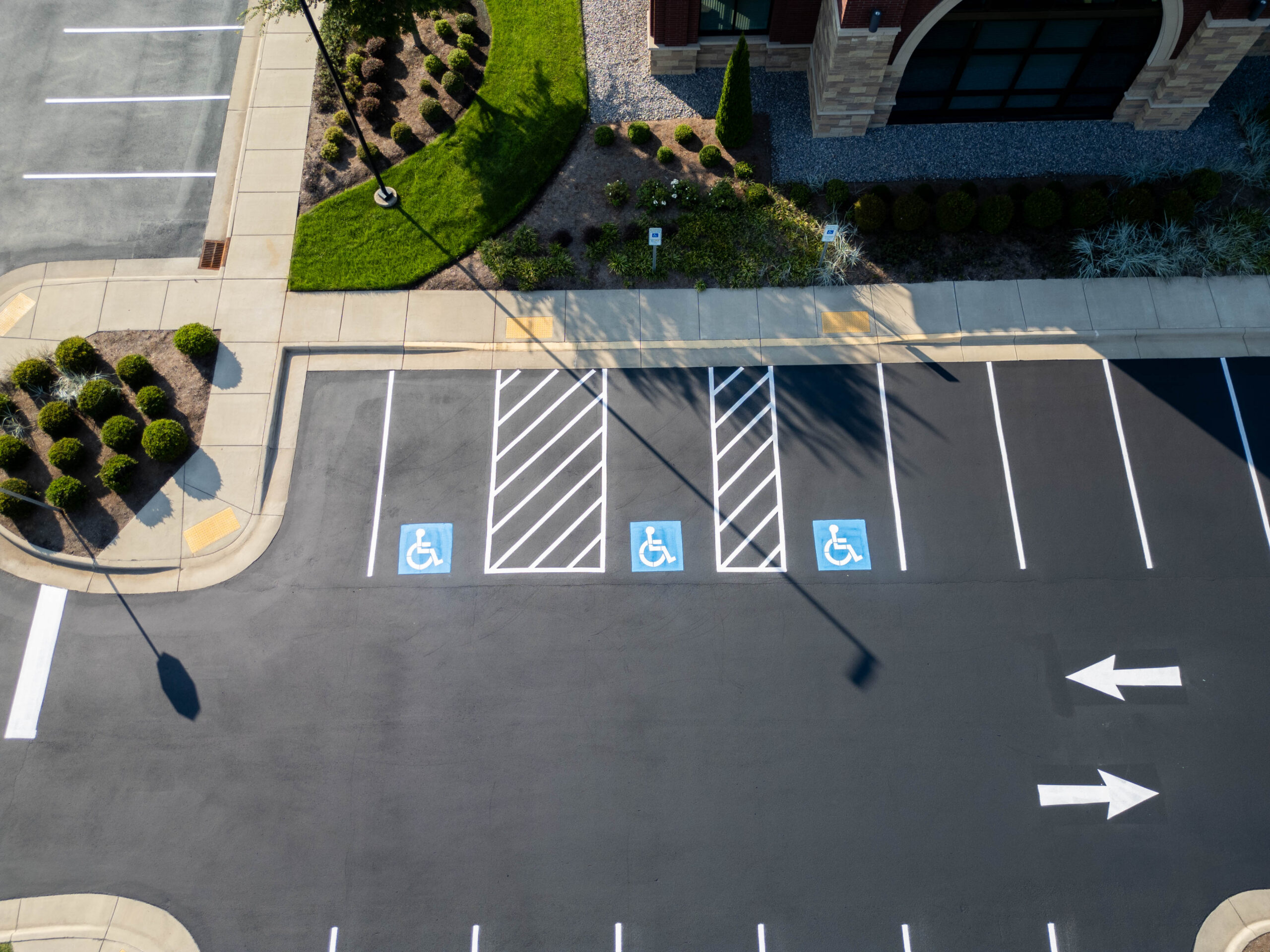
Accessible parking involves more than painted symbols. Space counts, dimensions, access aisles, surface slopes, signs, and the route to the building all affect whether people can use the parking facility.
This guide introduces commercial parking considerations in Charlotte. Use the U.S. Access Board parking guide and applicable state and local requirements when reviewing a specific property.
Note: This is not legal advice. For properties undergoing major renovations or new construction permitting, consult your architect of record for jurisdiction-specific requirements.
The Legal Foundation: What the ADA Actually Requires
The 2010 ADA Standards establish accessibility requirements for covered facilities. The rules that apply to a specific property depend on its use, construction or alteration history, and other applicable accessibility obligations.
The following items are key parts of a parking review; striping alone does not establish full compliance.
Element 1: The Required Number of Accessible Spaces
| Total Parking Spaces | Minimum Accessible Spaces | Minimum Van-Accessible |
|---|---|---|
| 1 – 25 | 1 | 1 of the 1 |
| 26 – 50 | 2 | 1 of the 2 |
| 51 – 75 | 3 | 1 of the 3 |
| 76 – 100 | 4 | 1 of the 4 |
| 101 – 150 | 5 | 1 of the 5 |
| 151 – 200 | 6 | 1 of the 6 |
| 201 – 300 | 7 | 2 of the 7 |
| 301 – 400 | 8 | 2 of the 8 |
| 401 – 500 | 9 | 2 of the 9 |
| 501 – 1,000 | 2% of total | 1 per 6 accessible spaces |
| 1,001+ | 20 + 1 per 100 over 1,000 | 1 per 6 accessible spaces |
Hospital outpatient facilities have a 10% requirement for patient and visitor parking. Rehabilitation facilities specializing in mobility conditions and outpatient physical therapy facilities have a 20% requirement. Independent medical offices generally use the standard scoping table; determine the facility type before calculating the count.
Element 2: Space and Access Aisle Dimensions
This is the most commonly misunderstood requirement, and the most common source of violations on lots that were designed to older standards.
Standard accessible stall: Minimum 8 feet wide, with an adjacent access aisle of minimum 5 feet wide. The access aisle may be shared between two adjacent accessible stalls.
Van-accessible stall — Option 1: Minimum 11 feet wide, with an adjacent access aisle of minimum 5 feet wide. Most common in new construction.
Van-accessible stall — Option 2: Minimum 8 feet wide, with an adjacent access aisle of minimum 8 feet wide. Useful when column spacing or layout constraints prevent an 11-foot stall.
Parking spaces and access aisles must be on the same level, with slopes no steeper than 1:48 in any direction. Connect access aisles to an accessible route. Routing pedestrians in front of parked vehicles is recommended, but the ADA Standards do not categorically prohibit a route behind spaces.

Element 3: Surface Slope
Accessible spaces and access aisles must have slopes no steeper than 1:48 in any direction. Measure the surface; appearance alone is not a reliable assessment.
A lot’s drainage slope can affect accessible parking. Have the proposed space and access aisle measured and seek design guidance where grading corrections or relocation may be needed.
Element 4: Pavement Markings
The ADA Standards require parking spaces and access aisles to be marked, but do not specify the marking color or require a wheelchair symbol painted on the pavement. State or local rules may impose additional marking requirements.
Mark access aisles to discourage parking in them. The federal ADA Standards do not prescribe a particular hatching pattern or color; confirm applicable local requirements.
Element 5: Signage
Sign mounting height: The bottom of the sign face must be at least 60 inches above the ground — high enough that a parked vehicle does not block the sign from view. Signs mounted at standard 48-to-54-inch mounting height fail this requirement.
Van-accessible designation: Every van-accessible stall requires additional text or a supplemental sign reading “Van Accessible.” This is a separate requirement from the base ISA sign. A lot that has no van-accessible sign — even if the stall is physically correct — does not meet the requirement.

Five Items to Check During a Parking Review
Review these conditions against the standards that apply to the site. A qualified accessibility professional can help resolve questions about existing facilities, alterations, and required corrections.
Violation 1: Too Few Accessible Stalls
Calculate required accessible parking separately for each parking facility. Confirm whether special scoping rules apply to the property’s use, and check counts when parking capacity changes.
Violation 2: Access Aisle Dimensions Under Current Standards
Measure accessible spaces and aisles against the applicable standards. Do not assume every older layout is noncompliant solely because of its age; existing-facility and alteration rules require a site-specific review.
Violation 3: Missing Van-Accessible Sign
This is the simplest violation to correct and one of the most common. Many lots have a stall that is physically configured as van-accessible — 11 feet wide, or 8 feet wide with an 8-foot aisle — but signed only with the standard ISA sign, missing the “Van Accessible” designation. Without the sign, the stall does not count as van-accessible regardless of its dimensions. The fix is a sign post installation — a minor addition during any restripe or maintenance visit.
Violation 4: Accessible Parking Slopes Steeper Than 1:48
Grade problems may require relocation, physical correction, or engineering review. Repainting the same sloped area does not correct the slope.
Violation 5: No Accessible Route from Stall to Building Entrance
Connect access aisles to the accessible entrance by an accessible route. Walking surfaces generally need 36 inches of clear width, with limited permitted reductions and additional requirements at turns or passing spaces. Changes in level, ramps, and obstructions must also be evaluated.
An accessible route may cross a vehicle aisle. Federal ADA Standards do not require every such crossing to have painted crosswalk markings, though local requirements and site safety considerations may support them.

What to Include in a Parking Review
Before a commercial restripe, identify the items that need review and which professionals are responsible for design or physical corrections:
- Total stall count and required accessible stall count verification
- Existing accessible stall dimension measurement against current ADAAG
- Slope reading in accessible stalls and access aisles using a digital level
- Signage height, ISA presence, and van-accessible designation review
- Accessible route assessment from stall to building entrance
- Access aisle marking status and configuration
Document the scope and any conditions outside the striping work. Signage, slopes, ramps, and routes may need separate corrections; a restripe alone cannot guarantee that a property meets every accessibility requirement.
Plan Corrections Before Striping
Resolve the required layout and any physical corrections before painting. Coordinate the plan with the property’s design professional and local authority when needed.
Frequently Asked Questions
Does repainting my parking lot trigger ADA compliance requirements?
Resurfacing and layout changes can be alterations. Limited maintenance, such as repainting a few existing spaces in place, may be treated differently. Existing accessibility obligations still matter, so confirm the scope and applicable rules before work starts.
My lot was built to code. Does it need to be updated?
Have existing conditions reviewed when planning work or when access concerns arise. The age of a lot alone does not determine every correction that is required; construction history, alterations, and applicable existing-facility obligations matter.
Do ADA requirements apply to private parking lots?
Private ownership does not by itself exempt a facility from the ADA. Public accommodations and other covered facilities can have parking obligations. Residential properties may also be governed by the Fair Housing Act, Section 504, and state or local requirements depending on their use and funding.
Can you handle both the compliance assessment and the restripe?
Contact ProLine to discuss the parking markings and project scope. Confirm whether an architect, engineer, or accessibility specialist is needed for design, slope, route, or other compliance questions.
Discuss Your Parking Lot Assessment
Contact ProLine Parking Lot Maintenance to discuss your parking layout and pavement markings. Identify any signage, grading, or accessible-route work before finalizing the striping scope.
Request a Parking Lot Assessment
704-530-5366 | info@prolineplm.com
7473-D Hagers Hollow Drive, Denver, NC 28037 | Monday–Friday, 8AM–5PM
Proline Parking Lot Maintenance — The Carolinas’ Premier Parking Lot Maintenance Company