A single 1/4-inch crack in your Charlotte parking lot is not a cosmetic problem. Left untreated through one winter, it will admit water, allow that water to freeze and expand in the sub-base, and emerge in spring as a pothole. Left untreated for two or three winters, it will connect with adjacent cracks and produce the interconnected web of structural failure that pavement engineers call alligator cracking — and that property managers call a very expensive conversation with a repaving contractor.
Parking lot crack sealing in Charlotte, NC is the single highest-return maintenance investment available to commercial property owners. The cost is measured in cents per linear foot. The cost of not doing it is measured in thousands of dollars per repair. This guide covers everything you need to make the right call: crack types, treatment methods, realistic cost ranges for the Charlotte market, and the maintenance timeline that keeps a well-maintained lot in service for 20+ years.
Why Asphalt Cracks: The Four Root Causes
Understanding why asphalt cracks is the first step to understanding why crack sealing works — and why timing matters.
Thermal Cycling
Asphalt is a viscoelastic material: it is not rigid, and it moves. Charlotte’s climate produces summer temperatures near 90°F and winter lows in the mid-20s — a swing of roughly 65 degrees. Asphalt expands in heat and contracts in cold. Over years of daily and seasonal cycling, that repeated movement generates fatigue stress at the surface that manifests as cracking.
This is physics, not negligence. Every asphalt surface cracks eventually. The question is whether you seal those cracks before water gets in.
UV Oxidation
Fresh asphalt contains oils — specifically, maltenes, the lighter aromatic compounds in the bitumen binder — that keep it flexible and dark. Sun exposure drives off those oils over time. The asphalt turns gray, stiffens, and loses its ability to absorb the stress of thermal cycling and load without cracking. An oxidized surface cracks faster and more extensively than a maintained one.
This is precisely what sealcoating prevents: it provides a UV barrier that slows oxidation dramatically. Lots that maintain a regular sealcoat schedule retain their flexibility and crack much more slowly than neglected lots.
Water Infiltration
Once a crack exists, water enters it. In Charlotte’s winter, that water freezes. Water expands roughly 9% when it freezes — inside a confined crack, that expansion exerts up to 2,000 psi of hydraulic pressure against the crack walls. The crack widens. When the water thaws and refreezes through successive cycles, the sub-base directly below the crack softens, loses bearing capacity, and the pavement above it begins to fail structurally.
This is the mechanism by which a $3 crack sealing job becomes a $600 pothole repair becomes a $6,000 remove-and-replace section. The water is the accelerant. Sealing the crack stops the water.
Sub-Base Failure and Heavy Load Stress
Asphalt is a wearing surface — it is designed to be flexible over a compacted aggregate sub-base. When the sub-base is inadequate, poorly compacted, or has been weakened by water infiltration, the asphalt above it has no structural support. Heavy vehicles — delivery trucks, garbage trucks, fire apparatus — compound the problem by applying dynamic loads that exceed the design capacity of a compromised base.
The result is fatigue cracking that appears in load-concentrated areas: near dumpster pads, fire hydrants, loading docks, and entrance aprons. When you see cracking concentrated in these zones, sub-base condition needs to be assessed before committing to a maintenance strategy.

The 4 Crack Types: What Each One Means and What to Do
Not all cracks are in the same category of urgency. Here is how to read your lot:
Type 1: Transverse and Longitudinal Cracks (Shrinkage / Thermal)
What they look like: Straight or slightly curved lines running across or along the pavement, usually isolated, width under 1/4 inch.
What causes them: Thermal cycling and shrinkage, typically in newer to mid-age pavement.
What to do: Hot rubber crack sealing as soon as they appear. These are the cracks where early intervention is most cost-effective. A fresh 1/4-inch thermal crack seals cleanly in under three minutes and is watertight for five to seven years. Leave it one more winter and it doubles in width and triples in length.
Urgency level: Moderate. Seasonal schedule is fine; do not let it roll past your next maintenance cycle.
Type 2: Block Cracking
What they look like: A series of roughly rectangular cracks creating a block pattern across the surface, typically 1/4 to 3/4 inch wide.
What causes them: UV oxidation. The asphalt binder has dried out and the surface is contracting and cracking as it stiffens.
What to do: Crack seal the blocks, then sealcoat over the top after cure. The sealcoat restores UV protection and prevents further oxidation-driven cracking. If you sealcoat without sealing the cracks first, you paint over the problem — water still gets in at the crack edges under the sealcoat.
Urgency level: High. Block cracking indicates oxidation is actively degrading the surface. Act before the next winter.
Type 3: Edge Cracking
What they look like: Cracking that runs parallel to and near the pavement edge, typically within two feet of the curb or the unsupported edge of the lot.
What causes them: Loss of lateral support at the edge — either from poor base preparation, erosion of the sub-base at the edge, or drainage issues causing water to undermine the edge.
What to do: Crack seal plus a drainage assessment. If water is directing itself at the lot edge due to grade or curb condition, sealing the surface crack will not stop the underlying erosion. The drain pattern needs to be corrected or the cracking will return in the same location every season.
Urgency level: High. Edge cracking often progresses faster than field cracking and can undercut a significant section of the lot perimeter.

Type 4: Alligator (Fatigue) Cracking
What they look like: An interconnected network of cracks forming a pattern resembling alligator or chicken-wire, typically in a localized zone.
What causes them: Structural failure. The sub-base beneath this area has lost bearing capacity, and the pavement is deflecting under load with each vehicle pass.
What to do: This zone cannot be crack sealed or sealcoated effectively. The correct repair is remove-and-replace: cut out the alligator section, address the sub-base condition, and install new asphalt. Applying surface treatments to alligator cracking wastes money and delays the inevitable.
Urgency level: Critical. Alligator cracking progresses rapidly under load. Each vehicle pass worsens the base condition. Early intervention on a small alligator section is dramatically cheaper than allowing it to spread.
Hot Rubber Crack Sealing vs. Cold Pour Crack Filler: The Real Difference
| Factor | Hot Rubber Crack Sealing | Cold Pour Crack Filler |
|---|---|---|
| Application temperature | 380–400°F (melter-applicator required) | Ambient temperature |
| Adhesion mechanism | Chemical bond to crack walls | Mechanical adhesion only |
| Flexibility after cure | Remains flexible through temperature swings | Becomes rigid; re-cracks with pavement movement |
| Expected service life | 5–7 years in commercial application | 1–2 seasons |
| Performance in freeze-thaw | Stretches with pavement contraction | Debonds and allows water entry |
| Best application | Any commercial lot with meaningful traffic | Very minor touch-ups, cosmetic only |
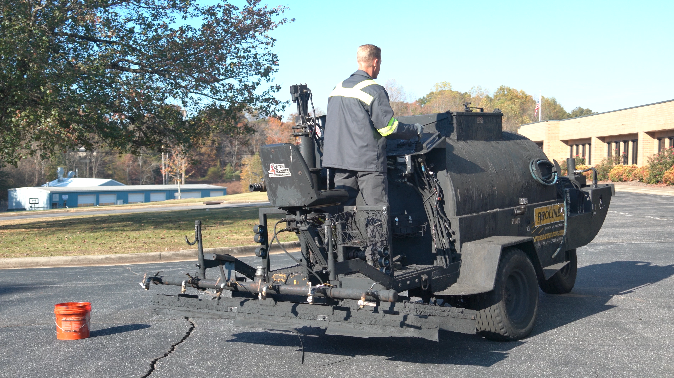
We use hot rubber on every commercial crack sealing project without exception. Cold pour is a retail-grade product that is priced for homeowners and performs accordingly. If a contractor is quoting you crack sealing and has not mentioned a melter-applicator or the material temperature, ask. The answer tells you what you are buying.
The Crack Sealing Process: Step by Step
Step 1 — Assessment and linear footage count. Before mobilizing, we walk the lot and document crack types, widths, and estimated total linear footage. This determines material quantities, equipment configuration, and whether routing is required.
Step 2 — Routing (where needed). Cracks wider than 3/4 inch or with irregular, deteriorated edges benefit from routing before sealing. A router creates a uniform reservoir — consistent width and depth — that holds sealant more effectively than an irregular crack face.
Step 3 — Clean the crack. Compressed air and a wire wheel remove vegetation, debris, and loose asphalt from the crack interior. This is the most important step for adhesion quality. Hot rubber applied to a dirty crack does not bond to the crack walls — it just fills the space and eventually pops out.
Step 4 — Heat the sealant. The hot rubber material is loaded into a melter-applicator and brought to working temperature — between 380 and 400°F.
Step 5 — Apply and squeegee. The applicator fills each crack from the bottom up, slightly overfilling. The squeegee tool levels the sealant flush with the pavement surface and creates the banded surface cap that extends the seal across the crack edges.
Step 6 — Sand and cure. High-traffic zones get a light sand broadcast over the fresh sealant to prevent tire pickup during the cure window, typically 20 to 30 minutes at summer temperatures.

What Does Parking Lot Crack Sealing Cost in Charlotte?
| Project Scale | Approximate Linear Footage | Typical Cost Range |
|---|---|---|
| Small retail / office lot | Under 500 LF | $400 – $900 |
| Mid-size commercial | 500 – 2,000 LF | $900 – $2,800 |
| Large commercial / HOA | 2,000 – 8,000 LF | $2,800 – $9,000 |
| Industrial / large facility | 8,000 – 20,000 LF | $9,000 – $22,000+ |
The comparison that matters: A single commercial pothole repair in Charlotte runs $400 to $1,200 depending on depth and diameter. A hot rubber seal on the crack that would have become that pothole costs $2 to $5. The return on crack sealing is not incremental — it is an order of magnitude.
The Commercial Parking Lot Maintenance Timeline
- Year 1–2: New asphalt needs to cure. No seal, no crack sealing needed yet. Monitor for construction-related issues.
- Year 2–3: First sealcoat application. Apply before significant oxidation sets in. Seal any early thermal cracks before the sealcoat cycle.
- Year 4–5: First scheduled crack sealing pass. Identify and seal all cracks that have developed. Follow with sealcoat refresh.
- Year 6–8: Second crack sealing pass. Sealcoat again. Assess any areas requiring patching.
- Year 9–12: Full condition assessment. Consider mill-and-overlay for sections showing advanced wear, or continue the cycle if surface is holding.
- Year 15–20+: Full repave or major overlay decision point. Lots following this schedule consistently reach this point in good condition. Lots that skip the cycle rarely make it past year 12.
The five-year crack sealing investment for a 50,000-square-foot commercial lot might total $6,000 to $12,000 over the cycle. A full repave of the same lot runs $75,000 to $150,000. The math does not require elaboration.
Frequently Asked Questions
How long does it take to crack seal a commercial parking lot?
A 20,000-square-foot lot with typical cracking takes one to two days. A large facility at 100,000+ square feet may take three to five days depending on crack density. We provide a timeline estimate as part of every scope proposal, including the traffic management plan for lots that need to remain partially open during work.
Can crack sealing be done in cold weather?
Hot rubber crack sealing requires the pavement temperature to be at least 40°F and rising. In Charlotte’s climate, that means work can continue through most of the year with the exception of the coldest stretches of January and February. Spring is the most productive window — after freeze season ends, before the next summer heat accelerates deterioration.
Should I crack seal before or after sealcoating?
Always crack seal first. The hot rubber sealant needs to bond directly to the asphalt crack walls, not to a layer of sealcoat. The correct sequence is: crack seal, allow 24 to 48 hours cure minimum, then sealcoat over the top. The sealcoat covers the band marks left by the crack sealing and produces the finished uniform surface.
What is the warranty on commercial crack sealing?
Proline warranties materials and workmanship on all crack sealing projects. We use hot rubber sealant rated by the manufacturer for a minimum five-year service life under normal traffic conditions. If a sealed crack re-opens within the warranty period due to workmanship, we come back and correct it at no charge.
Schedule Your Free Lot Assessment
If you manage a commercial property in Charlotte, Huntersville, Greensboro, Winston-Salem, or the surrounding Carolinas and have not had a professional crack assessment in the last two years, you are likely overdue. We offer free on-site lot assessments: we walk your property, document crack types and linear footage, and give you a written scope with honest numbers.
Schedule Your Free Lot Assessment or call 704-530-5366.
Proline Parking Lot Maintenance — The Carolinas’ Premier Parking Lot Maintenance Company
7473-D Hagers Hollow Drive, Denver, NC 28037