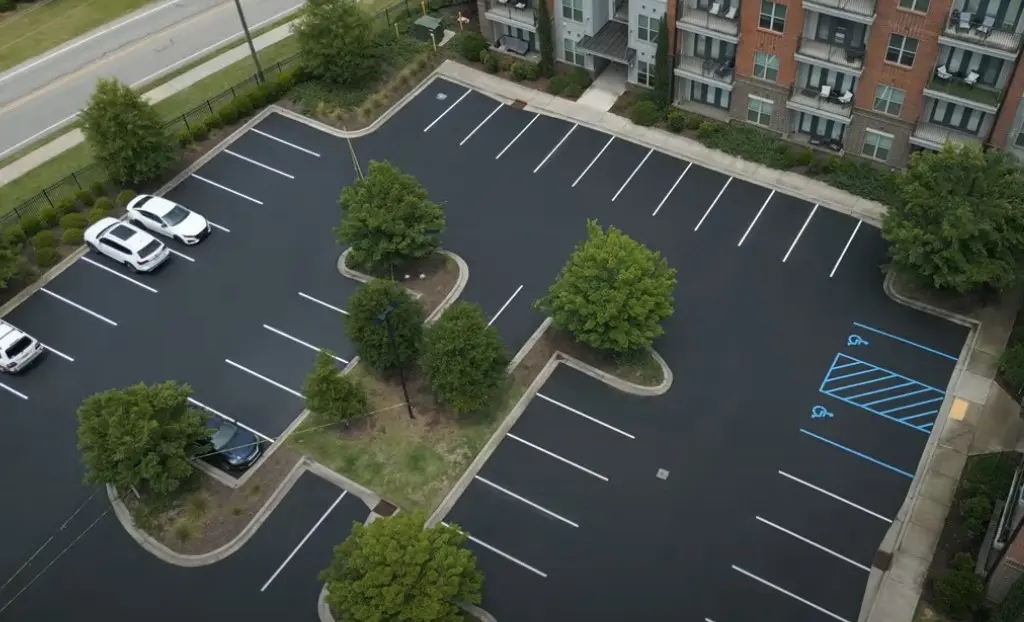
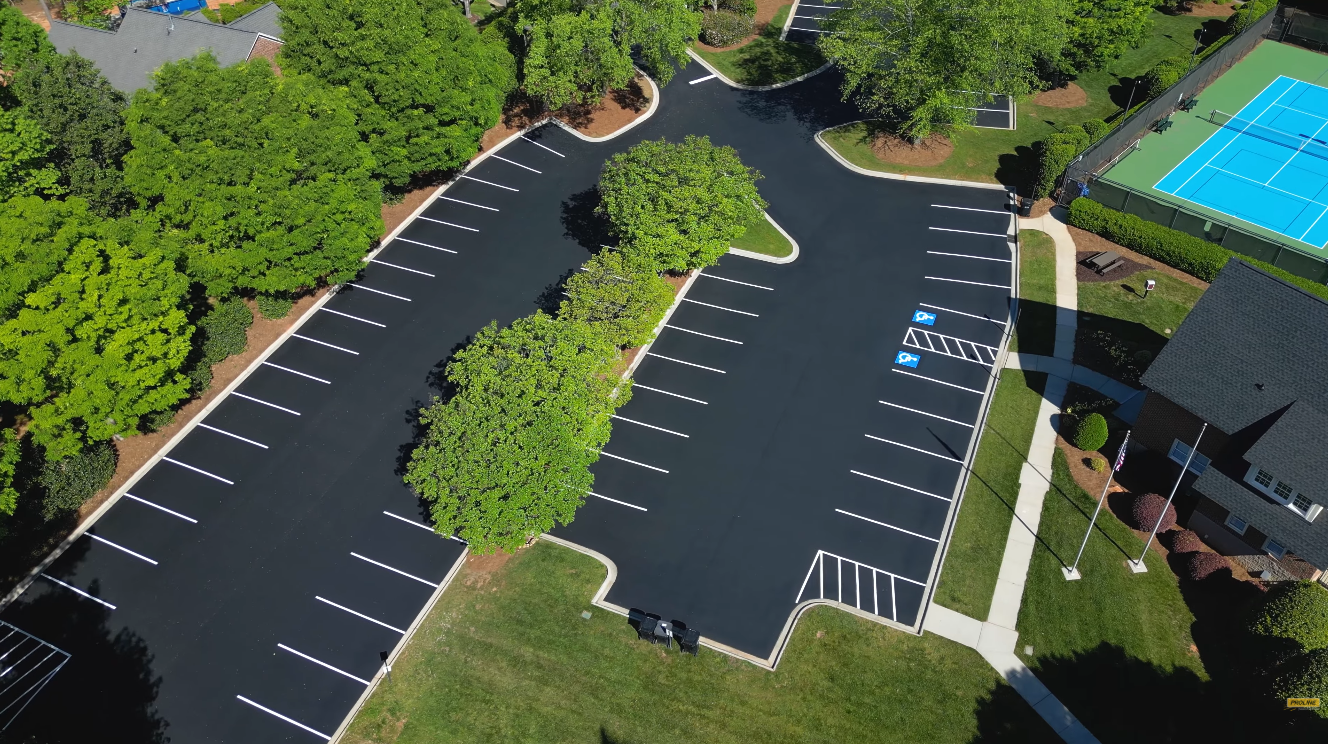
According to NOAA, the Atlantic hurricane season officially runs from June 1 through November 30, which means parking lot striping across the Carolinas spends nearly half the year under a combination of intense UV exposure and heavy seasonal rainfall, two of the fastest ways to wear down painted lines. Add daily traffic on top of that, and it’s no surprise striping in this region rarely lasts as long as a generic online estimate suggests. This guide covers what actually determines how often a multi-family parking lot needs restriping and why a calendar date alone isn’t the right way to decide.
Quick answers:
- There’s no single universal restriping interval. Paint type, traffic volume, and regional climate all affect how long striping actually stays visible.
- Standard traffic paint typically lasts 1 to 2 years in a hot, humid climate, while thermoplastic or epoxy markings commonly last several years longer under the same conditions.
- Higher-traffic multi-family communities wear down striping faster than lower-density properties, simply from more tires crossing the same lines every day.
- According to NOAA, the Carolinas’ combination of intense summer UV and a long hurricane season creates faster wear on painted markings than drier, milder climates typically see.
- Compliance-critical markings, accessible stalls and fire lanes, deserve a shorter visual inspection cycle than the rest of the lot, regardless of the broader restriping schedule.
There’s No Single Universal Timeline
A quick search for “how often to restripe a parking lot” tends to return a single number, often somewhere around two years, presented as if it applies everywhere equally. In practice, the right interval depends on three separate factors: the paint or marking material used, how much traffic the lot actually sees, and the climate it sits in. A property that ignores all three and restripes on a fixed calendar date alone is likely either paying for paint that didn’t need replacing yet or leaving faded markings up longer than it should.
Paint Type Is the Biggest Factor in How Long Striping Lasts
Standard traffic paint, the most common and least expensive option, typically holds up for 1 to 2 years before fading enough to need a repaint, especially in a hot, sunny climate. Thermoplastic markings, applied as a heated material that bonds to the pavement, commonly last 4 to 6 years under the same conditions, at a meaningfully higher upfront cost. Epoxy-based markings fall somewhere in between, often lasting 3 to 5 years and holding up well under heavy traffic. The paint type chosen at installation does more to set the actual restriping interval than almost any other single factor.
| Marking Type | Typical Lifespan | Notes |
|---|---|---|
| Standard traffic paint | 1 to 2 years | Lowest upfront cost, fades fastest under UV and traffic |
| Epoxy | 3 to 5 years | Good durability, moderate cost, common for heavier traffic |
| Thermoplastic | 4 to 6 years | Highest upfront cost, most durable, best for high-traffic areas |
Traffic Volume: Why a 300-Unit Community Fades Faster Than a 50-Unit One
More vehicles crossing the same painted lines every day means more physical wear on top of whatever UV and weather exposure is already happening. A larger multi-family community, or one with a lot of visitor and delivery traffic on top of resident vehicles, will typically see its striping fade faster than a smaller property using the same paint type under the same climate conditions. This is why two properties that installed the same marking material in the same year can end up needing restriping at noticeably different times.
How the Carolina Climate Specifically Accelerates Wear
Intense summer sun degrades paint pigment over time regardless of region, but the Carolinas add two additional factors that speed this up further. According to NOAA, the region sits squarely within the Atlantic hurricane season’s reach for roughly half the year, which means periods of heavy, sustained rainfall that add water exposure and abrasion on top of the usual UV fading. Humidity levels common across the region also affect how well paint cures and adheres in the first place, which is part of why choosing the right product and application conditions matters as much in this climate as choosing when to reapply it.
The Visual Signs That Mean It’s Time, Not Just a Calendar Date
Rather than restriping purely on a fixed schedule, it’s worth checking for specific signs: lines that are difficult to see from a normal driving speed, stall boundaries that have faded to the point where parking has become inconsistent, or arrows and directional markings that are no longer clearly legible. These signs can show up earlier or later than a generic timeline predicts, depending on the paint type, traffic, and climate factors already discussed, which is why a visual check remains more reliable than counting years on a calendar alone.
Why Compliance-Critical Markings Need a Shorter Inspection Cycle
Accessible stall markings and fire lane striping carry a different stake than a standard parking line, since their visibility ties directly into accessibility compliance and emergency vehicle access. According to the U.S. Access Board’s 2010 ADA Standards for Accessible Design, accessible parking requirements are federally defined, and a faded marking that’s no longer clearly identifiable creates a real compliance gap, not just a cosmetic one. According to the National Fire Protection Association, fire lane markings serve a similarly critical function for emergency access. Both are worth checking on a shorter, more frequent visual inspection cycle than the rest of the lot’s general striping.
Building a Restriping Schedule Into Your Broader Maintenance Plan
Rather than treating restriping as its own isolated decision, it fits naturally into the same annual walk-through and condition assessment used for the rest of a property’s pavement maintenance. Flagging fading striping during that same visit, rather than waiting for a separate dedicated inspection, keeps the decision grounded in what the lot actually looks like each year instead of an assumption carried over from whenever it was last done.
Keep Your Property Safe and ADA-Compliant with Fresh Restriping
Faded parking lines and worn pavement markings increase the risk of minor accidents, cause traffic confusion, and leave your multi-family property open to ADA compliance violations. Restriping your lot every 18 to 24 months ensures clear stall visibility, proper traffic flow, and maximum curb appeal for residents and prospective tenants alike.
ProLine Parking Lot Maintenance delivers precision layout and heavy-duty, long-lasting traffic paint designed to withstand heavy daily traffic and local weather conditions.
- ADA & Safety Standards: Precise striping for stalls, crosswalks, fire lanes, and accessible spaces to keep your lot fully compliant.
- High-Traffic Durability: Premium-grade traffic paint formulated to resist UV fading, tire scuffing, and oil wear.
Frequently Asked Questions
Does restriping need to happen at the same time as sealcoating or on its own separate schedule?
They often get scheduled together for convenience, since sealcoating typically covers over existing striping and requires it to be repainted afterward anyway. Still, they don’t have to be tied to the same interval. A property might need sealcoating on a 2- to 3-year cycle while its thermoplastic striping is still holding up fine at year three, in which case restriping that specific area early to match the sealcoat schedule isn’t necessary. Checking both independently, rather than assuming one dictates the other, gives a more accurate picture of what each actually needs.
How can I tell if faded striping is actually a safety/liability issue or just a cosmetic one?
Faded lines around standard parking stalls are typically a cosmetic and traffic-flow issue, since drivers can generally still navigate the lot even with somewhat worn markings. Faded or illegible accessible stall markings and fire lane striping are a different category entirely, since those tie directly into accessibility compliance and emergency vehicle access rather than general convenience. If compliance-critical markings are difficult to identify at a glance, that’s worth treating as a priority regardless of how the rest of the lot’s striping looks.
Does thermoplastic striping really last long enough to be worth the higher upfront cost in a hot, humid climate like the Carolinas?
For high-traffic areas or properties looking to minimize how often they’re scheduling restriping work, thermoplastic’s longer lifespan, commonly 4 to 6 years compared to standard paint’s 1 to 2, often justifies the higher initial cost over time. The calculation changes for lower-traffic areas of a lot where standard paint might reasonably last closer to its full expected lifespan anyway, making the cost difference less clearly worthwhile. Comparing the total cost over 5 years, rather than just the upfront price per linear foot, gives a more accurate picture of which option actually makes sense for a specific property.
Should high-traffic areas like near the leasing office or mailboxes be restriped more often than the rest of the lot?
Yes, in many cases these specific areas can benefit from restriping on a shorter interval than the rest of the property, since concentrated foot and vehicle traffic near shared amenities wears down markings faster than less-trafficked sections of the lot. Some properties address this by using a more durable marking material specifically in these high-wear zones while keeping standard paint elsewhere, rather than upgrading the entire lot. Treating the lot as having different wear zones, rather than a single uniform surface, often produces a more cost-effective restriping plan overall.
Does hurricane season affect when restriping should be scheduled in the Carolinas?
It’s worth factoring in. According to NOAA, the Atlantic hurricane season runs from June 1 through November 30, and scheduling restriping work right before or during that window risks fresh paint being compromised by heavy rain before it’s had adequate time to cure. Many contractors in the region prefer scheduling striping work outside peak hurricane season when possible, both for curing conditions and to avoid the disruption of rescheduling around a storm.
Can restriping be done at night to avoid disrupting residents?
In many cases, yes, and this is a common approach at occupied multi-family properties specifically to minimize how much the work disrupts residents’ daily parking. Nighttime work does depend on adequate lighting for the crew and on paint or marking materials that cure properly at lower nighttime temperatures, so it’s worth confirming with the specific contractor whether their materials and schedule support this approach. Advance resident notices about which sections will be closed and when remain important regardless of whether the work happens during the day or at night.
Does the color of the paint (white vs blue vs red) fade at different rates?
Yes, to some degree, since different pigments respond differently to UV exposure over time, though the marking material itself, standard paint versus thermoplastic versus epoxy, generally has a bigger effect on overall lifespan than color alone. Blue accessible-stall markings and red fire lane markings are worth checking just as closely as white standard striping, rather than assuming a specific color is inherently more durable. Since these colors also tend to mark compliance-critical areas, checking them on the shorter inspection cycle already discussed matters more than tracking subtle differences in fade rate by color.
How do I know if my HOA or property management company is restriping often enough?
Comparing the visible condition of your property’s striping against the general lifespan expectations for whatever paint type was used—standard paint, epoxy, or thermoplastic—gives a reasonable starting benchmark. If markings are noticeably harder to see than that expected lifespan would suggest, or if accessible and fire lane markings in particular look faded, that’s worth raising directly with the management company or HOA board rather than assuming it’s already on their radar. Asking what paint type was used and when it was last applied is a reasonable, specific question to bring to that conversation rather than a vague complaint about how the lot looks.
See also: How Parking Lot Striping Improves Traffic Flow in Multi-Family Communities, Signs Your Apartment Parking Lot Needs New Line Striping