Most parking lot striping does not fail all at once. It degrades section by section, marking by marking, over months, gradually enough that property managers who see it every day stop registering the change. The lot that looked fresh three years ago now has stall lines that are more suggestion than definition, crosswalks that have bleached into the asphalt, and a fire lane that tenants park in freely because the red curb paint has long since faded to gray.
The problem with gradual degradation is that it disguises the urgency. A parking lot with truly absent markings is obviously a problem. A parking lot with faint, partially legible markings feels like it is still functioning, until a tenant conflict over an invisible stall boundary, an ADA complaint about an unmarked accessible space, or a slip-and-fall incident at an unlit curb stop makes the cost of “partially functioning” very clear.
This post gives property managers and apartment owners in North and South Carolina a specific, observable checklist for evaluating whether their parking lot has crossed the threshold from manageable fade into re-stripe territory. Walk the lot with this list, and the answer will be unambiguous.
TL;DR — The Core Signs:
- Stall lines that are no longer crisp white, faded to gray or barely visible against the asphalt
- Parking conflicts and complaints are increasing without a change in the tenant population
- ADA markings, access aisle hatching, or ISA symbols that are no longer clearly legible
- Fire lane markings that are no longer deterring unauthorized parking
- Crosswalks and stop bars that are difficult to see in wet or low-light conditions
- A recent sealcoating that buried the existing striping underneath
- It has been 18–24 months or more since the last professional re-stripe
Sign 1: Your Stall Lines Have Gone from White to Gray
The most straightforward indicator that a parking lot needs re-striping is also the easiest to miss when you see the lot every day: the stall lines are no longer white.
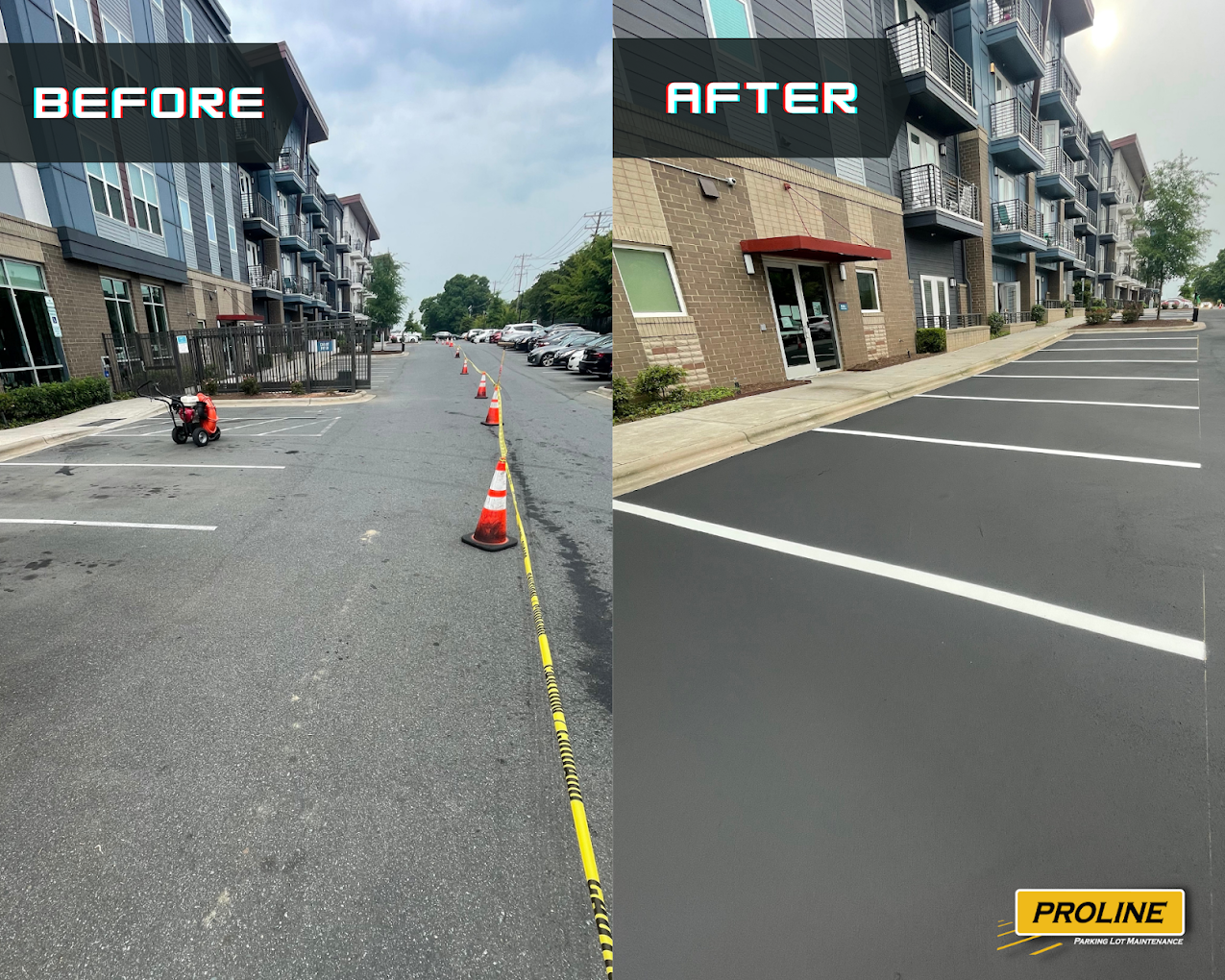
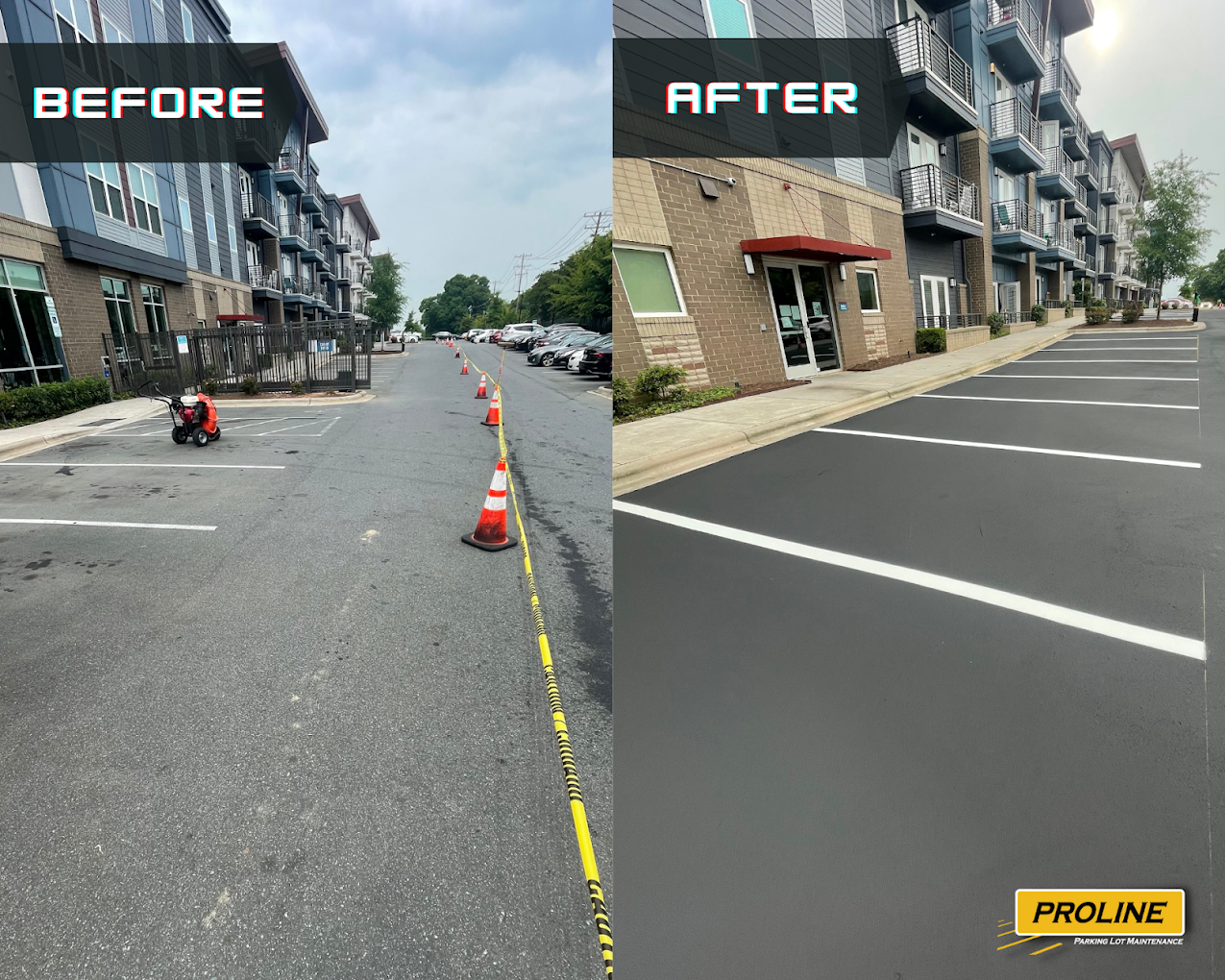
Freshly applied traffic paint on asphalt is a bright, high-contrast white that reads clearly against the dark asphalt background. As UV degradation and vehicle traffic wear the paint down over months, the white shifts progressively toward gray, then toward the color of the asphalt itself. The transition happens slowly enough that it registers as “the lines are still there” rather than “the lines have stopped functioning.”
A practical test: stand at the far end of a drive aisle and look down the row of stall lines at a low angle. At this viewing angle, similar to how a driver approaching a stall sees the lines. The contrast between the paint and the asphalt is more apparent than when looking straight down from above. Lines that appear adequate from directly above often appear faint or absent at the driver’s approach angle.
A second test: photograph one section of the lot and look at the image on your phone. Camera contrast settings often reveal a fade that the human eye automatically compensates for when viewing a familiar scene in person. If the stall lines are difficult to distinguish from the asphalt in a photograph taken in good afternoon light, they are below the visibility threshold a driver needs to use them reliably.
Lines that are not white, that require a second look to confirm they are there, that blend into the asphalt in anything less than direct sunlight, have crossed the re-stripe threshold. The lines may still be technically present, but they are no longer performing the guidance function for which they exist.
Where to look first: High-traffic stall rows near building entrances and mail stations fade faster than remote sections of the lot. Sections that receive afternoon sun exposure for most of the day fade faster than shaded sections. Start your conditioned walk in these areas; if they have reached the threshold, the rest of the lot is close behind.
Sign 2: Parking Conflicts and Complaints Are Increasing
This sign is behavioral rather than visual, but it is one of the most reliable indicators that striping has degraded below the functional threshold: your parking-related complaint volume is rising without any change in the tenant population or the number of available spaces.
Parking conflicts at apartment communities follow a predictable pattern when striping degrades. First, vehicles in high-traffic stall rows start parking slightly off-center, without clear line references; drivers self-position by feel rather than by visual boundary. Those small deviations compound across adjacent stalls until the outer stalls in a row are noticeably narrower than designed. Tenants start returning to their cars to find door dings from vehicles that could not open their doors without hitting something. Those incidents generate complaints.
Second, accessible stalls are increasingly occupied by non-disabled drivers who cannot see the markings indicating the space. Tenants with disabilities or mobility limitations find their designated spaces occupied and report it to management. The reporting tenant is frustrated; the occupying driver was not being malicious; they genuinely could not see the designation. The conflict is a visibility issue, not a tenant behavior issue, and it resolves when the markings are restored.
Third, disputes about designated spaces, visitor parking, reserved stalls, and numbered assignments increase when the stenciling that enforces those designations becomes illegible. Tenants disagree about which spaces are visitor-only, which are reserved, and whether a particular stall number belongs to unit 214 or 241 because the stenciled number has faded to the point where both readings are plausible. Management becomes the arbiter of conflicts that visible markings would resolve without any intervention.
If you have noticed a pattern of parking complaints, not a single incident, but a recurring volume, without any change in the property’s parking ratio or tenant population, the lot’s striping is likely the root cause. A re-stripe resolves the underlying condition rather than addressing each conflict individually as a tenant relations issue.
Sign 3: ADA Markings Are No Longer Clearly Legible
ADA-accessible parking markings are the highest-stakes striping elements on any apartment property, both for resident safety and regulatory compliance. They are also consistently the markings that receive the least attention during casual condition walks because they occupy a smaller portion of the lot’s visual field than the stall lines do.
There are four specific ADA marking elements to evaluate:
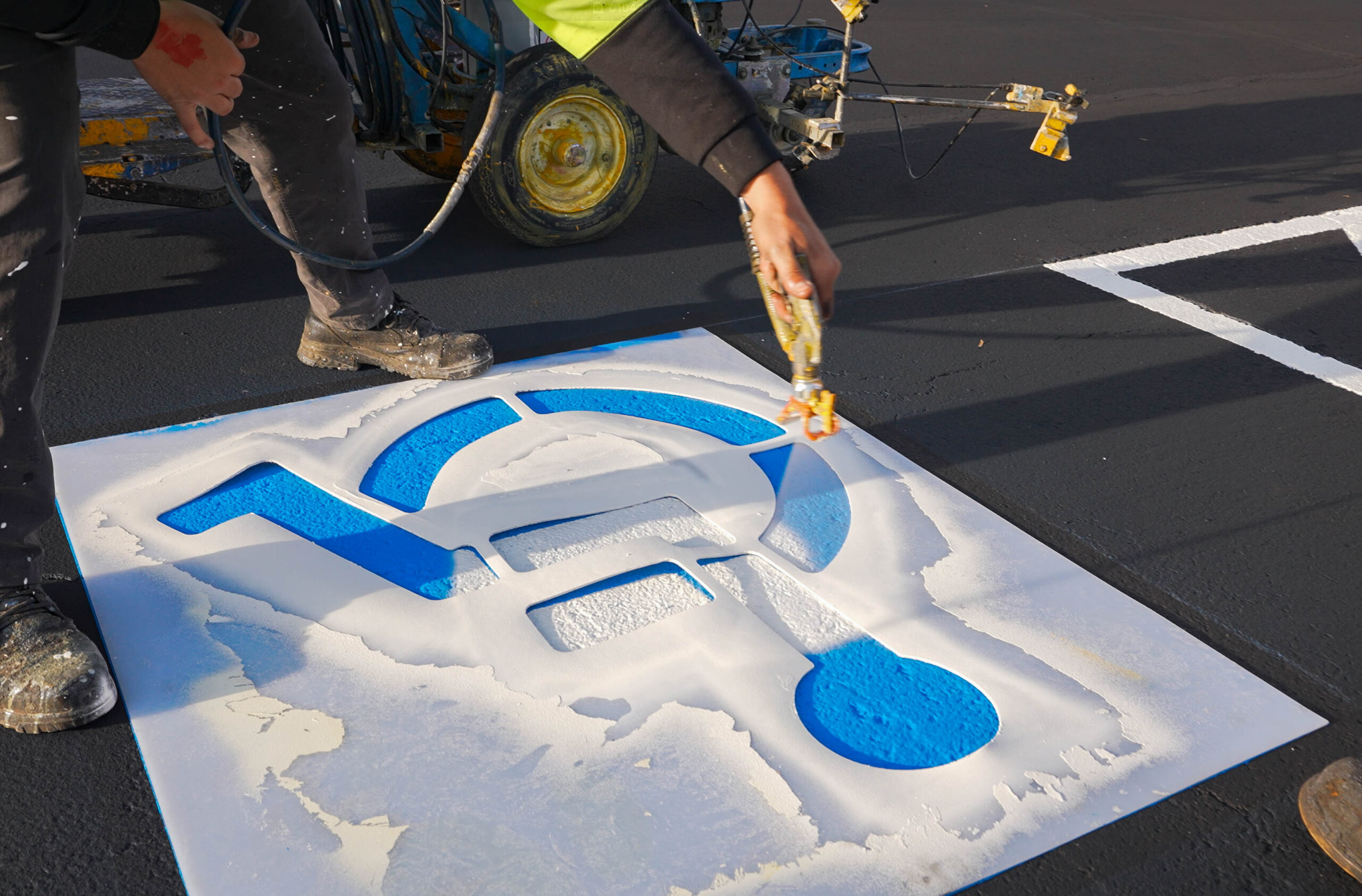
The International Symbol of Accessibility (ISA) is on the pavement surface. This is the wheelchair symbol painted in contrasting paint on the inside of each accessible stall. It must be clearly legible, not partially visible, not inferable, but unambiguously readable as the ISA. A faded or partially obscured ISA is a documented ADA deficiency. Stand inside the stall and look directly at the symbol. If you cannot identify it immediately, neither can a driver nor an ADA inspector.
Access aisle diagonal hatching. The hatched zone adjacent to each accessible stall is the clearance space for wheelchair and mobility device use. The diagonal lines that define this zone must be visible and distinguishable from the drive lane. Hatching fades faster than stall lines because it is painted in sections of the lot where drivers occasionally cut across. If the hatching is absent or barely visible, the access aisle is effectively unmarked, and it will be parked in.
Accessible stall boundary lines. The perimeter lines of accessible stalls must be clearly distinguished from standard stalls. If the stall boundary lines have faded to the point where an accessible stall is not distinguishable from an adjacent standard stall at a glance, the accessible space is functionally unmarked.
Van-accessible designation. Van-accessible spaces require additional marking indicating the van-accessible designation, either on the pavement surface or on the vertical sign. If the van-accessible designation is absent or illegible, the stall does not meet current 2010 ADAS requirements, regardless of its dimensions.
Any one of these four elements in a degraded or absent state is a re-stripe trigger for the accessible parking section of the lot, independent of the condition of the rest of the markings. The ADA compliance exposure from non-legible accessible markings does not wait for the stall lines to reach a similar fade level.
Sign 4: Vehicles Are Parking in the Fire Lane
Fire lane markings, red curb paint, and “NO PARKING FIRE LANE” stenciling function as a visual deterrent first and a legal prohibition second. When drivers can clearly see a red curb and fire lane stenciling, the vast majority comply without needing to think about the legal consequences. When those markings have faded, the deterrent disappears, and the legal prohibition becomes unenforceable in practice because no driver can be expected to know a designation exists when there is no visible indication of it.
If vehicles are regularly parking in your fire lane, even occasionally, the markings have degraded below the deterrence threshold. The fire lane may still technically exist as a designated clearance zone on the property’s site plan, but if the pavement markings are not providing the visual cue that keeps drivers out, the lane is not functioning as designed.
This is worth evaluating specifically rather than inferring from the general condition of the lot. Walk the fire lane sections of the lot. Look at the curb paint directly: is it red or a faded reddish-gray that blends with an aged curb? Look at the stenciling: are the letters “FIRE LANE” readable from 20 feet at a normal walking pace, or do they require a close look to make out? If you see tire marks on the curb face from vehicles that have pulled up against it, that is evidence that drivers are not seeing or responding to the fire lane designation.
In North Carolina and South Carolina, fire lane compliance is enforced by local fire marshals, who have the authority to cite property owners for noncompliant fire lane markings. A fire marshal inspection documenting faded markings can result in a compliance order requiring correction within a specified timeline. More seriously, a fire apparatus delayed in reaching a building because the fire lane was blocked by a vehicle that had parked there because the markings were absent is a scenario with severe consequences that no property operator wants to be responsible for explaining after the fact.
Sign 5: Crosswalks and Stop Bars Are Difficult to See in Wet or Low-Light Conditions
Crosswalks and stop bars may appear marginally adequate during a daytime condition walk in good weather. The relevant test is whether they function under the conditions when they matter most: at night, in the rain, or both simultaneously.
Carolina afternoon thunderstorms and early-evening rain events create the conditions that expose degraded markings. A crosswalk painted with worn traffic paint that has lost its retroreflective properties becomes nearly invisible on wet asphalt at night, the same wet asphalt that reflects every ambient light source in the lot, creating visual noise that makes faint markings disappear entirely.
Evaluate crosswalks and stop bars specifically under these conditions rather than only during daytime walks. If your property has exterior lighting, walk the lot after dark with the lights on and observe how visible the crosswalk markings are to someone approaching them at vehicle speed. If they are difficult for you to see while walking slowly and looking for them, they are inadequate as a safety marking for a driver approaching at 5–10 mph while also watching for pedestrians.
A practical benchmark: crosswalk markings should be clearly visible to a driver at the point where stopping before the crossing is still physically possible, given the approach speed in that section of the lot. If the marking is not visible at that distance under the conditions your residents navigate it most frequently, it has crossed the re-stripe threshold.
Stop bars share this standard. A stop bar that is legible on a dry Tuesday afternoon but difficult to see at 8 PM on a rainy Thursday, when more of your residents are arriving home, is a stop bar that is not performing its intended function during its most important operating window.
Sign 6: The Lot Was Recently Sealcoated but Not Re-Striped
This sign differs from the others because it does not require visual evaluation of the markings; it is a sequencing issue that creates a known problem regardless of the lot’s appearance.
Sealcoating covers existing pavement markings completely. A professional sealcoat application creates a new, dark surface layer over the existing asphalt and over every painted line, symbol, arrow, and stencil on that surface. After sealcoating, those markings exist only as buried paint beneath the new sealcoat layer. They may be faintly visible as ghost images if the paint was thick and the sealcoat was thin, but they do not meet any legibility standard for safety or ADA compliance.
If your apartment community’s parking lot has been sealcoated within the past 12 months and was not re-striped immediately after the sealcoat cured, your lot currently has no functioning pavement markings, regardless of what those ghost images may suggest. This is the most common pavement maintenance sequencing error ProLine encounters at Carolina apartment communities, and it is one that property managers often fail to recognize because the lot appears newly maintained from a distance.
The correct sequence is always to sealcoat the lot, allow the sealcoat to cure per the manufacturer’s specifications (typically 24–48 hours under normal conditions, longer in high-humidity Carolina summers), then re-stripe the full lot before returning it to unrestricted tenant use. A sealcoated lot that has not been re-striped needs re-striping immediately before the next rain event, before the next lease showing, and certainly before an ADA inspection.
Sign 7: It Has Been 18–24 Months or More Since the Last Professional Re-Stripe
Sometimes the most reliable sign is not a visual assessment at all; it is the calendar.
Professional traffic paint applied to an asphalt surface in North or South Carolina has a practical service life of 18–36 months, depending on traffic volume, paint specification, and sun exposure. High-traffic lots at large apartment communities in high-UV Carolina locations consistently reach the 18–24-month threshold before visibility degrades to functional levels. Moderate-traffic lots with professional-grade paint applications may reach 30–36 months in favorable conditions.
If you do not know when the lot was last professionally re-striped, not touched up, not re-striped over a faded base in-house, but fully re-striped by a professional contractor with traffic-grade paint, that uncertainty is itself a sign. A property without a documented re-stripe record is one that manages striping reactively rather than proactively, meaning re-stripe scopes occur after markings have already crossed the safety and compliance threshold rather than before.
The proactive standard: schedule an annual professional parking lot condition assessment, regardless of how the lot appears to the person who walks it every day. A fresh set of eyes with a calibrated standard for what functional markings look like and what faded markings look like, despite appearing serviceable, is the most reliable early-detection system for a property that needs re-striping before problems materialize.
ProLine Parking Lot Maintenance offers parking lot condition assessments for apartment communities across North and South Carolina. We evaluate every marking category, stall lines, ADA elements, fire lanes, crosswalks, stop bars, directional arrows, and stenciling and provide a written condition report with specific re-stripe recommendations based on our observations, not a generic re-stripe interval.
If any of these seven signs describe your apartment community’s parking lot, the re-stripe window is now — not after the next complaint, the next inspection, or the next incident. Contact ProLine to schedule an assessment or a re-stripe appointment for your North or South Carolina property.
Schedule Your Parking Lot Assessment →Frequently Asked Questions
How can I tell if my parking lot striping needs to be replaced or just touched up?
Touch-ups, the spot repainting of specific faded sections, are appropriate only when the majority of the lot’s markings remain in good condition and only isolated sections have faded. When fade is widespread across the lot, touch-ups over a degraded base produce uneven results and require redoing within months. If more than 30–40% of the lot’s markings are below the white-on-dark-asphalt contrast threshold, a full re-stripe is the correct scope. ProLine’s condition assessment can distinguish between the two situations.
Is there a legal standard for how visible parking lot striping must be?
The 2010 ADA Standards for Accessible Design set specific requirements for accessible parking markings: they must be clearly legible and meet objectively measurable dimensional standards. Fire lane markings must meet NC and SC fire code requirements. For standard stall lines, no federal standard specifies a minimum retroreflectivity value for private parking lots, but premises liability law holds property operators to a reasonable maintenance standard, which, in practice, means markings that function as intended under the conditions residents encounter them.
Can faded parking lot striping affect my property’s insurance or liability position?
Yes. Faded or absent pavement markings are a documented contributing factor in parking lot premises liability claims, particularly pedestrian incidents, slip-and-fall cases involving invisible curb stops, and vehicle conflicts in unmarked stall sections. When incident investigation documents that markings were degraded at the time of an event, the property operator’s ability to argue reasonable maintenance is weakened. Some commercial property insurers include parking lot condition in property risk assessments. A professional re-stripe on a documented maintenance cycle supports a reasonable maintenance defense.
My lot was just seal-coated. Why can’t I see the old lines anymore?
Sealcoating covers existing pavement markings completely. The new sealcoat layer is applied over the entire asphalt surface, including all painted lines, symbols, and stencils. After sealcoating, those markings exist only as buried paint beneath the new surface, not as functional markings. Re-striping immediately after sealcoat cure is a required completion step. A sealcoated lot that has not been re-striped has no functional pavement markings, regardless of the ghost images that may be faintly visible through the sealcoat.
How long does a professional parking lot re-stripe take, and how much disruption should residents expect?
Most apartment community re-stripes are completed in a single day. ProLine stages work in sections so that a portion of the lot remains available to residents throughout the project. Paint cures within a few hours under normal conditions, returning sections to use progressively as work moves through the lot. For communities where full-lot closure is not feasible, we coordinate with property management on a phased schedule that minimizes disruption to residents during the re-stripe.
What is the difference between professional re-striping and having maintenance staff repaint lines?
Professional re-striping uses airless spray equipment calibrated for consistent line width, edge sharpness, and paint thickness, producing markings that are dimensionally accurate and bond correctly to the pavement surface. Maintenance staff using rollers, brushes, or consumer-grade spray equipment produce lines that appear adequate initially but fade more quickly, exhibit inconsistent dimensions, and do not meet ADA dimensional accuracy requirements. For ADA-compliant accessible markings specifically, professional layout verification before painting is required, not just repainting what was previously there.
Do all seven signs need to be present before scheduling a re-stripe?
No. Any single sign on this list is sufficient justification for a re-stripe assessment. The signs are not cumulative, a parking lot that shows only Sign 3 (degraded ADA markings) needs ADA re-striping immediately, regardless of the condition of the rest of the lot. A lot that shows sign 6 (sealcoated without re-striping) needs a full re-stripe now, regardless of how well-maintained everything else appears. When in doubt, a professional condition assessment from ProLine takes the guesswork out of the decision.
How does ProLine determine what a full re-stripe costs for an apartment community in the Carolinas?
Restripe pricing for apartment communities is based on lot square footage, the number of stalls, the scope of required ADA and fire lane markings, and any specialty stenciling needed for designated zones. ProLine provides written estimates after a site visit or lot measurement; we do not quote re-stripes by phone without seeing the property, as an accurate estimate requires accurate measurements. Contact us to schedule a free site assessment and written estimate for your North or South Carolina property.
See also: How Fresh Parking Lot Striping Improves Resident Safety in Apartment Complexes, Why Professional Line Striping Is Essential for Multi-Family Apartment Communities